Indonesia And Australia Sign Critical-Minerals Framework To Anchor Battery Supply Chain
Indonesia and Australia have formally signed a critical-minerals cooperation framework in Jakarta on Monday, in a bilateral agreement that establishes joint processing standards, mutual investment-protection provisions, and coordinated marketing-and-pricing transparency across th…

Indonesia and Australia have formally signed a critical-minerals cooperation framework in Jakarta on Monday, in a bilateral agreement that establishes joint processing standards, mutual investment-protection provisions, and coordinated marketing-and-pricing transparency across the principal battery-metals supply chains that link the two economies into the wider global EV-and-energy-storage ecosystem.
The framework substantively addresses three principal commercial axes. The nickel-and-cobalt processing relationship — where Indonesia's substantial nickel-laterite reserves and Australia's high-grade nickel-sulphide deposits represent complementary rather than competing positions — is now formally governed by a joint technical-standards programme that improves the operational interoperability of downstream battery-customer qualification. The lithium relationship — where Australian hard-rock production routes substantially through Chinese refining capacity — is supplemented by a new joint refining-capacity initiative that targets meaningful Australian-Indonesian processing alongside the existing supply chain. The rare-earth element framework — where both economies have substantial but underdeveloped reserves — establishes a joint exploration-and-development programme that explicitly extends across the heavy-rare-earth-element category.
The geopolitical positioning of the framework is itself notable. Both Jakarta and Canberra have been progressively repositioning their critical-mineral strategies across the past two years, with the Indonesian government's principal preoccupation being to capture more of the downstream value-add within the domestic processing-and-manufacturing economy, and the Australian government's principal concern being to reduce the substantial Chinese-refining dependence that has characterised the historical Australian export profile. The bilateral framework substantially advances both objectives without explicitly framing the relationship as a counter-positioning against any single third party.
The commercial framework includes a meaningful concrete element on the joint stockpiling of critical-mineral inventory. The agreed initial commitment covers approximately 12,000 tonnes of high-purity nickel-class-one stock plus equivalent commitments across cobalt and lithium-carbonate, with the inventory held in mirrored facilities in Surabaya and Perth and the commercial-access framework structured around bilateral mutual-supply guarantees in the event of either market disruption or unilateral export-restriction action by any external party.
For the wider battery-metals investor landscape, the framework substantially crystallises the structural reality that the global supply-chain reconfiguration is increasingly running through bilateral-and-multilateral cooperation frameworks rather than through unilateral national-policy responses. The Korean-Japanese rare-earth framework signed last week, the EU's Critical Raw Materials Act implementation, the US Inflation Reduction Act's domestic-content provisions, and now the Indonesian-Australian bilateral all represent overlapping pieces of the architecture that is gradually reshaping the global critical-minerals trade-and-investment landscape across the rest of the decade.
Written by
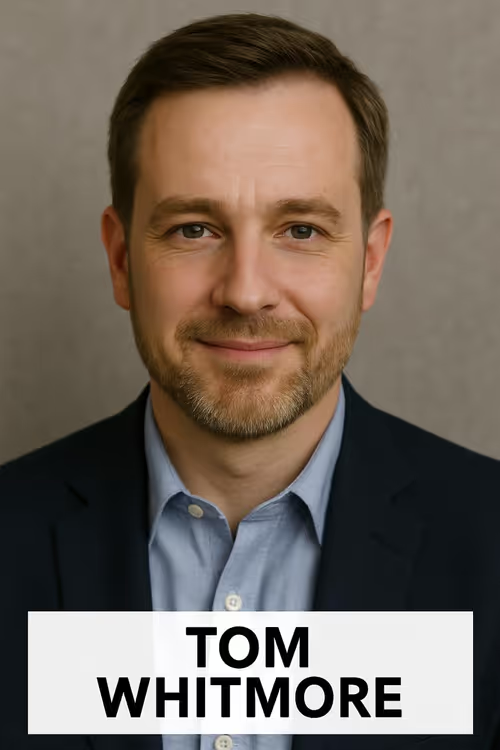
Tom Whitmore
Senior correspondent · Real Estate & Private Companies
Tom has interviewed most of the operators reshaping the Gulf skyline — and a few of the ones who tried and didn't. His beat is real estate, commodities, manufacturing, and the founder-led private companies that never bother to list. He knows which buildings and balance sheets survive a downturn before the spreadsheet does. Based in Dubai. Reach out at tom.whitmore@theplatinumcapital.com.