Samsung Q1 Memory Profit Triples As HBM Supply Tightens For AI Build-Out
Samsung Electronics reported first-quarter operating profit from its memory-semiconductor division of KRW 12.4 trillion, roughly tripling year-on-year and confirming that the supply-tightness dynamic in high-bandwidth memory — the specialised DRAM stack that anchors GPU-based AI …

Samsung Electronics reported first-quarter operating profit from its memory-semiconductor division of KRW 12.4 trillion, roughly tripling year-on-year and confirming that the supply-tightness dynamic in high-bandwidth memory — the specialised DRAM stack that anchors GPU-based AI compute — has now firmed into a structural rather than cyclical revenue uplift for the world's largest memory producer.
HBM revenue specifically grew approximately 250% year-on-year and now represents close to one-third of total memory-segment revenue, against a single-digit share two years ago. The company confirmed it has now passed Nvidia qualification on its HBM3E 12-stack product and is in volume production for shipments through the second half of the year — the milestone that was the principal share-loss risk against SK Hynix through the past two years and that the consensus model had pencilled in as taking another quarter to land.
The conventional DRAM and NAND segments also strengthened. DDR5 server-DRAM pricing is up roughly 35% year-on-year and continued to firm through the quarter as hyperscaler buying activity sustained. NAND has lagged the recovery for a quarter longer than DRAM, but the inventory dynamics are now visibly normalising and the ASP curve is showing the first meaningful upward pressure since mid-2024. The integrated memory-segment narrative has not been this constructively-aligned across all three product lines since the early stages of the 2017-18 super-cycle.
The foundry and system-LSI segments remain the more difficult element of the Samsung story. The foundry continues to lose ground against TSMC at the leading-edge node, with the 2-nanometre customer-pipeline progress that the company has flagged for two years still struggling to close the credibility gap with the Taiwanese incumbent. The system-LSI segment held flat year-on-year, with the Exynos mobile-processor business continuing its slow re-engagement with high-end OEM design wins.
For investors, the framing question is on the durability of the memory cycle. The conventional cyclical concern — that the AI compute build-out is investment-driven rather than end-demand-driven, and that the memory cycle could turn down as quickly as it turned up — remains live. But the Q1 evidence supports a more constructive case: the AI-infrastructure demand profile through 2027 is increasingly visible in the major hyperscaler capex commitments, and the supply response from the three-vendor memory market is rationally constrained relative to the demand acceleration. Samsung's Q1 print is the cleanest expression of that thesis to date.
Written by
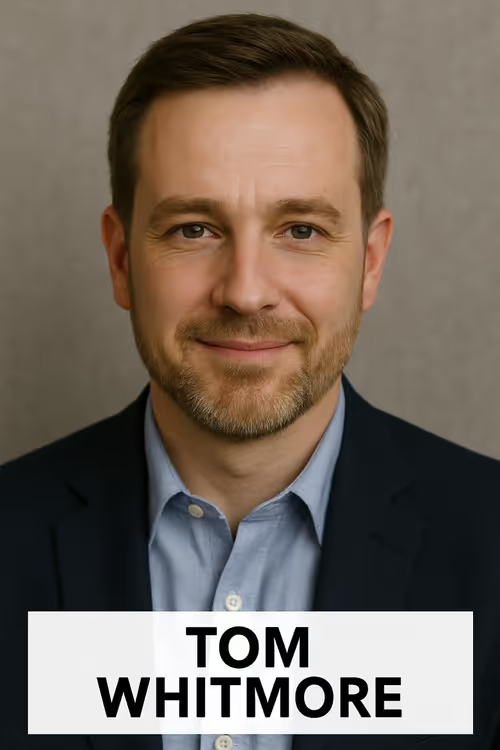
Tom Whitmore
Senior correspondent · Real Estate & Private Companies
Tom has interviewed most of the operators reshaping the Gulf skyline — and a few of the ones who tried and didn't. His beat is real estate, commodities, manufacturing, and the founder-led private companies that never bother to list. He knows which buildings and balance sheets survive a downturn before the spreadsheet does. Based in Dubai. Reach out at tom.whitmore@theplatinumcapital.com.


