


- 0% personal income tax remains structural. 9% federal corporate tax (above AED 375,000 profit) was introduced in mid-2023; 0% on qualifying free-zone income continues.
- The visa architecture has widened — Golden Visa (10 years, self-sponsored), Green Visa (5 years), and a freelancer pathway now cover the full founder-and-family stack.
- Capital access has deepened: regional VCs deployed ~$2.6 billion across 469 MENA deals in 2024 (MAGNiTT), with sovereign-anchored late-stage funding from PIF, Mubadala, ADQ, and ADIA increasingly accessible.
- The structural risks — corporate-tax compliance burden, regulatory tightening, real-estate cyclicality — have grown modestly. The strategic advantages have grown faster.
- For an internet-services founder targeting global B2B revenue, the combined tax-plus-cost-plus-talent envelope of Dubai in 2026 remains the most favourable of any major global financial centre.
Dubai's particular pitch to international founders in 2026 is not the one that filled the Instagram reels of 2021. The crypto-windfall narrative, the influencer-relocation cycle, the work-from-anywhere COVID-era flight — those have receded into the cyclical noise of any global cycle. What remains underneath, and what increasingly distinguishes Dubai from any plausible alternative city in the world, is the structural architecture that the emirate has methodically built for the operator who is genuinely trying to build a global business with serious commercial ambition.
The architecture is not new. The 9% federal corporate tax, introduced in mid-2023, was the most visible recent change — and the one that prompted the loudest "is Dubai still a tax haven?" headlines from a Western press that had never accurately characterised the city to begin with. The 0% personal income tax remains. The 0% qualifying-income corporate tax inside the major free zones remains. The visa pathways for founders, their families, and their key employees have widened rather than narrowed. The capital pool has deepened — Saudi PIF, Mubadala, ADIA, ADQ, ICD, and an increasingly visible family-office community now anchor a venture and growth-stage ecosystem that the city did not have at this depth a decade ago.
This piece is the careful answer to why a serious founder, in 2026, would still choose Dubai as their base — and why the case has actually strengthened, not weakened, through the past three years of regulatory tightening and global tax-policy realignment. We'll walk through the numbers, the legal architecture, the capital landscape, the cost of operating, and the honest list of risks. It is the working brief one would want on the desk before making this decision.
I. The numbers: Dubai's founder ecosystem in 2026
Dubai has been quietly, persistently growing through what the global media has variously called a property crash, a crypto crash, an oil-cycle inflection, and several other phases that turned out to be either smaller than headlined or didn't materialise at all. According to Dubai Statistics Center estimates, the city's resident population rose from approximately 3.4 million at the start of 2021 to roughly 3.7 million by mid-2025 — a growth rate that exceeds any comparable major global city outside of a handful of Indian and Chinese metropolitan areas.
The startup-and-business ecosystem has compounded alongside the demographic story. The Dubai International Financial Centre (DIFC), the city's flagship financial-services hub, ended 2024 with more than 5,500 active registered companies, up from approximately 3,300 just three years earlier according to DIFC's own annual review. The Dubai Multi Commodities Centre (DMCC) — Dubai's largest free zone by member companies — surpassed 24,000 active members in 2024, making it on that metric the world's most populated single free zone.
MENA-region venture capital deployment, where Dubai-headquartered companies capture a substantial share, reached approximately $2.6 billion across 469 disclosed deals in 2024, according to MAGNiTT's regional reporting — recovering meaningfully from the post-2022 cyclical low and approaching the cycle-peak readings of 2021. Dubai-headquartered companies captured roughly 35-40% of total regional deal value across the year, the largest single-city share within the MENA cluster.
Three structural movements are now visibly underwriting the forward picture into 2026 and beyond: an accelerating wave of family-office relocations to DIFC and DMCC; the deepening of sovereign-anchored late-stage capital from the wider Gulf region; and continuing absolute growth in the city's resident population, which underwrites the local enterprise market that increasingly distinguishes a Dubai-anchored startup from a pure regional play.
II. The tax architecture in 2026
0% personal income tax · 9% federal corporate tax above AED 375,000 profit · 0% qualifying free-zone income · 5% VAT · 0% capital gains · 0% inheritance · 0% dividend withholding tax to UAE residents
The tax framework is, for most founders, the load-bearing column of the entire Dubai value proposition. Understanding it precisely matters — because the loose press characterisation of the UAE as "the new tax haven" was always inaccurate and has become more so as the regulatory framework has matured through the past five years.
The personal-income side
The UAE imposes zero federal personal income tax on residents. This is a constitutional commitment that has held since the union's formation in 1971 and that the federal government has publicly reaffirmed as recently as 2024. There is no equivalent regime to the US worldwide-citizenship tax, no UK-style remittance-basis nuance, no Singapore-style territorial qualification: a Dubai resident pays no income tax on any income, regardless of source, regardless of remittance.
There is also no capital gains tax, no wealth tax, no inheritance tax, and no dividend withholding tax on dividends paid to UAE resident individuals. Founders who exit their companies typically pay no UAE tax on the proceeds — the eventual tax exposure depends solely on the citizenship and source-tax rules of their countries of origin.
The corporate-tax side: the 2023 introduction
The most consequential recent change was the introduction of federal corporate tax under Federal Decree-Law No. 47 of 2022, effective for financial years starting on or after 1 June 2023. The structure is:
- 0% corporate tax on annual taxable income up to AED 375,000 (~$102,000) — the small-business threshold
- 9% corporate tax on annual taxable income above AED 375,000
- 15% on multinational entities with global revenue above EUR 750 million, under the OECD Pillar Two framework
The 9% headline rate is among the lowest non-zero corporate tax rates in any G20-comparable jurisdiction.
The Qualifying Free Zone Person framework
For founders operating within a UAE free zone — DIFC, DMCC, ADGM-adjacent (Abu Dhabi), JAFZA, IFZA, the TECOM cluster, and several others — there is a continued 0% corporate tax rate on qualifying income, subject to substance requirements and the prohibition on transacting with the UAE mainland on certain activities.
The Qualifying Free Zone Person (QFZP) framework, clarified by a sequence of Cabinet Decisions and Ministerial Decisions issued through 2023-2025, defines which activities qualify for the 0% rate and which fall under the 9% rate. The broad principle: income from "qualifying activities" earned by a QFZP retains 0% corporate tax; "excluded income" (including income from natural persons except in specific carve-outs, intellectual-property income unless within de minimis thresholds, and certain mainland-source income above thresholds) is taxed at 9%.
For most internet-services, financial-services, consulting, and trade-export businesses operating from a free zone, the practical implication is that 0% remains achievable with reasonable compliance discipline.
VAT and the wider tax stack
The UAE introduced a 5% Value Added Tax in January 2018. The rate is comfortably the lowest VAT-equivalent rate in any major business jurisdiction — compared with 20% in the UK, 19-25% across the EU, 9% in Singapore, and 8.1% in Switzerland. Many service exports qualify for 0% VAT (zero-rated exports), and the threshold for mandatory VAT registration is AED 375,000 annual taxable revenue.
The UAE has signed Double Taxation Agreements with more than 138 countries as of late 2024 — the largest DTA network of any small jurisdiction globally and one of the most extensive of any country anywhere. This provides tax-residency certainty for cross-border income flows and is a non-trivial structural advantage for founders billing international clients.
III. The visa framework: founder, family, team
The UAE's visa architecture has transformed materially in the past five years. The historical sponsor-driven, employer-anchored model has been progressively replaced by a stack of long-term, self-sponsored residency options that have made Dubai meaningfully easier to relocate to than it was even three years ago.
The three visa pathways most relevant to international founders, in order of long-term commitment:
| Visa | Duration | Sponsor | Primary qualifying criteria |
|---|---|---|---|
| Golden Visa | 10 years (renewable) | Self-sponsored | AED 2m+ property investment, AED 2m+ company equity, or recognised "specialised talent" / investor profile |
| Green Visa | 5 years (renewable) | Self-sponsored | Freelance / skilled employee earning AED 15k+/month with a degree, or investor with company commercial license |
| Investor / Entrepreneur Visa | 3 years | Self-sponsored via the holding company | Owner of a UAE-licensed company, with operational substance |
| Standard Employment | 2 years | Employer | Full-time employment with a UAE-licensed entity |
The Golden Visa has become the de-facto default for serious founders. The AED 2 million threshold — achievable via a property purchase, equity stake in an active operating company, or recognised "specialised talent" status — is structured to map cleanly onto how a venture-stage founder typically arrives in the city. The 10-year horizon, the self-sponsorship (no employer dependency, no risk of falling out of status if the company changes ownership), and the family-inclusion provisions make it materially more practical than the older sponsor-driven model.
The family-inclusion provisions deserve specific attention. Golden Visa holders can sponsor spouses, children (with no upper age limit for the visa, though dependent visas for children typically follow education schedules), parents, and domestic staff under a single integrated framework. The historical friction around dependent visas — multiple separate applications, recurring renewal cycles, residency restrictions tied to the primary holder's status — has been largely engineered out.
Processing times, in practice, run two to four weeks for a clean Golden Visa application, four to eight weeks for the dependent applications. The General Directorate of Residency and Foreign Affairs (GDRFA) digital pipeline has substantially reduced the historical paper-document burden, and the visa-on-arrival regime applies to most G20 nationals through the initial 90-day exploration window.
IV. Free zones decoded: DIFC, DMCC, ADGM, IFZA, JAFZA
The free-zone architecture is what makes the UAE's tax and regulatory framework operationally distinctive. There are 40+ free zones across the UAE, each with its own regulatory authority, its own activity scope, its own pricing, and its own commercial-positioning logic. For an international founder, choosing the right one is a meaningful decision that materially affects cost, regulatory burden, and customer-facing credibility.
The major free zones most relevant to internet-and-services founders, in 2026:
| Free Zone | Anchor proposition | Best for | Annual licence (typical) |
|---|---|---|---|
| DIFC | English common law, financial-services regulator (DFSA), independent courts | Financial services, fund management, fintech, family office | AED 50,000 – 180,000 |
| DMCC | Largest free zone, broad activity scope, commercial flexibility | Trading, professional services, crypto, broad SME | AED 20,000 – 65,000 |
| ADGM (Abu Dhabi) | English common law, FSRA financial regulator, AI/innovation focus | Financial services, alternative assets, crypto, AI startups | AED 40,000 – 150,000 |
| IFZA | Low-cost flexibility, fast setup, Dubai mainland-adjacent | Bootstrap stage, freelance, consulting, small SaaS | AED 12,000 – 25,000 |
| JAFZA | Jebel Ali Port logistics anchor, industrial | Manufacturing, distribution, logistics, e-commerce fulfilment | AED 25,000 – 75,000 |
| TECOM districts | Sector-specific clusters (Internet City, Media City, Studio City, Academic City) | Tech, media, education, design — sector clustering | AED 25,000 – 60,000 |
The DIFC nuance
DIFC sits in a category of its own. As a financial-services-anchored free zone with its own legal system — English common law, independent courts, an independent regulator (the DFSA), and a court-of-final-appeal system that hears commercial disputes in English — it is structurally closer to the City of London than to any other regional alternative. For funds, wealth managers, family offices, fintechs, and any financial-services activity that needs international counterparty credibility, DIFC remains the dominant choice across the entire MENA region.
The cost of operating in DIFC is correspondingly higher — both the licence fees and the substantially higher real-estate cost — but the regulatory and reputational uplift is real. As of year-end 2024, DIFC hosted more than 5,500 active companies including 27 of the world's top 30 systemically-important banks, the largest single concentration of family offices in the Middle East, and a fast-growing fintech cluster anchored around the DIFC FinTech Hive accelerator.
The DMCC pragmatism
DMCC is the practical default for a broad mid-market SME — particularly for trading, professional services, and the substantial cohort of consulting / digital-marketing / e-commerce / crypto-adjacent businesses that don't need DIFC's financial-services regulatory framework. The activity scope is broad, the cost is moderate, the physical infrastructure (the Jumeirah Lakes Towers cluster) is well-developed, and the setup process is mature.
The ADGM advantage (Abu Dhabi)
Strictly outside Dubai, but practically inside the same operating envelope from a founder's perspective, the Abu Dhabi Global Market (ADGM) operates with broadly similar features to DIFC — English common law, an independent regulator (FSRA), and a strong financial-services anchor — at marginally lower cost and with a more deliberate cultivation of crypto, AI, and frontier-technology activities. For founders for whom Abu Dhabi's location is acceptable, ADGM is increasingly the credible alternative to DIFC.
If you're regulated financial services or a fund: DIFC or ADGM.
If you're general SME / trading / professional services: DMCC.
If you're early-stage / bootstrap / freelance: IFZA.
If you're crypto, AI, or frontier-tech: ADGM (or DIFC if financial-services adjacent).
If you need physical / logistics / industrial: JAFZA.
V. Capital access: VC, family office, sovereign
The capital landscape in 2026 looks materially different from what it did in 2019, and the change is not principally a matter of more dollars (though there are more) — it is a matter of the composition of available capital.
Five years ago, the Dubai-headquartered venture-stage business raising more than $10 million was probably routing through a Silicon Valley lead, a Singapore-anchored regional fund, or a UAE-domiciled family-office consortium that was new at venture investing and learning on the job. Today the canonical raise has multiple regional VC participants, an anchor commitment from one of the substantial sovereign-linked vehicles (PIF, Mubadala, ADIA, ADQ, ICD), and a meaningful global co-investor — often from Asia rather than the US, reflecting both the changing global capital flows and Dubai's deepening Asian investor relationships.
The regional VC layer
The regional VC ecosystem now has substantial depth. The principal Dubai-headquartered or substantially-active funds in 2026 include:
- BECO Capital — early-stage technology, regional consumer
- Wamda Capital — early-stage MENA, founder-led
- Shorooq Partners — early-stage technology, increasingly cross-regional
- Global Ventures — Series A/B technology, broad-stage
- COTU Ventures — early-stage, regional and Indian sub-continent
- Nuwa Capital — Series A, technology and consumer
- Cotu Ventures, Hambro Perks, Class 5 Global, Investcorp, and several more
Several of the largest global venture firms now maintain MENA-region presence, with Sequoia Capital (now operating under its post-2024 regional structures), Andreessen Horowitz's selective regional commitments, and the substantial Singapore-and-India-anchored funds (Peak XV, Lightspeed, Accel India) increasingly active on Dubai-headquartered cap tables.
The family-office layer
Knight Frank's Wealth Report 2024 estimates that approximately 600 single-family offices now operate from the UAE (the majority from Dubai's DIFC), up from fewer than 100 a decade ago. The family-office migration cycle — driven by both push factors (UK non-dom regime changes, Singapore's reduced single-family-office threshold appeal, Swiss banking-secrecy erosion) and pull factors (Dubai's no-tax regime, lifestyle, geographic centrality, English-language operating environment) — has been one of the most consequential trends underlying the city's capital-market deepening.
For founders, the practical implication is that family-office capital is now genuinely accessible at the seed-to-Series-B range in a way it was not five years ago. The hybrid family-office / venture-investor profile has become a recognisable feature of the regional cap-table landscape.
The sovereign layer
The sovereign-and-sovereign-linked capital base — PIF (Saudi), Mubadala (Abu Dhabi), ADIA (Abu Dhabi), ADQ (Abu Dhabi), ICD (Dubai), and the various subsidiary vehicles operating across the same anchor capital — has materially expanded its venture-and-growth-stage engagement across the past three years. PIF's $100bn+ technology-and-AI deployment programme, Mubadala's substantial private-credit and growth-equity portfolios, and ADQ's increasing engagement with Egyptian and broader regional growth companies represent the principal late-stage capital pool now available to Dubai-anchored businesses.
For a founder at the Series B+ stage, sovereign-anchored late-stage capital is now genuinely a primary financing avenue rather than a backstop option.
"The capital pool has deepened. Saudi PIF, Mubadala, ADIA, ADQ, ICD, and an increasingly visible family-office community now anchor a venture and growth-stage ecosystem that the city did not have at this depth a decade ago." The structural finding
VI. The talent equation
Dubai is a city of approximately 3.7 million people, 88% of whom are non-citizens. There are more than 200 nationalities represented in the resident population. English is the universal commercial-and-social operating language. The schools, the healthcare system, the customer-service infrastructure, and the residential-real-estate market all assume an internationally-mobile workforce as the baseline rather than the exception.
The practical implication for a founder is that hiring is meaningfully easier than in any major city outside of London, New York, and Singapore. The principal talent pools that converge in Dubai:
- Financial services and legal — substantial inflow from London (Brexit-and-tax-driven), Singapore (cost-driven), and an increasingly serious cohort from New York and the wider European financial centres.
- Technology and engineering — large pools of senior talent from India, Pakistan, Egypt, and the broader MENA region; growing cohort of Eastern European and Russian engineering talent; and an increasing share of Western European technology professionals.
- Operations and commercial leadership — strong representation from the wider Anglo-influence regions (Australia, South Africa, Canada), with broad cross-industry depth.
- Hospitality and consumer-services — exceptionally deep talent pool, anchored by the city's substantial hospitality and aviation industries.
Median compensation for senior technology roles in 2025-2026 reporting (based on regional executive-search firm benchmarks):
| Role | Annual compensation (median, AED) | USD equivalent (approx) |
|---|---|---|
| Senior software engineer | 320,000 – 480,000 | $87k – $131k |
| Engineering director / VP | 600,000 – 1,000,000 | $163k – $272k |
| Product manager (senior) | 350,000 – 550,000 | $95k – $150k |
| Marketing director | 360,000 – 600,000 | $98k – $163k |
| CFO (growth-stage) | 600,000 – 1,200,000 | $163k – $327k |
| General Counsel | 500,000 – 900,000 | $136k – $245k |
These figures are 25-45% lower than equivalent London and New York compensation for the same seniority bands, and roughly comparable to Singapore — though Singapore's cost of living, particularly housing, is materially higher than Dubai's at the senior-leadership tier.
VII. Geographic leverage: the time-zone bridge
Dubai sits in the UTC+4 timezone, which is one of the most operationally consequential and underrated structural advantages the city offers. A founder running a globally-distributed business from Dubai has:
- Asia overlap in the morning — Singapore and Hong Kong open at the Dubai 8am working start; Beijing and Tokyo are within 4-5 hours.
- Europe overlap through the day — London opens at Dubai's noon (mid-day in summer); Continental Europe is comfortably accessible through the working day.
- US overlap in the late afternoon and evening — New York opens at Dubai's 5pm; West Coast at 8pm — late but operationally workable.
The result is an 8-10 hour working day that genuinely overlaps with all three major global business regions — something no other major city achieves at the same intensity. Singapore is comfortably positioned for APAC and decent for Europe, but US overlap requires evening-hour commitment. London is well-positioned for Europe and decent for US, but APAC requires very early-morning work. New York is positioned for North America but European overlap is limited to morning hours, and APAC requires unusual schedules.
Beyond the time-zone, the physical-infrastructure leverage is itself substantial. Dubai International Airport (DXB) has been among the world's busiest international airports for more than a decade, with direct flights to roughly 240 destinations across six continents. The DXB-and-DWC (Al Maktoum International) infrastructure programme being executed through 2030 will extend that profile further. Emirates and flydubai, anchored from the city, between them connect substantially more secondary destinations than any single airline operating from any other Western hub.
VIII. The regulatory path: corporate tax and transfer pricing
The 2023 introduction of federal corporate tax — and the subsequent ramping-up of the Transfer Pricing (TP) framework, OECD Pillar Two implementation, and Economic Substance Regulations (ESR) — represents the most significant regulatory transition in UAE business law in a generation. The practical compliance burden for a founder operating in 2026 is meaningfully higher than it was three years ago, and any honest assessment of "is Dubai still easy?" needs to engage with the new reality directly.
The compliance stack — what's now required
A typical Dubai-headquartered free-zone company in 2026 needs to navigate, in approximate order of priority:
- Corporate tax registration with the UAE Federal Tax Authority (FTA), required for all entities (including free-zone companies and entities below the AED 375,000 threshold).
- Annual corporate tax return, due nine months after financial year-end. Even QFZP-qualifying entities must file, demonstrating their qualifying status.
- Transfer Pricing documentation for transactions with related parties (parent companies, sister companies, controlled foreign affiliates). The disclosure requirements escalate with revenue scale.
- Economic Substance Regulations (ESR) compliance for entities conducting "relevant activities" — banking, insurance, fund management, lease-finance, headquarters, shipping, holding companies, IP, distribution, service centres. Annual reporting and substance demonstration.
- VAT registration and quarterly returns, if annual taxable revenue exceeds AED 375,000.
- Anti-Money Laundering (AML) compliance, with substantial recent tightening, particularly for free-zone entities in DIFC and DMCC.
The OECD Pillar Two layer
For multinational entities with global consolidated revenue above EUR 750 million, the OECD's Pillar Two "Global Minimum Tax" framework applies, imposing a 15% effective minimum tax rate on profits in any single jurisdiction. The UAE has implemented this through domestic legislation. For founders below this threshold — which is the vast majority of growth-stage businesses — Pillar Two does not directly apply, but the global tax-coordination architecture is reshaping how all jurisdictions structure their incentive regimes.
The compliance burden is real, but it remains substantially less onerous than the equivalent stack in the UK, EU, or US. A well-organised Dubai company can satisfy its full corporate-tax, transfer-pricing, ESR, and VAT obligations with a single competent in-house finance lead plus an external accounting and tax-advisor retainer running AED 60,000-150,000 annually. The marginal compliance cost is real but bounded.
IX. Real costs of building in Dubai
The full cost envelope for setting up and operating from Dubai in 2026 is substantially below the equivalent envelope in London, New York, or San Francisco, comparable to Singapore at the SME level but materially cheaper at the housing-and-schools tier, and meaningfully above what was once possible in the looser pre-2020 era.
Setup costs
- Free-zone licence and incorporation: AED 12,000-50,000 first year, with renewal at similar levels in subsequent years (IFZA at the low end, DIFC at the higher end).
- Mainland licence: AED 25,000-80,000 first year, with additional regulatory authority fees varying by activity.
- Visa fees (Golden Visa): AED 4,000-8,000 per applicant including medical, biometrics, and ID issuance.
- Bank account opening: No direct fee, but the practical timeline is 4-12 weeks and several rounds of compliance documentation are typically required.
- Office requirements: Varies — flexi-desk options at IFZA from AED 5,500/year; full physical office requirement at DIFC starting at AED 50,000/year for the smallest qualifying configurations.
Recurring operating costs
For a small-to-mid-stage technology company with 10-15 employees in DMCC or similar free zone:
| Cost line | Annual range (AED) | Notes |
|---|---|---|
| Free-zone licence renewal | 20,000 – 65,000 | Activity-and-zone-dependent |
| Office space (300-500 sqft serviced) | 50,000 – 120,000 | DMCC, varies by tower |
| Office space (1,500 sqft DIFC) | 375,000 – 600,000 | Premium pricing |
| Accounting and tax compliance | 60,000 – 150,000 | External advisor retainer |
| Health insurance (per employee) | 6,000 – 18,000 | Mandatory |
| Visa renewals (per employee, 2-year cycle) | 4,000 – 7,000 | Amortised, ~half this annually |
Personal cost of living (senior founder profile)
- Two-bedroom apartment (Marina, Downtown, JBR): AED 120,000-220,000 annual rent.
- Two-bedroom apartment (JLT, Business Bay): AED 90,000-150,000.
- Villa (Arabian Ranches, Springs): AED 200,000-450,000.
- International school (per child, GCSE/A-Level pathway): AED 60,000-130,000.
- Domestic helper (live-in): AED 30,000-50,000 including visa sponsorship.
- Private healthcare (family of four, premium coverage): AED 25,000-45,000.
X. The honest assessment: risks and watch items
An honest case for Dubai needs to engage with the risks. The principal items to track:
Corporate tax compliance burden has materially grown
The 9% corporate tax, the transfer pricing framework, and the Pillar Two anti-avoidance architecture have collectively raised the operational compliance overhead for a Dubai company from "minimal" to "moderate". A founder cannot simply incorporate and bill, without compliance discipline. The marginal cost is bounded — but it is real.
Real estate cyclicality
The Dubai property market is structurally tied to oil prices, regional macro stability, and the international wealth migration cycle. The 2014-16 downturn, the 2020 COVID-cycle softening, and various smaller corrections through the past two decades have all been real. The current cycle (2022-2026) has been unusually firm, and a reversion at some point in the next several years should not surprise.
Currency peg
The AED is pegged to the US dollar at AED 3.6725. This is mostly an operational advantage but does mean that UAE interest-rate policy is effectively imported from the Federal Reserve. Any large US monetary-policy episode propagates directly into Dubai's borrowing-cost environment.
Geopolitical proximity
Dubai is geographically close to regional flashpoints that periodically affect insurance pricing, shipping routes, and currency volatility. The kingdom-and-region risk premium is real, and operational continuity-planning is more relevant in this jurisdiction than in a London or Singapore.
Regulatory drift
The substance requirements (ESR), the corporate-tax framework, and the AML rules have all tightened progressively across the past five years. There is no reason to expect this direction to reverse. Operating in Dubai in 2030 will likely require more formal substance demonstration, more documentation, and more advisor cost than operating today.
XI. Sector spotlights: fintech, web3, AI, climate
Fintech
The fintech ecosystem is anchored on three pillars: the DIFC Innovation Hub (housing FinTech Hive, the region's longest-running fintech accelerator); the DFSA's regulatory framework (encompassing Innovation Testing Licences, AML/KYC rules, and capital-markets oversight); and the substantial customer-side demand from a regional financial-services industry that has been digitising at unusual speed. Tabby, Tamara, Pyypl, Lean Technologies, Sarwa, and the dozens of growth-stage fintech companies headquartered in Dubai illustrate the depth.
Web3 and digital assets
The Virtual Assets Regulatory Authority (VARA), established by Dubai Government in 2022, has built one of the most operationally-developed digital-assets regulatory frameworks globally. As of 2024-2025, VARA has issued operating licences to most major global exchanges (Binance, OKX, Bybit have all secured the necessary permissions), to several DeFi protocols, and to a growing list of crypto-native institutional services. The regulatory framework is materially more constructive than the US position, more developed than the EU's MiCA implementation, and broader in scope than Singapore's approach.
AI and frontier technology
The AI ecosystem in 2026 has effectively two anchor points: the UAE's Technology Innovation Institute (TII), based in Abu Dhabi, which produces the Falcon family of open-weight language models that have been among the most-cited frontier-model releases globally; and the constellation of commercial-AI startups (G42 in Abu Dhabi; AI71 and various smaller companies in both Dubai and Abu Dhabi) that have positioned the wider UAE as a meaningful third pole of AI infrastructure and capability alongside the US and Chinese centres of gravity. The HUMAIN announcement out of Saudi Arabia in May 2026, while structurally a Saudi initiative, anchors the broader regional positioning that Dubai-headquartered AI startups benefit from.
Climate and energy transition
Dubai hosted COP28 in November-December 2023, and the UAE's federal Net Zero by 2050 commitment — alongside the Mohammed bin Rashid Al Maktoum Solar Park (one of the world's largest single-site solar projects, planned to reach 5 GW by 2030), Masdar's continuing renewable-energy investment programme, and the substantial sovereign-capital commitments to clean-energy and carbon-removal — has produced a climate-and-energy-transition cluster of substantial commercial scale. For climate-tech and energy-transition founders, the combination of regulatory framework, sovereign capital, and the regional energy-industry adjacency is now a credible reason to position in the UAE.
XII. Compared with alternatives
How does Dubai compare, structurally, against the principal alternative jurisdictions that an international founder might evaluate in 2026?
| Jurisdiction | Headline advantage | Principal trade-off |
|---|---|---|
| Dubai (UAE) | 0% personal tax, 9% corporate (0% free zone), broad visa pathways, multi-region time-zone leverage, deep talent pool | Compliance burden growing; regional geopolitical proximity; real-estate cyclicality |
| Singapore | Stable rule-of-law, English common law, deep capital markets, English language, 0% capital gains | 17% corporate tax (above qualifying thresholds), high cost of housing/schools, regional distance from MENA/Africa, narrower talent pool |
| Riyadh (Saudi Arabia) | Huge sovereign capital (PIF), large domestic market, government-funded growth programmes, 0% personal tax | Newer ecosystem, language friction (Arabic dominant in regulatory work), evolving regulatory framework, social-flexibility constraints |
| Bahrain | Low cost, banking-and-fintech heritage, English language | Smaller addressable market, less depth than Dubai/Abu Dhabi |
| London (UK) | Deep capital markets, world-class talent, English common law, mature ecosystem | 25% corporate tax, post-Brexit visa friction, high cost of living, declining wealth-management appeal |
| Estonia | E-residency, simple corporate structure, EU access | EU corporate tax framework, smaller market, limited capital access |
| Portugal | D7/Digital Nomad visa, EU access, lifestyle | Post-NHR-reform tax framework substantially less favourable, slower banking infrastructure, smaller capital pool |
The honest read: for an internet-services or financial-services founder building a global business at $1m-$100m revenue scale, Dubai's combined tax + cost + talent + capital-access envelope is the most favourable single jurisdiction in 2026. Singapore is the closest peer and is better for an APAC-focused business; London remains preferable for a UK-or-European-customer-anchored business that needs deep institutional credibility; Riyadh's case is strengthening fast but the ecosystem maturity gap remains real.
XIII. The practical setup: 2026 step-by-step
For a founder making the move in 2026, the canonical setup sequence:
Step 1 — Scope the business activity
Define the precise activity scope (financial services? trading? technology services? consulting? media?) — this determines which free zone or mainland authority is the right home. Most internet-services businesses fall into DMCC, DIFC, or one of the TECOM clusters; financial services into DIFC or ADGM; bootstrap stages into IFZA.
Step 2 — Choose legal structure
Most founders incorporate as a Free Zone Company (FZ-LLC) within their chosen free zone. The structure supports 100% foreign ownership, no requirement for a local Emirati sponsor, and full repatriation of capital and profits. For mainland operations, an LLC structure is the typical default — and since the 2021 Commercial Companies Law reform, 100% foreign ownership is also possible for most non-strategic sector mainland activities.
Step 3 — Name reservation and initial approval
Most free zones process company name reservation and initial regulatory approval within 5-10 business days. Several reject specific words (Bank, Insurance, Royal, etc. require specific regulatory authority); the trademark-and-conflict check is routine.
Step 4 — Bank account opening
This is the most operationally-frustrating step for most new arrivals. UAE banks have substantially tightened AML and KYC processes through the past five years, and a clean account opening typically takes 4-12 weeks with several rounds of compliance documentation. The major banks (Emirates NBD, ENBD, Mashreq, FAB, ADCB, DIB, RAKBank) have varying levels of openness to new-account onboarding; specialist account-opening advisory services (Sovereign, Creation BC, several others) have emerged to manage the process.
Step 5 — Founder visa
The Golden Visa application is typically processed within 2-4 weeks for a clean application. The investor / entrepreneur visa is faster (5-10 business days) but provides only 3-year validity. Family applications follow once the primary applicant is approved.
Step 6 — Office
Physical office requirements vary by free zone. DIFC requires a physical office (no flexi-desk options for most company types). DMCC allows flexi-desks for service-business categories. IFZA explicitly supports flexi-desk-based setups. Co-working spaces (AstroLabs in JLT, In5 across multiple TECOM districts, Letswork, A4 Space) provide bridge solutions for the early period.
Step 7 — Tax and regulatory registration
Corporate tax registration with the FTA is required for all entities. VAT registration is required if annual taxable revenue is above AED 375,000. The Economic Substance and Transfer Pricing frameworks apply depending on the activity scope and intra-group transaction profile.
Step 8 — Hiring
Employment of UAE residents requires Ministry of Human Resources and Emiratisation (MOHRE) approval and visa sponsorship through the employer entity. Visa processing for an employee typically runs 2-4 weeks once the formal offer is in place. WPS (Wage Protection System) compliance applies to monthly salary payments.
XIV. Frequently asked questions
Can I run a Dubai company without living in Dubai?
Yes, technically. A free-zone company can be established and operated by a non-resident founder who maintains residency elsewhere. The practical implication is that "qualifying free zone person" tax status — and therefore 0% corporate tax — requires demonstrable substance, which usually means at least one director-or-employee with UAE residency and a physical office. Pure shell structures are increasingly difficult to defend under the ESR and Transfer Pricing frameworks.
Can I do business with US and EU clients from a Dubai entity?
Yes. The UAE's DTA network covers 138+ countries including all major US-and-EU jurisdictions. Most cross-border invoicing — billing US, UK, EU, or Asian clients — works straightforwardly, with the customer typically receiving the invoice through their normal supplier-onboarding process. Payment processing through UAE banks works to most international correspondent-banking destinations.
What about US clients who require Permanent Establishment certification?
A small fraction of US enterprise customers — typically Fortune 500 procurement-and-compliance teams — require their international suppliers to demonstrate either US tax-residency, or a specific Permanent Establishment (PE) certification under the relevant tax treaty. For US-UAE trade, the US-UAE Income Tax Treaty provides the framework — and the UAE-issued Tax Residency Certificate is the standard document. Securing this certificate typically requires demonstrable UAE residency and operating substance.
Do I need a local Emirati sponsor?
For free-zone companies: no. 100% foreign ownership is the default. For mainland companies: since the 2021 reform of the Commercial Companies Law, 100% foreign ownership is also the default for most non-strategic sectors. Strategic sectors (telecoms, certain commercial fishing, certain trading activities) retain Emirati-ownership thresholds, but for the vast majority of activities a founder might pursue, no local sponsor is required.
Can I move profits out of Dubai?
Yes. The UAE has no exchange controls and no restrictions on the repatriation of capital, profits, or dividends. Free zone status specifically guarantees full repatriation. Practical limitations relate to anti-money-laundering controls at the banking layer rather than to formal capital controls — large transfers will trigger source-of-funds documentation but are permitted.
Is Dubai on any tax-haven black or grey lists?
The UAE was removed from the EU's tax-haven grey list in 2023 following the implementation of the corporate-tax framework and the Economic Substance Regulations. It is not on the OECD's blacklist, the FATF blacklist, or any of the principal global blacklists as of 2026. The reputational positioning has substantially strengthened across the past five years.
What changed in 2024-2025?
The most significant changes: (1) implementation guidance for the corporate-tax framework was substantially clarified, particularly around QFZP qualifying-income definitions; (2) Pillar Two domestic legislation was enacted for multinational entities above the EUR 750m threshold; (3) the family-office regulatory framework in DIFC was substantially upgraded with the new DIFC Family Wealth Centre framework; (4) the Golden Visa scope was broadened to include more "specialised talent" pathways and reduced minimum thresholds for several categories.
XV. The forward look
The narrative case for Dubai — the lifestyle, the infrastructure, the optimism — does most of the heavy lifting in casual press coverage of the city. The structural case, which we've worked through above, is what actually makes the decision defensible across a multi-decade horizon.
The structural case is anchored on four points that have, taken together, no equivalent in any other major global city: (1) a tax framework that remains among the most favourable in the world for a venture-stage business, even after the 2023 corporate-tax introduction; (2) a visa architecture that genuinely supports a founder-and-family relocation rather than the historical sponsor-employer model; (3) capital access that has materially deepened across the past three years, with regional VCs, the family-office layer, and sovereign capital now functioning as an integrated stack; and (4) the multi-region time-zone leverage that makes globally-distributed business operations meaningfully easier from Dubai than from any other major financial centre.
Each of these advantages has structural durability. The compliance burden has grown — that is real — but the advantages are widening faster than the costs. The geopolitical environment continues to require careful operational thinking, but the architecture for managing that risk has become more mature.
For a serious international founder approaching the relocation-or-headquartering decision in 2026, the careful answer to "why Dubai?" is not the simplistic tax-haven framing of the past, nor is it the lifestyle-and-optimism framing that fills the casual press. It is the structural framing: this is the working city that has been most deliberately engineered, across the past two decades, to make the global founder's actual day-to-day operating life easier than any plausible alternative. That structural reality is what underwrites the continuing migration of serious operators to the emirate — and what will continue to do so through the rest of this decade and likely well into the next.
A clean Dubai setup — free-zone company, founder Golden Visa, family inclusion, working bank account, tax registration, and the first physical office — runs roughly 8-12 weeks of elapsed time and AED 80,000-200,000 of all-in setup cost for a venture-stage technology business. The mature local advisory ecosystem (Sovereign Group, Creation BC, Trowers & Hamlins, Charles Russell Speechlys, the Big Four firms, and several specialist boutiques) substantially reduces the friction at every step.
The Platinum Capital newsroom covers the regional regulatory and capital-markets landscape on a continuing basis. Email editor@theplatinumcapital.com with feedback, corrections, or topics you'd like covered in subsequent long reads.
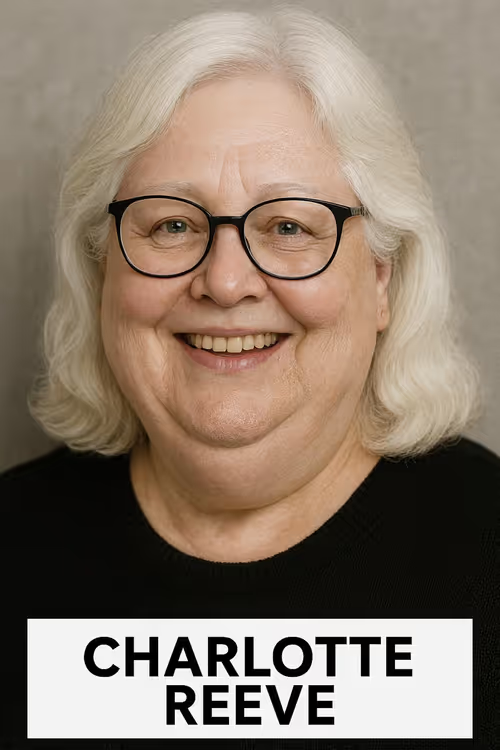
About the author
Charlotte Reeve
Charlotte cut her teeth on an equities desk before moving to the other side of the notebook. She covers capital markets, stock exchanges, and the fintech operators trying to disintermediate the banks that trained her. Sharpest on market microstructure and payments infrastructure; still reads a prospectus for fun. Based in Singapore.