Gulf Sovereign Wealth: How the Middle East Is Reshaping Global Finance
Gulf sovereign wealth funds have evolved from passive custodians of petrochemical revenues into aggressive architects of global capital flows, commanding stakes in everything from Silicon Valley startups to European infrastructure and fundamentally altering the balance of financial power between East and West. This meticulously researched account traces how Abu Dhabi, Riyadh and Doha are deploying trillions in strategic assets to secure geopolitical leverage far beyond their borders, raising urgent questions about transparency, market distortion and the future independence of Western economic policy.…
The New Financial Gravity
When Abu Dhabi's Mubadala Investment Company quietly closed a $2.3 billion stake in a leading European semiconductor firm in February 2026, it barely made headlines. A decade ago, a Gulf sovereign wealth fund acquiring strategic technology assets of that magnitude would have triggered parliamentary inquiries and front-page alarm. Today, it is simply how global capital moves — and the direction of that movement increasingly flows from the Persian Gulf outward.
The Gulf Cooperation Council's sovereign wealth funds now collectively manage an estimated $4.1 trillion in assets, according to the Sovereign Wealth Fund Institute's 2026 tracker. That figure has swelled by roughly $600 billion since 2022, fuelled by sustained energy revenues, aggressive diversification mandates, and a generational shift in investment philosophy that favours direct stakes over passive portfolio allocation. The result is a structural reordering of global finance, with Riyadh, Abu Dhabi, Doha, and Kuwait City operating as genuine power centres alongside New York, London, and Singapore.
From Passive Holdings to Strategic Control
The transformation in Gulf sovereign wealth strategy isn't merely quantitative. It's architectural. Saudi Arabia's Public Investment Fund, now managing approximately $930 billion, has moved decisively beyond its early-stage trophy acquisitions — the Newcastle United purchase, the LIV Golf investment — into hard infrastructure and technology platforms. PIF's $15 billion commitment to NEOM's industrial zones has attracted co-investment from South Korea's Samsung Engineering and Japan's JGC Holdings, creating supply chain linkages that tie Asian manufacturing to Gulf capital in ways Western competitors are finding difficult to replicate.
Abu Dhabi Investment Authority, the world's third-largest sovereign fund at roughly $990 billion, has accelerated its pivot toward private markets. ADIA's 2025 annual review disclosed that private equity and infrastructure now constitute 32 per cent of its portfolio, up from 25 per cent in 2021. That is a significant shift. Its real estate arm has taken major positions in logistics assets across India's Gujarat International Finance Tec-City and Indonesia's new capital, Nusantara, wagering that emerging market urbanisation will deliver superior risk-adjusted returns over the next two decades.
Qatar Investment Authority, managing approximately $510 billion, has pursued a different but equally consequential path, deepening its presence in European luxury, financial services, and green energy. QIA raised its stake in TotalEnergies to 3.8 per cent and backed a €4 billion green hydrogen project in Portugal announced in late 2025. The message is clear: the fund views the energy transition not as a threat to Gulf wealth but as a deployment opportunity.
The Family Office Explosion
Below the sovereign fund tier, an equally dramatic shift is underway. The Gulf's ultra-high-net-worth families are professionalising their capital at a pace few predicted. Dubai's International Financial Centre reported 340 registered single-family offices by the first quarter of 2026, a 45 per cent increase from 2024. Abu Dhabi Global Market has seen similar growth, with 185 family office registrations.
These are not vanity structures. Gulf family offices — many seeded with fortunes from construction, retail, and logistics — are deploying serious capital into venture, growth equity, and cross-border real estate. The Al Ghurair family's investment arm has built a $1.2 billion portfolio spanning fintech stakes in Singapore, agricultural land in sub-Saharan Africa, and commercial property in London's King's Cross district. The Olayan Group, long one of Saudi Arabia's most sophisticated private investors, expanded its direct investment team in New York to 40 professionals in 2025, focusing on US healthcare and enterprise software.
This professionalisation is pulling Western talent eastward. Compensation packages for senior portfolio managers at Gulf family offices now routinely exceed those at comparable positions in London or Zurich. Recruitment firm Heidrick & Struggles found in its 2026 compensation survey that total remuneration for Gulf-based CIOs at family offices averaging $5 billion in assets ran 18 per cent above the European median. Few outside the region have noticed.
Emerging Market Corridors
Perhaps the most consequential dimension of Gulf capital's rise is the creation of new financial corridors that bypass traditional Western intermediation entirely. The Gulf-India investment axis has become particularly pronounced. Mubadala and ADQ, Abu Dhabi's infrastructure-focused sovereign fund, together committed over $7 billion to Indian assets in 2025 alone, spanning data centres, renewable energy, and healthcare chains. PIF's India office in Mumbai, opened in 2025, has a mandate to deploy $10 billion over five years.
The Gulf-Southeast Asia corridor is maturing fast. GIC, Singapore's sovereign fund, and QIA launched a $3 billion joint venture in January 2026 targeting logistics and cold chain infrastructure across Vietnam, Thailand, and the Philippines. Abu Dhabi's ADQ has deepened its partnership with Indonesia's sovereign fund, INA, co-investing in toll roads and port facilities in Java and Sulawesi.
These South-South capital flows are building financing ecosystems that operate increasingly independently of Wall Street and the City of London. When a Saudi family office can invest in an Indian SaaS company through a Dubai-based fund administrator, with legal structuring handled in ADGM and custody in Singapore, the traditional Anglo-American financial intermediation chain becomes optional rather than essential. Think about that for a moment.
Risks and Reckonings
The Gulf's financial ascendancy carries real vulnerabilities. Governance standards at sovereign funds have improved markedly since the opaque era of the 2000s, but they remain uneven. PIF's dual role as both a sovereign investor and the execution arm of Saudi Arabia's Vision 2030 creates potential conflicts between commercial return and political objective — a tension visible in the fund's continued commitment to projects with uncertain commercial viability, including several NEOM verticals where cost overruns have been substantial.
Concentration risk is another concern. Despite the diversification rhetoric, hydrocarbon revenues still fund the majority of sovereign wealth accumulation. Brent crude averaging $78 per barrel through the first half of 2026 has been comfortable, but a sustained move below $60 — not implausible given weakening Chinese demand growth — would pressure fiscal balances and slow new capital commitments.
Geopolitical exposure is rising in tandem with portfolio expansion. Gulf funds now hold meaningful stakes in assets across jurisdictions with deteriorating relations — holding positions simultaneously in Chinese technology and American defence supply chains creates a hedging challenge that no amount of portfolio theory can fully resolve.
Yet the direction of travel is unmistakable. The Gulf's sovereign and private wealth pools are no longer supplementary players in global finance. They are principals — setting terms, selecting partners, and building institutions that will shape capital allocation for decades. The question for traditional financial centres is no longer whether to engage with this reality, but how quickly they can adapt to a world in which they are no longer the default destination for the planet's largest pools of investable capital.
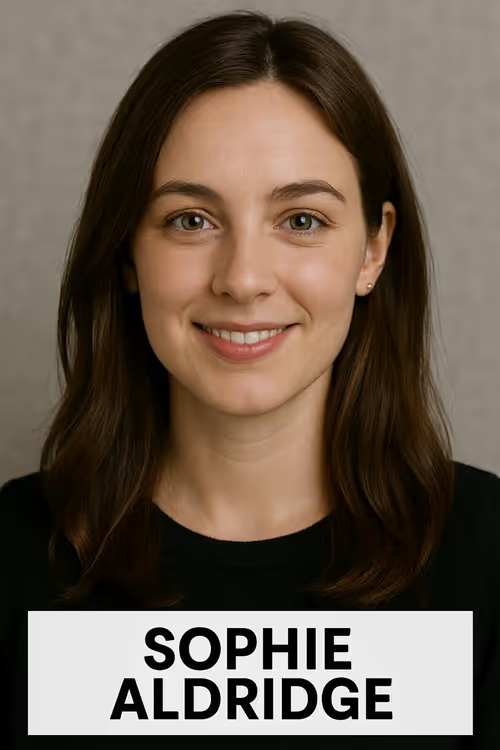
Written by
Sophie Aldridge
Global Economics Editor · Geopolitics
Sophie spent a decade advising governments on trade policy before deciding the story was more interesting than the memo. She covers global economics, geopolitics, and the power transitions reshaping emerging markets. Sharpest on sanctions, supply chains, and the politics behind the price of everything. Based in Washington, D.C. Reach out at sophie.aldridge@theplatinumcapital.com.