South Korea's KEPCO Closes €12bn Czech Republic Nuclear-Reactor Contract As Asian Nuclear Export Cycle Accelerates
South Korea's Korea Electric Power Corporation (KEPCO) formally closed the €12 billion contract for the construction of two APR-1400 pressurised-water reactor units at the Dukovany nuclear-power site in the Czech Republic on Thursday — completing the most significant single bilat…

South Korea's Korea Electric Power Corporation (KEPCO) formally closed the €12 billion contract for the construction of two APR-1400 pressurised-water reactor units at the Dukovany nuclear-power site in the Czech Republic on Thursday — completing the most significant single bilateral nuclear export transaction in Asian nuclear-power-sector history and substantially advancing the broader Asian-nuclear-export cycle that has been progressively gaining commercial momentum across the post-2022 global energy-security-recalibration period.
The Dukovany contract architecture, formally articulated in simultaneous signing ceremonies in Prague and Seoul, comprises the engineering, procurement, and construction of two APR-1400 reactor units at the existing Dukovany site — matching the APR-1400 reactor technology standard that KEPCO has deployed at the Barakah Nuclear Energy Plant in the UAE, which completed its four-unit construction cycle in 2024 and represents the most recent and commercially-proven large-scale APR-1400 export reference. The combined 2,800 MW capacity of the two Dukovany units will represent approximately 19% of the Czech Republic's current installed electricity-generation capacity on completion, and the South Korean government-backed Export-Import Bank of Korea has committed approximately €9 billion of the total contract value through a sovereign-backed financing framework.
The strategic context is meaningful. The Czech Republic's Dukovany procurement — formally opened as a competitive tender in 2022, engaging EDF France (EPR technology), Westinghouse (AP1000), and KEPCO (APR-1400) across the evaluation phase — ultimately selected the KEPCO-APR1400 proposal on the combined criteria of competitive lifecycle cost-of-electricity, technology proven-ness, and financing-package competitiveness. The sovereign-backed Korean financing framework has been central to KEPCO's nuclear-export competitive positioning across the global tender cycle, providing the kind of integrated EPC-and-finance package that European and American competitors have historically struggled to replicate.
The wider Asian nuclear export context is meaningful. The Dukovany KEPCO closure is the second major Asian-reactor-technology export contract of the 2026 commercial year — following the Japan-Poland contract for four ATMEA reactor units at the Patnow site, signed in March 2026. The combined Asian-reactor-export momentum across KEPCO (UAE, Czech Republic), Mitsubishi's JAEA-partnered ATMEA (Poland), and JNFL's parallel fuel-cycle discussions across Eastern Europe represents a substantive structural repositioning of the global nuclear-reactor supply chain away from the French Framatome and American Westinghouse duopoly that characterised the prior two decades of commercial-nuclear export activity.
For investors and policymakers watching the wider European energy-security and nuclear-power-cycle dynamic, the Thursday KEPCO Dukovany closure is the clearest single confirmation that the post-2022-anchored European return to nuclear-power-capacity expansion has continued to compound — driven by the structural energy-security-and-decarbonisation framework that has progressively broadened the political consensus around nuclear-capacity additions across France, Czech Republic, Poland, Romania, and Finland. The principal forward variable through the rest of the year is the rate of progress on the wider European nuclear-development-cycle pipeline, with the French EPR2 programme, the Polish AP1000 Westinghouse progression, and the Romanian CANDU-E refurbishment cycle all expected to deliver meaningful additional capital-commitment milestones across the Q3–Q4 2026 window.
Written by
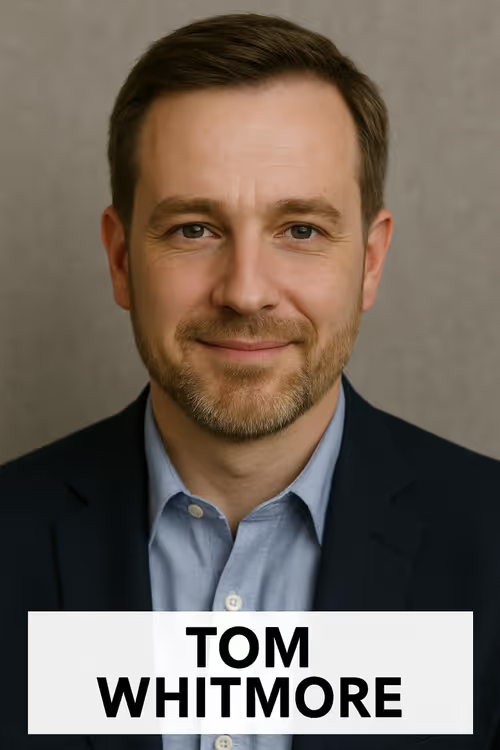
Tom Whitmore
Senior correspondent · Real Estate & Private Companies
Tom has interviewed most of the operators reshaping the Gulf skyline — and a few of the ones who tried and didn't. His beat is real estate, commodities, manufacturing, and the founder-led private companies that never bother to list. He knows which buildings and balance sheets survive a downturn before the spreadsheet does. Based in Dubai. Reach out at tom.whitmore@theplatinumcapital.com.


