

Norway's NBIM Sovereign-Wealth Fund Crosses $2 Trillion AUM Threshold As Global-Equity Rally Compounds
Norway's Norges Bank Investment Management (NBIM) — manager of the Government Pension Fund Global, the world's largest sovereign-wealth fund — confirmed on Thursday that the fund's aggregate assets-under-management crossed the $2 trillion threshold across the past trading week — …

Norway's Norges Bank Investment Management (NBIM) — manager of the Government Pension Fund Global, the world's largest sovereign-wealth fund — confirmed on Thursday that the fund's aggregate assets-under-management crossed the $2 trillion threshold across the past trading week — confirming the substantial post-2024 global-equity-rally compounding effect on the fund's substantially-equity-weighted portfolio-construction framework and substantially elevating the fund's strategic-positioning across the wider global institutional-asset-allocator landscape.
The aggregate AUM print, at approximately $2.02 trillion as of Wednesday's close, was driven principally by the substantial year-to-date global-equity-market trajectory across the principal North American, European, Japanese, and emerging-market equity components of the fund's portfolio-allocation framework. The fund's equity-allocation closed at approximately 71.4% of aggregate assets across the Wednesday print — broadly tracking the long-term-target framework of approximately 70% set by the Norwegian Ministry of Finance under the fund's mandate-framework — with the parallel fixed-income-and-real-estate-and-unlisted-renewable-energy-infrastructure asset-allocation components accounting for the balance.
The substantive year-to-date return-trajectory profile is meaningful. The fund's year-to-date return through Wednesday's close was approximately 9.8% on aggregate, principally driven by the substantial 13.4% year-to-date return on the equity-allocation component, the parallel 2.1% return on the fixed-income-allocation component, and the meaningful contribution from the unlisted-real-estate-and-renewable-energy-infrastructure allocations. The cumulative inflow contribution from continued substantial Norwegian-petroleum-sector revenue across the year stands at approximately $32 billion across the year-to-date window.
The wider sovereign-wealth-fund-sector context is meaningful. The Government Pension Fund Global's substantial $2 trillion AUM positioning substantially exceeds the parallel scale of the principal competitor sovereign-wealth-fund constituents — Abu Dhabi Investment Authority (ADIA, approximately $1.05 trillion), China Investment Corporation (CIC, approximately $1.35 trillion), Saudi Arabia's Public Investment Fund (approximately $930 billion), and Singapore's GIC (approximately $770 billion). The substantial cumulative-scale advantage NBIM retains across the broader institutional-asset-allocator competitive-landscape continues to compound the strategic-positioning advantage the fund has been progressively building across the post-1996-establishment commercial trajectory.
For investors and policymakers watching the wider sovereign-wealth-fund-sector cycle dynamic, the Thursday NBIM milestone is the cleanest single confirmation that the substantial global-equity-rally compounding-effect on the wider institutional-asset-allocator complex continues to compound and that the underlying global-equity-market structural-trajectory framework remains substantially constructive through the 2026 commercial cycle. The principal forward variable through the rest of the year is the rate-of-progression on the wider global-equity-market trajectory — which will substantially determine the rate at which the NBIM aggregate-AUM progresses across the late-decade window toward the substantive $2.5-3.0 trillion framework that the long-term-projection cycle has been pencilling toward.
Written by
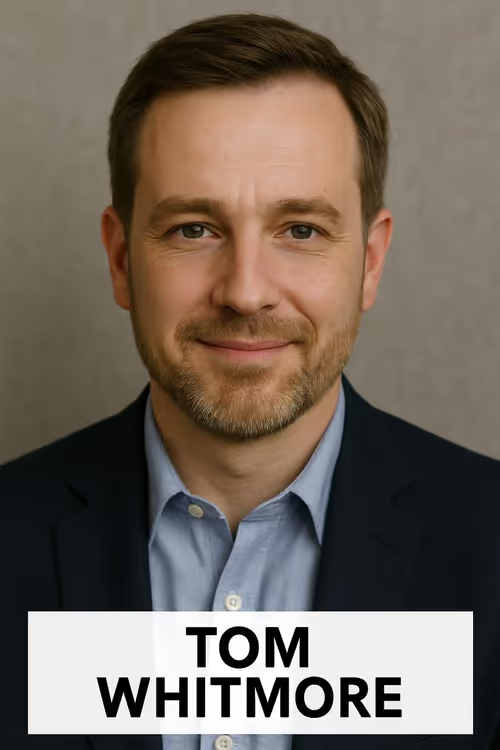
Tom Whitmore
Senior correspondent · Real Estate & Private Companies
Tom has interviewed most of the operators reshaping the Gulf skyline — and a few of the ones who tried and didn't. His beat is real estate, commodities, manufacturing, and the founder-led private companies that never bother to list. He knows which buildings and balance sheets survive a downturn before the spreadsheet does. Based in Dubai. Reach out at tom.whitmore@theplatinumcapital.com.