

Rola Abu-Manneh: Standard Chartered UAE CEO Redefines Regional Banking
Rola Abu-Manneh has quietly transformed Standard Chartered's UAE operations into a powerhouse of institutional and wealth management growth, cementing the bank's position as a critical conduit between Gulf capital and global markets. Her strategic pivot toward digital infrastructure and sustainable finance has not only outpaced regional competitors but reshaped expectations of what international banks can achieve within an increasingly ambitious Emirati financial ecosystem.…
The Architect of Standard Chartered's Gulf Ambition
When Rola Abu-Manneh took the helm of Standard Chartered's UAE operations in 2020, the bank's regional footprint was respectable but unremarkable. Six years later, the institution she commands has become one of the most consequential foreign banking presences in the Middle East, with UAE assets under management surpassing $18 billion and a wealth division that has quietly become the preferred channel for ultra-high-net-worth families seeking cross-border capital deployment between the Gulf, South Asia, and Africa.
Abu-Manneh's trajectory matters — not just as a corporate success story but as a case study in how the UAE's financial architecture is being reshaped by leaders who grasp a simple truth: Dubai and Abu Dhabi are no longer way stations for international capital. They are destinations. Under her watch, Standard Chartered UAE has posted double-digit revenue growth for three consecutive years, with 2025 full-year operating income rising an estimated 14 per cent year-on-year, according to figures disclosed at the bank's regional strategy briefing in February 2026.
Rewriting the Playbook for Foreign Banks in the Gulf
The old playbook for international banks in the UAE was simple enough: service corporate clients with trade finance, maintain a modest retail presence, and funnel regional wealth toward London, Geneva, or Singapore. Abu-Manneh has systematically torn it up. Her strategy positions Standard Chartered UAE as a full-spectrum institution capable of competing with both local champions like First Abu Dhabi Bank and Emirates NBD and the elite tier of global private banks.
Central to this effort has been the bank's expansion of its private banking and wealth management capabilities within the DIFC. In the first quarter of 2026, Standard Chartered opened an expanded advisory hub in Gate Village, adding roughly 60 relationship managers and investment specialists focused exclusively on clients with investable assets exceeding $5 million. This followed the bank's 2025 decision to domicile its Africa and Middle East wealth management coordination function in Dubai rather than London — a symbolic and operational shift that Abu-Manneh reportedly championed at the group level with CEO Bill Winters. That is a significant move for a London-headquartered institution.
The numbers back up the rationale. The UAE's private wealth pool grew to approximately $1.1 trillion by end of 2025, according to Boston Consulting Group's Global Wealth Report, with net inflows driven by residency-linked investment programmes and the continued migration of entrepreneurs from South Asia, the former Soviet states, and increasingly, sub-Saharan Africa. Standard Chartered, with its legacy network spanning 53 markets across Asia, Africa, and the Middle East, possesses a connectivity advantage that few competitors can match.
Family Offices and the New Geography of Capital
Abu-Manneh has been particularly sharp in reading the strategic significance of family offices to the UAE's financial ecosystem. Dubai alone is now home to more than 1,200 single-family offices, up from fewer than 400 in 2021, according to the Dubai International Financial Centre Authority. Abu Dhabi Global Market has registered over 300. Few outside the region have noticed just how fast this has happened. These entities collectively manage hundreds of billions in assets and require institutional partners capable of executing complex, multi-jurisdictional strategies.
Standard Chartered's response under Abu-Manneh has been to build a dedicated family office coverage team that integrates commercial banking, treasury solutions, and investment advisory under a single umbrella. In a January 2026 interview with Bloomberg, she described the approach as "institutional rigour applied to entrepreneurial capital" — a formulation that resonated with clients accustomed to being courted by private banks offering little beyond custody and discretionary mandates.
The bank has secured several marquee mandates in this segment. Client confidentiality precludes identification, but industry sources confirm that Standard Chartered UAE now serves as primary banking partner to at least three family offices with combined assets exceeding $10 billion, including one prominent Indian industrial family that relocated its treasury operations to DIFC in late 2025 and a Gulf-based conglomerate that consolidated its African investment portfolio through the bank's Nairobi and Lagos corridors.
Emerging Markets as Competitive Moat
What separates Abu-Manneh's Standard Chartered from rivals like HSBC, JPMorgan, and Citi in the UAE is a deliberate emphasis on emerging market connectivity. Competitors have tended to orient their Gulf operations toward transatlantic capital flows. Abu-Manneh built her strategy around South-South corridors — India to UAE, UAE to East Africa, Gulf to Southeast Asia.
This orientation tracks with macroeconomic reality. UAE-India bilateral trade reached $85 billion in 2025, making India the Emirates' largest trading partner. At the same time, Gulf sovereign wealth funds — led by ADQ, Mubadala, and the Abu Dhabi Investment Authority — have deployed over $40 billion into Indian infrastructure, technology, and financial services since 2022. Standard Chartered, with deep institutional relationships on both ends, has captured a disproportionate share of the associated banking flows.
The Africa corridor is equally compelling. UAE-Africa trade volumes exceeded $70 billion in 2025, driven by logistics, energy, and agricultural commodities. Abu-Manneh has positioned Standard Chartered's Dubai operations as the de facto treasury and clearing hub for corporates and investors operating across Anglophone and Francophone Africa, leveraging the bank's on-the-ground presence in markets such as Kenya, Nigeria, Ghana, and Côte d'Ivoire — markets where many international competitors have pulled back or left entirely.
The Leadership Premium
Abu-Manneh's influence extends well beyond Standard Chartered's balance sheet. She sits on the board of the UAE Banks Federation and has been a vocal advocate for regulatory frameworks that accommodate digital assets, open banking, and sustainable finance. Her engagement with the Central Bank of the UAE on the dirham-denominated digital currency pilot — mBridge — has positioned Standard Chartered as one of the first foreign institutions to participate in cross-border CBDC settlement trials between the UAE, China, Hong Kong, and Thailand.
Within Standard Chartered's global hierarchy, her ascendancy has been unmistakable. The UAE operation now contributes an estimated eight to nine per cent of group revenue, up from roughly five per cent when she assumed leadership. That is a significant shift. Speculation persists in banking circles that Abu-Manneh is being groomed for a group-level role, though associates say she remains focused on the regional mandate, which she views as unfinished.
That assessment may be the most telling indicator of all. The Gulf's transformation into a global financial centre of gravity is not a future aspiration — it is a present condition. Abu-Manneh has demonstrated that foreign banks willing to commit genuine strategic capital, intellectual and financial, to the region can build franchises of enduring significance. Standard Chartered's UAE operation, under her leadership, has become the proof case. Others will be measured against it for years to come.
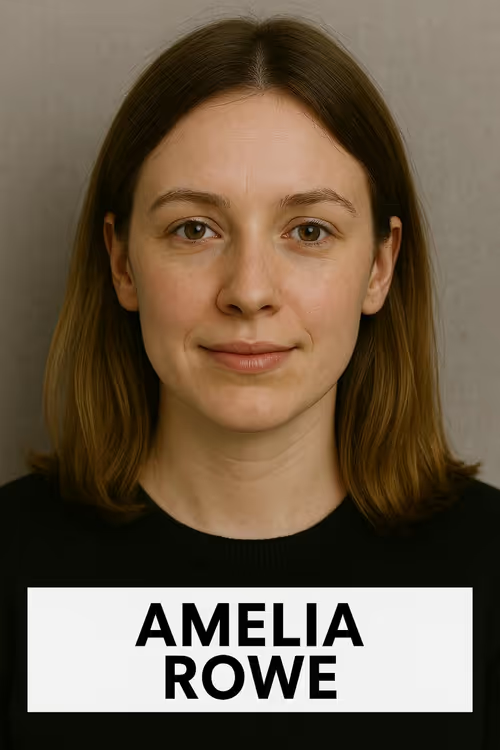
Amelia Rowe is a senior journalist at The Platinum Capital covering banking and financial services across the Gulf and emerging markets.
Written by
Amelia Rowe
Senior correspondent · Banking & Economy
Amelia spent eight years inside a sovereign wealth fund before deciding she'd rather write about institutional money than allocate it. She covers central banking, insurance, and the macro decisions that quietly choose which markets get the next decade. Sharp on monetary policy; impatient with anyone who confuses noise with signal. Based in London. Reach out at amelia.rowe@theplatinumcapital.com.