
Fixed Income Innovation: New Structures for a Rate-Reset World
As central banks navigate an era of structural rate recalibration, the fixed income landscape is undergoing its most consequential architectural transformation in decades, forcing sophisticated allocators to reassess duration assumptions and credit exposure frameworks that once seemed immutable. From contingent capital instruments to rate-linked structured notes engineered for asymmetric return profiles, the new generation of fixed income vehicles demands a level of analytical precision and institutional discipline that separates informed capital from capital merely in motion.…
When Gulf debt markets reopened in May 2026 after a prolonged halt triggered by US-Israeli strikes on Iran, the speed and scale of the rebound told its own story. More than $10 billion in bonds and sukuk were placed within weeks — not because investors had forgotten geopolitical risk, but because they had recalibrated around it. That recalibration is producing something far more structural than a post-conflict bounce. Quietly, and with relatively little fanfare, the region's fixed income market is being redesigned — retooled for a world where rates reset unpredictably, where regional conflict reshuffles sovereign credit, and where private capital increasingly demands bespoke terms rather than standardised paper.
The Rate-Reset Reality and What It Demands
The era of low-rate certainty that made conventional fixed-rate bonds the default choice for conservative capital is not simply over. It has been replaced by something more volatile and, paradoxically, more interesting. Central bank policy rates across the US, UK, and eurozone have oscillated within ranges that would have seemed implausible a decade ago. That volatility has filtered directly into GCC debt pricing — and the market's response has been instructive.
Saudi Arabia dominated the regional market in Q1 2026, raising $32.54 billion across 42 issuances — a 3.1% year-on-year increase. That volume was not achieved by brute force alone. Saudi issuers, led by the sovereign and its quasi-government entities, structured instruments that addressed investor anxiety about duration risk head-on. Floating-rate tranches, step-up coupons, and callable structures accounted for a meaningfully larger share of the quarter's issuances compared to prior years. The market is actively innovating, not simply issuing at scale. That distinction matters.
The UAE placed $13.57 billion across 36 offerings in the same quarter. Dubai-linked entities showed particular creativity, blending conventional and sukuk structures within single programmes — an approach that broadens the investor base without requiring separate documentation frameworks. Qatar, Bahrain, Kuwait, and Oman collectively added a further $8.93 billion. The GCC debt market is no longer a Saudi story with regional footnotes. It is a coordinated, if competitive, fixed-income ecosystem.
Sukuk Structures Are Evolving Beyond the Template
Conventional issuances represented 65.2% of total GCC debt in Q1 2026, with US dollar instruments accounting for 85% of total volume at $46.78 billion. The headline numbers are solid. But the more instructive trend sits inside the sukuk segment, where the real structural evolution is happening.
Issuers across the Gulf are moving away from commodity murabaha structures — the dominant format for the better part of two decades — toward wakala-based and hybrid arrangements that offer greater flexibility in asset composition and profit distribution. For family offices and private investors, this matters in ways that are not always obvious from headline yields. The risk-return profile shifts. Often materially.
Several Abu Dhabi and Saudi corporates have begun embedding sustainability-linked performance conditions directly into sukuk covenants — tying coupon step-ups or step-downs to measurable ESG targets rather than simply slapping a green label on the instrument. For institutional investors with reporting obligations, and for sovereign wealth-adjacent family offices with reputational considerations, this represents a genuine structural advance. It converts what was previously a marketing overlay into an economic mechanism. Incentives align across issuer and investor in ways that conventional ESG-labelled bonds rarely achieve. That is a significant shift — and one that deserves more attention than it has received.
IPO-Adjacent Capital Structures and the Private Equity Bridge
The resumption of Saudi IPO activity following the Iran conflict disruption has opened an unusual window. Debt and equity markets are now operating simultaneously at elevated activity levels. The opportunities sitting between them deserve close attention.
Mutlaq Al Ghowairi Construction — whose revenues more than doubled between 2021 and 2023 to SR3.3 billion and are forecast to reach SR6.29 billion in 2026 — is preparing a 240-million-share offering at a 30% free-float, with Morgan Stanley leading and Albilad Capital, ANB Capital, Arqaam Capital, and Emirates NBD acting as bookrunners. Dar Albalad, the IT services firm active across insurance, healthcare, utilities, and finance, is also moving toward listing, backed by strong demand visibility evidenced by approximately 15 recent investor meetings across Saudi Arabia, the UAE, and the United Kingdom.
What connects these equity events to fixed income innovation is the bridge capital market that sits between them. Pre-IPO convertible notes, mezzanine facilities with equity kickers, and structured preference instruments are being placed privately with family offices and sophisticated regional investors ahead of public listings. The pitch is straightforward: access companies at valuations below the anticipated IPO price while retaining debt-like downside protection through the lock-up period. For private investors managing between $50 million and $500 million, these structures represent one of the most attractive current opportunities in GCC capital markets — combining income generation with equity optionality in a single instrument. Few outside the region have noticed. They should.
Emerging Market Fixed Income: The GCC Is Not the Only Corridor
Private capital that emerged from the Gulf conflict pause has not flowed exclusively into GCC instruments. A meaningful portion has moved into sovereign and quasi-sovereign debt across Central Asia and Africa, where yield premiums remain attractive and where bilateral relationships with Gulf sovereigns have established a level of implicit comfort that formal credit ratings do not always capture. The numbers tell a complicated story — but the direction of travel is clear.
Kazakhstan and Uzbekistan have both seen increased Gulf investor participation in local currency and dollar-denominated debt programmes over the past twelve months. Kenya and Egypt have attracted Gulf-based family office capital into structured trade finance instruments offering shorter durations and higher yields than comparable sovereign bonds. These are not peripheral allocations. They reflect a deliberate strategic pivot.
The common thread across these corridors is that investors no longer accept standard terms from emerging market issuers simply because the yield differential looks sufficient. Duration caps, put options at specified intervals, and collateral arrangements linked to commodity flows or export receivables are increasingly standard demands from sophisticated Gulf-based investors entering these markets. That discipline is improving deal quality across the board and building a more mature secondary market dynamic in corridors that previously suffered from chronic illiquidity.
What This Means for Private Wealth and Family Office Allocation
For family office principals and private investors across the Gulf, Central Asia, and Southeast Asia, the current fixed income environment offers genuine strategic optionality — provided investment teams can evaluate structures beyond yield and credit rating. Not all of them can. That gap is itself an opportunity.
The most consequential near-term opportunities sit in three areas: structured sukuk with genuine economic ESG linkage; pre-IPO convertible paper in the Saudi and UAE corporate sectors ahead of a busy second-half listing calendar; and short-duration emerging market instruments with embedded protective provisions across the Central Asia and East Africa corridors.
Families that built wealth through operating businesses are often better positioned than they realise to evaluate these instruments. Commercial instincts about sector dynamics, management quality, and contract enforceability translate directly into fixed income due diligence. The skills transfer more cleanly than most assume. The rate-reset world does not reward passivity or standardisation. It rewards those who can read structure with the same precision they once applied to a balance sheet — and move before the rest of the market catches up.
Written by
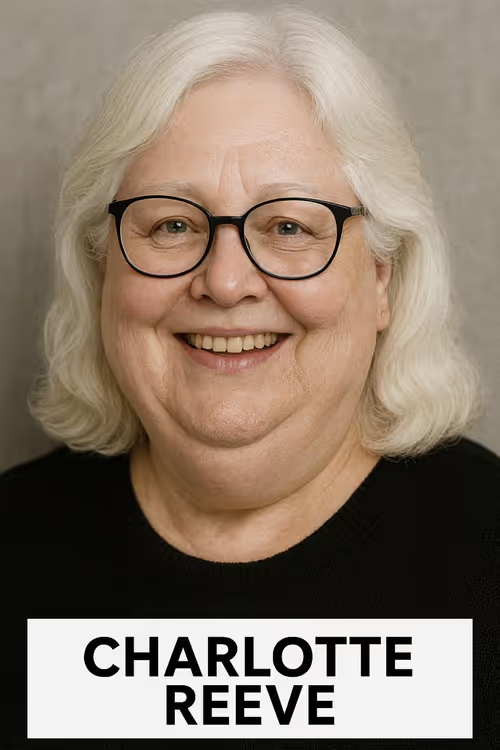
Charlotte Reeve
Senior correspondent · Capital Markets & Fintech
Charlotte cut her teeth on an equities desk before moving to the other side of the notebook. She covers capital markets, stock exchanges, and the fintech operators trying to disintermediate the banks that trained her. Sharpest on market microstructure and payments infrastructure; still reads a prospectus for fun. Based in Singapore. Reach out at charlotte.reeve@theplatinumcapital.com.