

Mohamed Alabbar: The Man Who Built Downtown Dubai and What He Is Building Next
Mohamed Alabbar transformed a stretch of desert into one of the most recognisable skylines on earth, delivering the Burj Khalifa and Dubai Mall as monuments to a city's relentless ambition—and to his own capacity for executing at a scale few developers have ever attempted. Now, with aggressive bets on cross-border digital commerce, logistics infrastructure, and large-scale residential platforms from Cairo to Ho Chi Minh City, he is quietly repositioning himself not as a builder of iconic towers but as an architect of the consumer ecosystems that will define emerging-market growth for the next decade.…
The Architect of a Skyline
Very few people alive today can point to a city's skyline and claim authorship over its most recognizable features. Mohamed Alabbar is one of them. As the founder and managing director of Emaar Properties, Alabbar has been the driving force behind some of the most ambitious real estate developments of the past three decades — none more iconic than the Burj Khalifa, the world's tallest building, and the sprawling urban ecosystem of Downtown Dubai that surrounds it. But reducing Alabbar to a single tower, however extraordinary, misses the full picture. His career spans real estate, retail, technology, e-commerce, and cross-border investment. And his next chapter may prove as consequential as the one that made him famous.
From Government Service to Global Developer
Born in 1956 in the United Arab Emirates, Alabbar studied finance and business administration at Seattle University before returning to the Gulf to begin a career that would intertwine public service with private enterprise. He served in various advisory and governmental roles in Dubai, working closely with the emirate's leadership during a period of extraordinary economic transformation. In 1997, he founded Emaar Properties. It would go on to become one of the largest real estate development companies in the world by market capitalization.
Emaar's early ambitions were bold by any measure. The company's flagship project, Downtown Dubai, wasn't conceived as a collection of luxury towers. It was an entirely new city center — a mixed-use district integrating residential, commercial, hospitality, and entertainment functions around the Dubai Mall and the Burj Khalifa. When the 828-meter tower opened in 2010, it captured global attention. But the more enduring achievement may have been the urban fabric around it: a district that functions as the commercial and cultural heart of a city that barely existed in its current form a generation earlier. That is a significant distinction.
Building an Empire Beyond Towers
Alabbar's ambitions extended well beyond the borders of Dubai. Under his leadership, Emaar developed projects across multiple countries, including Egypt, Turkey, India, Pakistan, and several other markets in the Middle East and Asia. The Dubai Mall, another Emaar creation, became one of the most visited retail and entertainment destinations on the planet, drawing tens of millions of visitors annually. Emaar Hospitality Group, a subsidiary, established the Address Hotels + Resorts and Vida Hotels and Resorts brands, adding a hospitality dimension to the company's portfolio.
Alabbar also served as chairman of the board of Eagle Hills, a private real estate investment and development company based in Abu Dhabi. Eagle Hills has pursued large-scale mixed-use developments in Bahrain, Jordan, Morocco, Serbia, and Ethiopia. Few outside the region have noticed. But these ventures reflected a clear philosophy: that premium urban development could be replicated — with local adaptation — in emerging and frontier markets hungry for modern infrastructure and foreign investment.
The Digital Pivot
Perhaps the most telling indicator of Alabbar's restlessness as a business leader was his move into technology and e-commerce. In 2017, he launched Noon.com, an Arabic-language e-commerce platform designed to compete with global giants in the Middle Eastern market. Backed by significant investment from Alabbar and Saudi Arabia's Public Investment Fund, Noon positioned itself as a homegrown alternative to Amazon in the region. The platform expanded into grocery delivery, food services, and digital payments — a broader bet on the digitization of consumer life in the Gulf.
This was not a vanity project. Alabbar recognized early that the future of retail — an industry central to Emaar's business model — would be reshaped by digital commerce. Rather than wait for disruption to arrive at the doors of his malls, he chose to participate in it. Noon has faced the intense competitive pressures common to e-commerce globally, but it has established itself as a significant regional player. More than anything, the venture demonstrated Alabbar's willingness to operate far outside his original domain of expertise. That takes nerve.
What He Is Building Next
Alabbar's current trajectory suggests a leader far from settling into the role of elder statesman. Emaar continues to launch major residential and mixed-use projects in Dubai, capitalizing on the emirate's post-pandemic surge in population growth, foreign investment, and demand for premium real estate. The company has announced several large-scale developments in recent years, responding to a market that has experienced remarkable price appreciation and an influx of high-net-worth individuals relocating to Dubai from Europe, Asia, and other regions.
Beyond Emaar's core business, Alabbar has been involved in ventures that signal an interest in food security, agriculture, and logistics — sectors that have gained strategic importance across the Gulf as governments seek to diversify their economies and reduce dependence on imported goods. His investment activities, conducted through various private vehicles, have touched sectors ranging from fashion to financial technology. The portrait that emerges is of a businessman whose curiosity and appetite for scale show no signs of fading.
Then there is the matter of legacy within Emaar itself. As the company matures, questions about succession and long-term strategic direction grow harder to ignore. Alabbar built an organization with deep institutional capabilities, but his personal vision and relationships — particularly with Dubai's ruling family — have been central to its success. How Emaar evolves in its next phase, and whether it can sustain its ambition under different leadership, will be one of the more closely watched stories in global real estate.
A Builder in the Truest Sense
Mohamed Alabbar belongs to a rare category of business leaders: those whose work is physically visible from space. The Burj Khalifa can be seen from nearly every corner of Dubai. But Alabbar's influence extends far beyond what satellites can capture. He helped define a model of urban development that has been studied and emulated across the developing world — one that combines sovereign ambition, private-sector execution, and an understanding that great cities are not accidents but acts of will. Now in his late sixties, he continues to build, invest, and expand, seemingly undeterred by the scale of what he has already accomplished. In an industry that often rewards caution, Alabbar has made a career of the opposite. The results, quite literally, speak for themselves.
Written by
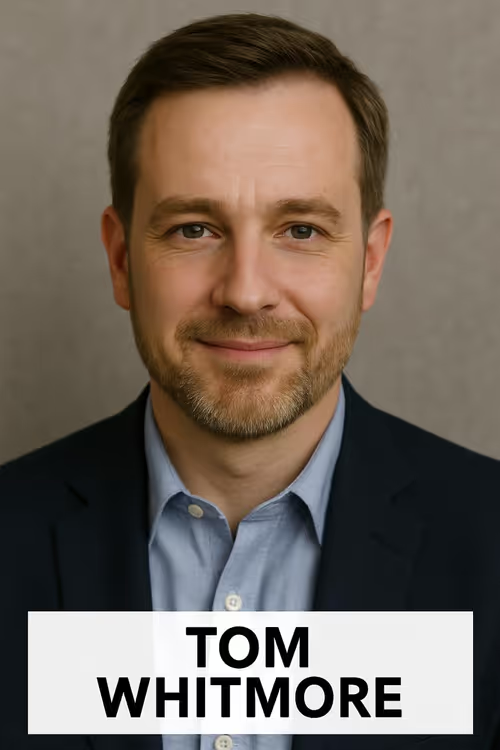
Tom Whitmore
Senior correspondent · Real Estate & Private Companies
Tom has interviewed most of the operators reshaping the Gulf skyline — and a few of the ones who tried and didn't. His beat is real estate, commodities, manufacturing, and the founder-led private companies that never bother to list. He knows which buildings and balance sheets survive a downturn before the spreadsheet does. Based in Dubai. Reach out at tom.whitmore@theplatinumcapital.com.