

Rola Abu-Manneh: Standard Chartered UAE CEO Redefines Regional Banking
Under Abu-Manneh's stewardship, Standard Chartered's UAE operations have evolved from a conventional international banking outpost into a strategic hub channelling capital flows between the Gulf, Africa and South Asia. Her disciplined focus on trade corridors, digital infrastructure and institutional client deepening has positioned the franchise as a benchmark for how global banks can extract outsized relevance from a rapidly maturing Middle Eastern market.…
The Architect of Standard Chartered's Gulf Ambitions
When Rola Abu-Manneh took the helm of Standard Chartered's UAE operations in 2021, the bank's footprint in the Emirates was respectable but unremarkable. Five years later, the transformation she has engineered is one of the most compelling leadership stories in Middle Eastern banking. Under her watch, Standard Chartered UAE has evolved from a conventional corporate banking outpost into a sophisticated wealth management and cross-border financing powerhouse — one that now sits at the heart of the London-headquartered group's global growth thesis.
Abu-Manneh's trajectory mirrors a broader shift across the Gulf's financial sector: the rise of regionally embedded executives who grasp both the institutional rigor demanded by international regulators and the relationship-driven dynamics that define capital flows between the Middle East, South Asia, and Africa. Sovereign wealth funds are deploying hundreds of billions. Family offices are multiplying at an extraordinary pace. And Abu-Manneh has positioned Standard Chartered squarely in the path of that money.
Wealth Management as the Central Pillar
The numbers speak for themselves. Standard Chartered's affluent and high-net-worth client base in the UAE grew by an estimated 28% between 2023 and the end of 2025, according to figures the bank disclosed at its annual regional briefing in January 2026. Assets under management in the bank's UAE wealth division reportedly surpassed $12 billion — a figure that puts it in direct competition with established private banking players such as Julius Baer, Lombard Odier, and the regional arms of UBS. That is a significant shift.
Abu-Manneh has been blunt about the opportunity. Speaking at the Dubai International Financial Centre's annual forum in February 2026, she noted that the UAE alone is expected to attract more than 6,700 millionaires on a net basis in 2025-2026, citing Henley & Partners migration data. "The wealth corridor between the subcontinent, East Africa, and the Gulf is not a future opportunity — it is a present reality, and we intend to be the bank of choice for clients who operate across these geographies," she said.
Her strategy has been to exploit Standard Chartered's unique network advantage. Unlike Swiss private banks that have set up Dubai offices primarily as booking centres, Standard Chartered operates fully licensed commercial operations in over 50 markets, including India, Pakistan, Kenya, Nigeria, Singapore, and Hong Kong. Consider a Gujarati industrialist with manufacturing interests in East Africa and a family residence in Dubai, or a Nairobi-based tech entrepreneur seeking structured lending against a diversified portfolio. That network is not easily replicated.
The Family Office Offensive
Perhaps the most decisive move under Abu-Manneh's leadership has been Standard Chartered's aggressive courtship of the family office segment. The UAE's regulatory environment — particularly the frameworks established by the Abu Dhabi Global Market and DIFC — has attracted an estimated 1,500 single-family offices as of early 2026, up from fewer than 400 in 2020. Few outside the region have noticed just how fast that number has climbed. Many of these entities manage portfolios ranging from $100 million to several billion dollars, and they need banking partners capable of providing institutional-grade custody, credit, and advisory services.
In the third quarter of 2025, Standard Chartered UAE launched a dedicated family office coverage desk staffed with 14 relationship managers and investment specialists, several of whom were recruited from Credit Suisse's former Middle East operation and from HSBC's Global Private Banking division. The unit reportedly onboarded 45 family office clients in its first six months, with aggregate relationship balances exceeding $3.4 billion.
Abu-Manneh has also forged partnerships that push the bank's capabilities beyond traditional banking. A collaboration announced in late 2025 with Mubadala Investment Company's venture arm gives Standard Chartered's family office clients access to co-investment opportunities in growth-stage technology companies — a proposition that has proven especially attractive to next-generation family members looking for exposure beyond real estate and fixed income.
Corporate and Institutional Banking: The Quiet Engine
Wealth management generates the headlines. But Abu-Manneh has been equally deliberate in strengthening the corporate and institutional banking franchise. Standard Chartered UAE participated in several landmark transactions in 2025, including a $2.75 billion syndicated facility for Abu Dhabi National Oil Company's downstream expansion and a $600 million green sukuk issuance for Masdar, the Emirates' clean energy champion.
The bank's transaction banking revenues in the UAE grew 19% year-on-year in 2025, driven in part by its role as a key clearing bank for renminbi-denominated trade flows between China and the Gulf. Non-oil trade between the UAE and China exceeded $80 billion in 2025, and as the UAE and Saudi Arabia deepen bilateral trade agreements with Beijing, Standard Chartered's presence in both Shanghai and Dubai makes it a natural intermediary.
Abu-Manneh has been particularly vocal about the opportunity in sustainable finance. Standard Chartered committed to facilitating $300 billion in green and transition finance globally by 2030, and the UAE operation has become one of the group's most active originators. The bank structured approximately $4.2 billion in ESG-linked loans and bonds from its Dubai platform in 2025, spanning sectors from renewable energy to sustainable aviation fuel.
Competing in a Crowded Market
Abu-Manneh's achievements have to be weighed against a fiercely competitive backdrop. Emirates NBD and First Abu Dhabi Bank — the Gulf's two largest lenders by assets — have both expanded aggressively into private banking and international markets. FAB's 2024 acquisition of a majority stake in a European private bank and Emirates NBD's growing presence in India, Turkey, and Egypt mean Standard Chartered can no longer lean solely on its international network as a differentiator.
At the same time, global players are doubling down on the region. JPMorgan Chase expanded its Dubai headcount by more than 30% in 2025. Goldman Sachs and Morgan Stanley have both upgraded their DIFC offices to regional hub status. The competition for talent is fierce, with senior private bankers commanding compensation packages that rival those offered in Singapore and Hong Kong.
Yet Abu-Manneh's advantage may lie precisely in the space between the global bulge bracket and the regional champions. Standard Chartered is not trying to compete with JPMorgan on M&A advisory or with FAB on local dirham lending. Instead, it occupies a distinctive niche: the internationally networked bank with deep emerging-market expertise, regulatory licenses in corridors that matter, and a client base that thinks in terms of Nairobi-Mumbai-Dubai rather than New York-London. That is a harder position to attack than it looks.
The Road to 2030
Abu-Manneh has set ambitious targets. She told The Platinum Capital in a recent interview that Standard Chartered UAE aims to grow its revenue contribution to the group by 40% by 2028, with wealth management and sustainable finance as the primary growth vectors. The bank is also investing heavily in digital infrastructure, having allocated $150 million over three years to upgrade its UAE technology stack, including AI-driven portfolio analytics and real-time cross-border payment capabilities.
For Standard Chartered's group CEO, Bill Winters, the UAE operation under Abu-Manneh has become a proof of concept — evidence that the bank's strategy of focusing on high-growth corridors in Asia, Africa, and the Middle East can deliver returns that satisfy shareholders accustomed to the profitability metrics of simpler, domestic-focused banks. The UAE's non-oil economy is projected to grow at approximately 5% annually through 2030. Abu Dhabi and Dubai are cementing their status as twin centres of global capital formation. The conditions for that thesis to hold have rarely been stronger.
Rola Abu-Manneh has not merely managed a country franchise. She has built an institution within an institution — one that reflects where the gravity of global wealth is shifting and what it demands of the banks that serve it.
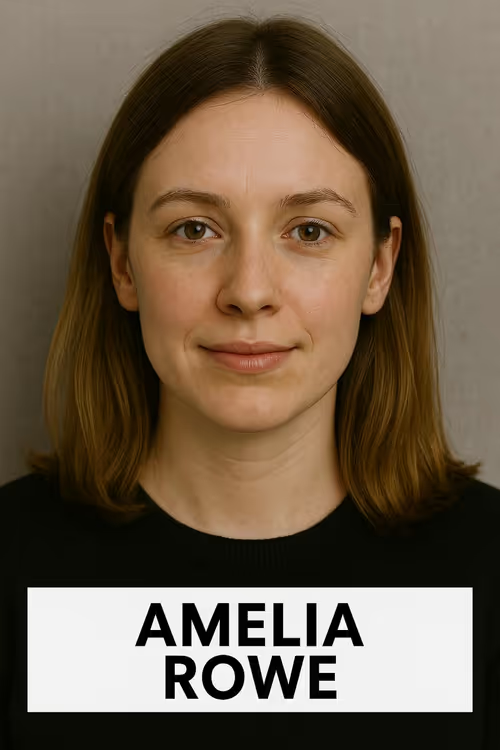
Written by
Amelia Rowe
Senior correspondent · Banking & Economy
Amelia spent eight years inside a sovereign wealth fund before deciding she'd rather write about institutional money than allocate it. She covers central banking, insurance, and the macro decisions that quietly choose which markets get the next decade. Sharp on monetary policy; impatient with anyone who confuses noise with signal. Based in London. Reach out at amelia.rowe@theplatinumcapital.com.