
Rola Abu-Manneh: Standard Chartered UAE CEO Redefines Regional Banking
Rola Abu-Manneh has transformed Standard Chartered's UAE operations into a strategic linchpin for the bank's broader Middle East ambitions, leveraging the country's position as a global capital corridor to drive double-digit growth across corporate, institutional and wealth management divisions. Her leadership marks a decisive shift in how international banks approach the region, moving beyond legacy correspondent banking models toward deeply embedded, innovation-led franchises that rival domestic incumbents in both scale and influence.…
The Architect of Standard Chartered's Gulf Ambition
When Rola Abu-Manneh took the helm of Standard Chartered's UAE operations in 2020, the bank's regional footprint was respectable but unremarkable. Six years later, she has engineered one of the most decisive transformations in Gulf banking — turning the UAE franchise into a strategic fulcrum for the London-headquartered lender's emerging markets thesis. Sovereign wealth funds are rewriting the rules of global capital allocation. Family offices are multiplying at unprecedented speed. And Abu-Manneh has positioned Standard Chartered not merely as a participant but as a principal architect of the new financial order taking shape between Dubai and Abu Dhabi.
Her tenure has coincided with — and arguably accelerated — the UAE's emergence as a global wealth corridor. The numbers speak with unusual clarity: Standard Chartered's UAE wealth management assets under management surpassed $12 billion in early 2026, roughly triple the figure from when Abu-Manneh assumed leadership. The bank's corporate and institutional banking revenues in the Emirates grew by double digits for four consecutive years, outpacing several regional incumbents with far deeper local roots. That is a significant shift.
Capturing the Family Office Migration
Abu-Manneh's most consequential strategic bet has been her early recognition that the UAE's family office boom was not a cyclical phenomenon but a structural realignment of global wealth geography. The Dubai International Financial Centre registered over 450 single-family offices by the first quarter of 2026 — a figure that has more than quadrupled since 2021. Abu Dhabi Global Market has tracked a similar trajectory, with its family office registrations exceeding 280.
Standard Chartered moved aggressively under Abu-Manneh's direction to build bespoke advisory capabilities tailored to these entities, many of which are relocating from London, Geneva, Singapore, and Mumbai. The bank established a dedicated family office coverage unit in 2024, staffed with relationship managers fluent in succession planning, Shariah-compliant structuring, and cross-border tax optimization. By mid-2026, the unit had onboarded more than 90 family office clients with combined investable assets exceeding $8 billion.
"The families arriving in the UAE are not looking for a transactional bank. They want an institutional partner that understands both Asian supply chains and European regulatory frameworks," Abu-Manneh told delegates at the Arab Bankers Association Forum earlier this year. "That intersection is precisely where Standard Chartered operates."
Private Wealth as a Revenue Engine
The private banking division under Abu-Manneh's oversight has become one of the fastest-growing segments within Standard Chartered's global wealth franchise. The bank's UAE affluent and high-net-worth client base expanded by approximately 35 percent between 2023 and 2025, driven by inflows from South Asian entrepreneurs, Chinese industrialists diversifying offshore, and a growing cohort of tech founders who established residency under the UAE's golden visa programme.
Standard Chartered's private bank in the UAE now manages portfolios for clients with a minimum threshold of $5 million in investable assets, competing directly with Julius Baer, Lombard Odier, and the regional arms of UBS and HSBC. Abu-Manneh has differentiated the offering by leaning hard into Standard Chartered's unmatched corridor capabilities — the ability to facilitate investment flows between Africa, the Middle East, and Asia in ways that Swiss private banks structurally cannot replicate.
This corridor advantage proved particularly potent in 2025 and into 2026, as Gulf-based investors increased allocations to Indian infrastructure bonds, Indonesian sovereign sukuk, and Nigerian fintech ventures. Standard Chartered facilitated more than $3.2 billion in cross-border private wealth investment flows through its UAE desk in 2025 alone, according to figures the bank disclosed in its annual results. Few outside the region have noticed just how large those flows have become.
Institutional Banking and the Sovereign Capital Nexus
Abu-Manneh's influence extends well beyond wealth management. She has cultivated deep relationships with the UAE's sovereign wealth apparatus — including the Abu Dhabi Investment Authority, Mubadala Investment Company, and ADQ — positioning Standard Chartered as a preferred counterparty for transactions involving Asian and African markets where the bank maintains extensive on-the-ground operations.
In 2025, Standard Chartered acted as joint lead manager on a $1.5 billion green sukuk issuance for a Mubadala portfolio company and served as adviser on ADQ's acquisition of a significant minority stake in an East African logistics platform. Those mandates reflect Abu-Manneh's ability to connect the Emirates' outbound capital deployment ambitions with Standard Chartered's frontier market expertise — a combination that few competitors can credibly offer.
The bank's transaction banking division in the UAE has also expanded substantially, processing trade finance volumes exceeding $28 billion in 2025. The growth has been fuelled by the UAE's deepening role as a re-export hub between China and Africa, a trade axis that Abu-Manneh has described as "the most consequential commercial corridor of this decade."
Leadership in a Contested Market
Abu-Manneh's ascent carries significance beyond Standard Chartered's balance sheet. As one of the most senior female banking executives in the Gulf, her prominence challenges persistent assumptions about the region's corporate hierarchies. She sits on the board of the UAE Banks Federation and has been a vocal advocate for regulatory modernisation, particularly around digital asset frameworks and open banking protocols.
Her leadership has not gone uncontested. HSBC, under its UAE CEO, has mounted a formidable challenge in the corporate banking segment, while Emirates NBD and First Abu Dhabi Bank continue to leverage their domestic scale advantages. Then there is Citigroup's renewed Middle East push, announced in late 2025 with a planned doubling of its Dubai-based institutional banking headcount. That adds another competitive vector entirely.
Yet Abu-Manneh's strategic clarity — anchoring Standard Chartered's UAE proposition in corridor banking, family office advisory, and sovereign-linked deal flow — has given the franchise a coherence that many rivals lack. Her approach is less about competing across every segment and more about dominating the specific intersections where global capital meets Gulf ambition. It is a disciplined bet, and so far, it is paying off.
Bill Winters, Standard Chartered's group chief executive, acknowledged as much during the bank's first-quarter 2026 earnings call, citing the UAE as "a flagship example of how our network model creates value that standalone domestic banks or global banks without our emerging markets depth simply cannot match." The remark was widely interpreted as a direct endorsement of Abu-Manneh's stewardship — and perhaps a signal that her influence within the group's strategic direction will only grow from here.
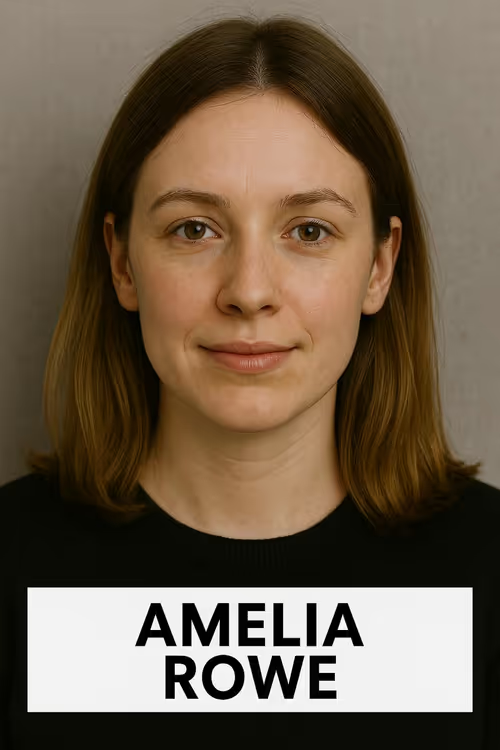
Amelia Rowe is a senior journalist at The Platinum Capital covering banking and financial institutions across the Gulf and emerging markets.
Written by
Amelia Rowe
Senior correspondent · Banking & Economy
Amelia spent eight years inside a sovereign wealth fund before deciding she'd rather write about institutional money than allocate it. She covers central banking, insurance, and the macro decisions that quietly choose which markets get the next decade. Sharp on monetary policy; impatient with anyone who confuses noise with signal. Based in London. Reach out at amelia.rowe@theplatinumcapital.com.