

Riyadh's Commercial Property Market and Vision 2030
Riyadh's commercial property market is experiencing unprecedented momentum as Vision 2030 drives a sweeping diversification agenda, attracting multinational corporations to establish regional headquarters and fuelling demand for Grade A office space at a pace that has outstripped supply in key districts. With sovereign-backed gigaprojects reshaping the urban landscape and regulatory reforms lowering barriers to foreign ownership, the Saudi capital is positioning itself as the Middle East's preeminent business hub in a direct challenge to Dubai's long-held dominance.…
Riyadh's Commercial Property Market and Vision 2030
The Saudi capital is experiencing what may be the most concentrated burst of commercial real estate development in the history of the Middle East. Riyadh's office market recorded vacancy rates above 20 per cent as recently as 2019. That market has now inverted entirely. Prime Grade A office space in the King Abdullah Financial District and along King Fahd Road commands rents exceeding SAR 2,500 per square metre annually, with vacancy in top-tier buildings falling below 2 per cent in early 2026. None of this happened by accident. It is the product of deliberate state policy, unprecedented capital deployment, and a deadline that grows closer by the day.
The Regional Headquarters Mandate Reshapes Demand
No single policy decision has altered Riyadh's commercial property dynamics more than the 2021 directive requiring multinational corporations to establish regional headquarters in the kingdom by January 2024 — a deadline that was quietly extended but whose effects have cascaded through the market with remarkable force. By mid-2026, more than 540 companies have relocated or established regional headquarters in Riyadh, according to figures from the Ministry of Investment. PwC, Deloitte, Boston Consulting Group, Baker Hughes, and Unilever are among them, each taking significant office footprints in the capital.
The sheer volume of corporate relocations has blown open a supply-demand imbalance that developers are scrambling to address. Knight Frank estimated in its Q1 2026 Saudi Arabia report that Riyadh requires an additional 3.2 million square metres of office space by 2030 to meet projected demand. JLL's latest data places current Grade A office stock at approximately 5.1 million square metres, with roughly 1.8 million square metres under construction or in advanced planning stages. Do the maths: even accounting for projects currently breaking ground, the city faces a structural deficit likely to persist through the end of the decade.
Giga-Projects and the New Commercial Geography
Riyadh's commercial property story cannot be separated from the giga-projects redefining the city's physical footprint. The most consequential for the office market is King Salman Park, the 16-square-kilometre urban development on the site of the former Riyadh Air Base, expected to include over 12,000 residential units and substantial commercial space upon completion. Then there is New Murabba, anchored by the Mukaab — a 400-metre cubic structure that the Public Investment Fund describes as the world's largest modern downtown — carrying an estimated total investment of SAR 50 billion.
ROSHN, the PIF-backed national real estate developer, has expanded its mandate beyond residential communities to include mixed-use commercial components across its Sedra and Warefa communities in Riyadh. The company reported total assets exceeding SAR 90 billion in 2025 and has positioned itself as a blunt instrument of state housing and urbanisation policy. Meanwhile, Riyad REIT and Al Rajhi REIT have increased their commercial portfolio allocations, with Riyad REIT acquiring two Grade A office assets in the Olaya district in late 2025 valued at a combined SAR 680 million. That is a significant shift.
These developments are creating entirely new commercial nodes in a city that has historically concentrated its office stock along a narrow north-south corridor. For institutional investors, the diversification of Riyadh's commercial geography offers both opportunity and complexity. New submarkets mean new risk profiles, and the absence of historical rental data in emerging districts makes underwriting a far more nuanced exercise.
Private Wealth and Family Office Capital Flows
Gulf-based family offices and ultra-high-net-worth investors have emerged as major participants in Riyadh's commercial property market. The motivations are a familiar cocktail: patriotic capital allocation, attractive yields, and the expectation of sustained population growth. Riyadh's population, currently estimated at approximately 8.5 million, is targeted to reach between 15 and 17 million by 2034 under the Riyadh Strategy, a subsidiary framework of Vision 2030. That demographic trajectory underpins long-term demand for commercial, retail, and hospitality assets.
Several prominent Saudi family offices — including those affiliated with the Olayan Group, the Al-Subeaei family, and the Bin Laden Group — have increased direct allocations to Riyadh commercial real estate over the past 18 months, according to advisers familiar with the transactions. At the same time, Emirati and Kuwaiti family offices have started taking positions, attracted by yields on stabilised Grade A office assets currently ranging between 7.5 and 8.5 per cent — a meaningful premium over comparable assets in Dubai, where yields have compressed to between 6 and 7 per cent. Few outside the region have noticed.
Savills reported in its 2026 Global Family Office Real Estate Survey that 34 per cent of Gulf-based family offices now identify Riyadh as their preferred city for new commercial property investment, up from just 11 per cent in 2022. The speed of this capital rotation reflects the gravitational pull of Vision 2030 spending and a broader recognition that Riyadh's institutional infrastructure — from regulatory frameworks under the Capital Market Authority to the growth of Saudi Exchange-listed REITs — has matured considerably.
Risks Beneath the Surface
For all its momentum, Riyadh's commercial property market carries real friction. Construction cost inflation remains elevated, with building materials costs rising approximately 14 per cent year-on-year in 2025 according to the General Authority for Statistics. Labour availability, despite significant visa reforms and the growing role of contractors from India, China, and Turkey, continues to constrain project timelines. Several high-profile office developments originally scheduled for 2027 delivery have already slipped to 2029.
Then there is the oil question. Should prices sustain a decline below $65 per barrel, the pressure on public finances could slow the cadence of government-linked project spending. The PIF, which sits at the centre of much of Riyadh's development activity, reported assets under management of approximately $930 billion in early 2026, but its expenditure commitments across NEOM, the Red Sea, Qiddiya, and domestic real estate are enormous. Any reprioritisation of spending would ripple straight through the commercial property pipeline.
Currency risk is minimal for dollar-pegged investors, but regulatory evolution — particularly around foreign ownership rules, which were liberalised further in 2025 to allow non-GCC nationals to own freehold commercial property in designated zones — introduces a layer of legal due diligence that international investors cannot afford to skip.
A Market Defined by Conviction
Riyadh's commercial property market in 2026 is fundamentally a bet on the execution capacity of the Saudi state. The demand signals are genuine: corporate relocations are real, population growth is accelerating, and capital is flowing in volumes that would have seemed implausible five years ago. But the market is also priced for success. Grade A rents have doubled since 2021. Land values in prime districts have risen by as much as 180 per cent. The development pipeline assumes a degree of economic diversification that remains aspirational in key sectors.
For institutional investors, family offices, and sovereign wealth funds weighing allocation to the kingdom, the calculus is straightforward but consequential: Riyadh offers some of the most compelling risk-adjusted returns in global commercial real estate, provided one believes that Vision 2030 will deliver even two-thirds of what it promises. Given what has been achieved already, scepticism is increasingly hard to sustain — but prudent underwriting demands it all the same.
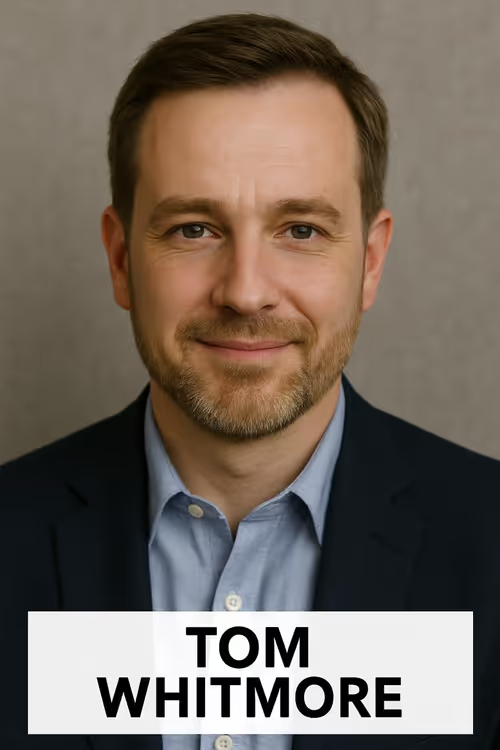
Written by
Tom Whitmore
Senior correspondent · Real Estate & Private Companies
Tom has interviewed most of the operators reshaping the Gulf skyline — and a few of the ones who tried and didn't. His beat is real estate, commodities, manufacturing, and the founder-led private companies that never bother to list. He knows which buildings and balance sheets survive a downturn before the spreadsheet does. Based in Dubai. Reach out at tom.whitmore@theplatinumcapital.com.


