

Georgia and Serbia Property Markets: The Investors Arriving Early
As Western capital markets grow increasingly crowded and yield-compressed, a discerning tier of global investors is quietly positioning itself in the property markets of Georgia and Serbia, two jurisdictions combining EU-adjacent stability with frontier-level return potential. Those arriving earliest to Tbilisi's expanding commercial corridors and Belgrade's regenerating riverfront districts are not speculating — they are executing a calculated asymmetric play that later entrants will study for years to come.…

While Dubai closes beachfront land deals at Dh400 million and Riyadh commits billions to mixed-use megaprojects, a quieter rotation is underway among sophisticated private investors — and the mainstream financial press has almost entirely missed it. A growing cohort of Gulf family offices, diaspora capital from Central Asia, and yield-seeking individuals from Southeast Asia is directing meaningful allocations toward two markets that remain largely off the radar: Georgia and Serbia. Both countries are absorbing foreign capital at an accelerating rate. Both offer entry prices that Gulf investors would recognise from Dubai a decade ago. And both carry a structural logic that rewards those who move before the crowd arrives.
The Macro Case: Why Emerging Europe Is Capturing Serious Attention
Start with context. As Riyadh's King Salman Park Foundation advances its SAR 11 billion residential district — anchored by Kolaghassi Development Company and underpinned by a CMA-regulated fund through Mulkia Investment Company — Gulf-based capital is clearly not slowing down at home. But institutional and family office investors who have watched Dubai's super-prime segment compress in yield terms are actively seeking complementary positions in faster-moving markets. Georgia and Serbia, both beneficiaries of European integration momentum and significant infrastructure investment, are absorbing that interest with striking regularity.
The numbers are worth sitting with. Serbia's GDP growth held at approximately 3.8 percent in 2024, with foreign direct investment reaching a record €4.3 billion. Georgia posted growth of over 8 percent in 2023 and has maintained robust expansion since, driven by tourism, financial services, and a surge in high-value relocation. Neither country makes international headlines. That is precisely the point for investors operating on a 5-to-10-year horizon.
Tbilisi: The Entry Window That Professionals Are Using Quietly
Georgia's capital has undergone a structural transformation that the broader investment community is only beginning to price in. Premium districts — Vake, Vera, and the Mtatsminda plateau — saw average prices per square metre rise by approximately 18 to 22 percent year-on-year through 2024. Yet finished product still trades at €1,200 to €2,500 per square metre. Comparable quality in Belgrade now commands €2,500 to €4,000. Both figures remain a fraction of what Gulf investors routinely deploy in JBR or Business Bay. That gap will not stay open indefinitely.
The demand drivers are structural, not speculative. Georgia's flat 20 percent personal income tax, the absence of a capital gains tax on property held for more than two years, and a legally straightforward foreign ownership framework have made it a serious jurisdiction for individuals relocating from Russia, Central Asia, and increasingly the Middle East. Developers including Biltmore Group Georgia and Redix have attracted Gulf-linked private buyers for boutique apartment blocks in central Tbilisi. Gross rental yields in the short-term accommodation sector run between 9 and 13 percent in tourist-heavy quarters. These are not theoretical projections — they are operational figures reported by resident property managers working with foreign-held portfolios.
Belgrade: Institutional Confidence Meets Supply Constraints
Serbia presents a different but equally compelling proposition. Belgrade's residential market draws on two distinct demand sources: domestic urbanisation from a city population of 1.8 million, and a sustained wave of foreign relocation that began during the pandemic and has not reversed. The Belgrade Waterfront development — a USD 3.5 billion mixed-use regeneration of the Sava riverfront — has functionally repositioned the city's premium residential expectations. Units in BW Residences and Sky Garden now regularly transact at €5,000 to €7,000 per square metre. Five years ago, that figure would have been unthinkable in Belgrade.
Supply has stayed disciplined. Planning constraints in the city's older districts, combined with Belgrade municipality's selective approach to high-rise approvals, have prevented the kind of speculative overbuild that erodes yields elsewhere. The result: well-located residential product in Savski Venac, Stari Grad, and the emerging Savamala cultural corridor holds value and generates consistent rental demand from the tech, consulting, and diplomatic community that now constitutes a large share of Belgrade's premium tenant base.
Gulf investors with direct or indirect exposure to Riyadh's Sports Boulevard — where Rikaz Properties and Al Jazira Capital are structuring a SAR 700 million luxury hotel fund within the Urban Wadi district — will recognise the institutional logic immediately. Anchor infrastructure investment creates addressable demand for surrounding residential and hospitality product. The same dynamic is playing out along the Sava. Investors who entered Belgrade Waterfront-adjacent residential between 2019 and 2021 have seen capital appreciation of 40 to 65 percent on stabilised assets. Few outside the region have noticed. They should.
Who Is Actually Buying — and How
The buyer profile across both markets has shifted materially over the past 24 months. Early movers were predominantly individual investors from Russia, Ukraine, and the Caucasus acting on direct market knowledge. The current cohort is more structured. Family offices from Kazakhstan and Azerbaijan have been active in both Tbilisi and Belgrade, typically acquiring two to six units within a single development as a portfolio position rather than a single-asset bet. UAE-based investors — several connected to the broader Arabian Acres client network that structured Dubai's record Dh400 million Jumeirah Coastline land assembly in March 2026 — have begun conducting Georgia and Serbia due diligence as part of multi-market residential diversification strategies.
Preferred structures vary by market. In Georgia, direct freehold acquisition remains dominant, with Georgian lawyers and local property managers handling asset administration. In Serbia, some international buyers have used local SPVs or worked through established developers offering structured buy-back or guaranteed rental arrangements during the initial stabilisation period. Neither market yet has the depth of REIT or regulated fund infrastructure available in the Gulf. Private club-style co-investment vehicles — managed informally among connected family office networks — are filling that gap, and becoming more common by the quarter.
The Forward View: Before the Institutions Formalise Their Positions
The single most consequential variable for both Georgia and Serbia is European Union integration. Georgia received EU candidate status in December 2023. Serbia has been an official candidate since 2012, with accession timelines perpetually debated but structurally advancing. Full or near-full accession for either country would trigger a re-rating of real estate values that compresses current yields sharply — and rewards early capital holders with appreciation multiples rather than incremental gains. That is a significant shift in risk-reward calculus, and it is not yet reflected in pricing.
For private investors, family offices, and next-generation wealth holders currently deploying across the Gulf's premium residential segment — where per-square-metre benchmarks are set by transactions like the Jumeirah Coastline deal — Georgia and Serbia represent an asymmetric allocation. Modest capital requirements. Strong income returns at current entry. Structural upside tied to geopolitical milestones that are no longer purely speculative. The investors arriving early in these markets are not abandoning Dubai or Riyadh. They are building complementary positions in cities that, within a decade, will no longer be considered early-stage markets at all.
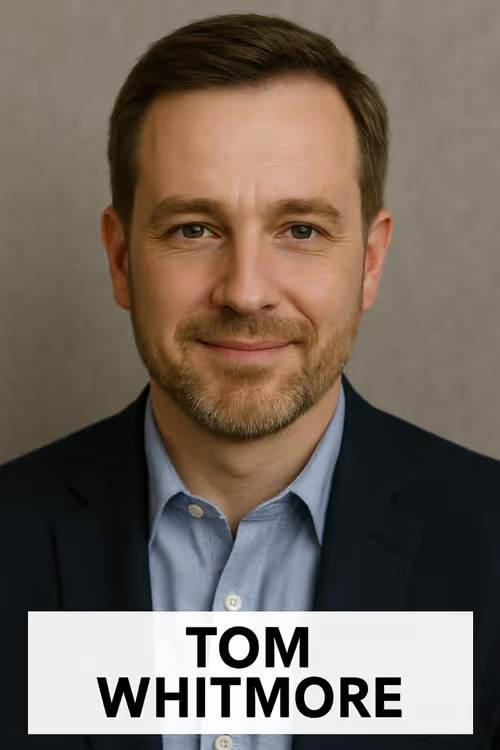
Written by
Tom Whitmore
Senior correspondent · Real Estate & Private Companies
Tom has interviewed most of the operators reshaping the Gulf skyline — and a few of the ones who tried and didn't. His beat is real estate, commodities, manufacturing, and the founder-led private companies that never bother to list. He knows which buildings and balance sheets survive a downturn before the spreadsheet does. Based in Dubai. Reach out at tom.whitmore@theplatinumcapital.com.