

Blackstone's Steve Schwarzman and the Private Equity Gulf Expansion
Steve Schwarzman's aggressive push into the Gulf states represents far more than a geographical diversification play; it is a calculated wager that the sovereign wealth giants of Abu Dhabi, Saudi Arabia and Qatar will become the dominant allocators of global capital for the next generation. Blackstone's deepening entanglement with Gulf ambitions — from infrastructure megaprojects to digital economy bets — is quietly reshaping the power dynamics of private equity itself, raising profound questions about the interdependence of Western financial engineering and petrodollar-fuelled statecraft.…
The Dealmaker Who Redefined Scale
Few figures in modern finance command the kind of gravitational pull that Stephen A. Schwarzman exerts over global capital markets. As co-founder, chairman, and chief executive officer of Blackstone Inc., Schwarzman has spent nearly four decades building what is now the world's largest alternative asset manager, overseeing hundreds of billions of dollars in assets across private equity, real estate, credit, and hedge fund solutions. His name has become synonymous with the very concept of private equity at institutional scale. And increasingly, his ambitions are turning toward the Gulf — where sovereign wealth, economic diversification, and a hunger for world-class financial infrastructure are converging in ways that few regions can match.
From Lehman Brothers to a Global Empire
Schwarzman's biography reads like a masterclass in financial ambition. He graduated from Yale University and Harvard Business School, then cut his teeth at Lehman Brothers, rising to managing director before departing in 1985 to co-found Blackstone with former U.S. Secretary of Commerce Pete Peterson. The firm launched with modest capital and a bold thesis: that a new class of alternative investment vehicles could generate superior returns for institutional investors willing to accept illiquidity in exchange for performance.
That thesis proved spectacularly correct. Blackstone grew from a boutique advisory firm into a colossus. Its 2007 initial public offering on the New York Stock Exchange ranked among the largest by a private equity firm at the time, and it marked a turning point — not just for Blackstone, but for the entire alternative asset management industry. Under Schwarzman's stewardship, the firm has continually expanded its reach, entering new asset classes and geographies with a discipline that has earned it a reputation for execution few competitors can rival.
A Strategic Eye on the Gulf
Schwarzman recognized the strategic importance of the Gulf Cooperation Council states early on. The region's sovereign wealth funds — including Abu Dhabi Investment Authority, Mubadala Investment Company, the Abu Dhabi Investment Council, Saudi Arabia's Public Investment Fund, and the Qatar Investment Authority — collectively manage trillions of dollars. They represent some of the most consequential pools of institutional capital on the planet. For a firm like Blackstone, whose model depends on attracting large-scale, long-duration commitments, the Gulf has always been a natural partner base.
But the relationship runs deeper than capital raising. Schwarzman has cultivated personal relationships with senior leadership across the region, making frequent visits and engaging in the kind of high-level diplomacy that blurs the line between finance and statecraft. His connections with decision-makers in Riyadh, Abu Dhabi, and Doha are well documented in public reporting, and Blackstone has been involved in significant investment activity tied to Gulf-based capital over the years.
As Saudi Arabia pursues its Vision 2030 agenda — a sweeping economic transformation plan designed to reduce the kingdom's dependence on hydrocarbons — demand for sophisticated private equity and infrastructure investment has surged. The UAE, meanwhile, continues to position Abu Dhabi and Dubai as global financial centers with regulatory frameworks designed to attract the world's leading asset managers. That is a significant shift. Schwarzman has been attentive to these dynamics, and Blackstone's presence in the region reflects a long-term strategic commitment rather than an opportunistic foray.
Infrastructure, Real Estate, and the Diversification Imperative
Blackstone's core competencies align remarkably well with the Gulf's economic priorities. The firm is one of the world's largest investors in real estate, with a global portfolio spanning logistics, hospitality, office, and residential assets. Its infrastructure platform has grown substantially, targeting energy transition, transportation, and digital infrastructure — all sectors that feature prominently in the economic plans of Gulf states.
The region wants world-class real estate development, data center capacity, logistics networks, and renewable energy projects. That creates a broad canvas for collaboration between Gulf sovereign investors and firms like Blackstone. Schwarzman has spoken publicly about the enormous investment opportunity presented by artificial intelligence infrastructure, including the data centers required to power it — an area where Gulf states have expressed strong ambitions and committed significant capital. Few outside the region have noticed just how aggressively those bets are being placed.
What makes Schwarzman's approach distinctive is his willingness to think in generational terms. While many private equity firms chase shorter-duration opportunities, Blackstone has increasingly positioned itself as a provider of perpetual capital solutions — vehicles with no fixed endpoint that can deploy capital patiently across cycles. This philosophy resonates deeply with sovereign wealth funds, whose mandates often span decades rather than the typical private equity fund life of ten years.
Philanthropy and the Power of Relationships
Beyond his corporate role, Schwarzman has established himself as one of America's most prominent philanthropists, with major gifts to institutions including the MIT Schwarzman College of Computing, the Schwarzman Scholars program at Tsinghua University in Beijing, and significant donations to the New York Public Library, Oxford University, and numerous other institutions. His philanthropic profile enhances his standing as a global figure and has opened doors with political and business leaders across continents, including in the Gulf.
Schwarzman operates at the intersection of capital, policy, and institutional leadership — and he does it more comfortably than almost anyone else in finance. He served as chair of the Strategic and Policy Forum under the Trump administration and has been a visible presence at the World Economic Forum in Davos, the Future Investment Initiative in Riyadh, and other major convenings where global economic strategy is debated and shaped.
What Comes Next
At an age when many executives contemplate retirement, Schwarzman shows little sign of stepping back. Blackstone continues to grow, and the Gulf remains one of the most dynamic theaters for that expansion. The firm's ability to attract capital from the region's sovereign investors, deploy it into high-conviction themes like infrastructure and technology, and deliver institutional-grade returns has reinforced a virtuous cycle of trust and partnership.
The broader story here is one of convergence. The Gulf's sovereign capital seeks global deployment. Blackstone offers global reach, operational expertise, and a track record that few can match. At the center of this equation stands Schwarzman — a dealmaker whose understanding of scale, relationships, and timing has made him one of the most influential financiers of his generation. As the Gulf's economic transformation accelerates, his role in shaping the flow of capital between the region and the world is only likely to grow.
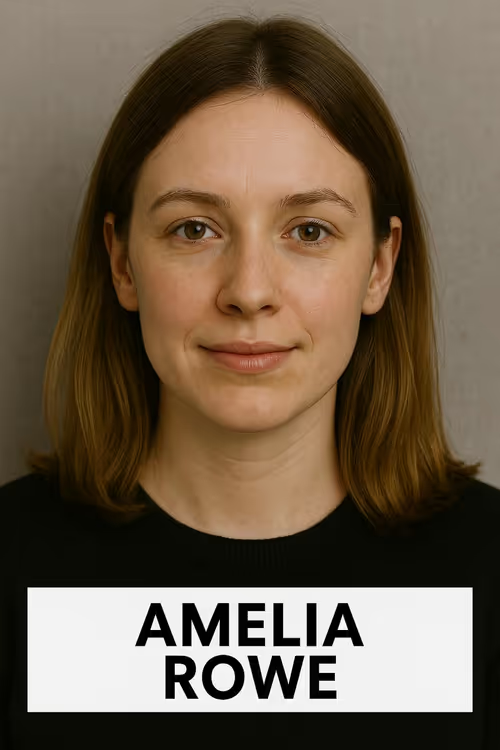
Amelia Rowe is a senior journalist at The Platinum Capital, covering finance and institutional investment.
Written by
Amelia Rowe
Senior correspondent · Banking & Economy
Amelia spent eight years inside a sovereign wealth fund before deciding she'd rather write about institutional money than allocate it. She covers central banking, insurance, and the macro decisions that quietly choose which markets get the next decade. Sharp on monetary policy; impatient with anyone who confuses noise with signal. Based in London. Reach out at amelia.rowe@theplatinumcapital.com.