Yasir Al-Rumayyan: The Man Steering Saudi Arabia's $700 Billion Sovereign Wealth Fund
Yasir Al-Rumayyan has quietly transformed the Public Investment Fund from a sleepy domestic holding vehicle into one of the most aggressive and consequential investors on the global stage, deploying capital across Silicon Valley, professional sports, and green hydrogen with a boldness that has rattled conventional sovereign wealth orthodoxy. Whether his audacious bets ultimately vindicate Crown Prince Mohammed bin Salman's post-oil vision or expose the fund to ruinous concentration risk remains the defining question of Gulf state capitalism in the twenty-first century.…
The Architect of a Post-Oil Kingdom
When Yasir Al-Rumayyan walks into a boardroom — whether in Riyadh, London, or Silicon Valley — he carries with him the weight and ambition of an entire nation's economic transformation. As the governor of Saudi Arabia's Public Investment Fund (PIF), one of the world's largest sovereign wealth funds, Al-Rumayyan has become the most consequential figure in global sovereign investing. His mandate is nothing short of extraordinary: to diversify the Saudi economy away from its dependence on hydrocarbons and position the kingdom as a dominant force in sectors ranging from technology and entertainment to sports and renewable energy. Few individuals in global finance wield as much capital, influence, or strategic ambition.
From Saudi Capital Markets to the World Stage
Al-Rumayyan's rise to the helm of PIF was not accidental. A graduate of Harvard Business School's executive education programs, he built his career across Saudi Arabia's financial services sector, holding senior positions at Saudi Fransi Capital and later running Saudi Arabia's Capital Market Authority. He knew the kingdom's financial plumbing inside and out. That expertise, combined with a sharp instinct for deal-making, made him a natural pick when Crown Prince Mohammed bin Salman began reshaping PIF from a relatively passive domestic holding entity into an aggressive, globally oriented investment vehicle.
He took charge in 2015, at a moment of profound transition. The fund had historically held stakes in domestic blue-chip companies. Now it was being reimagined as the primary engine of Vision 2030 — Saudi Arabia's sweeping plan to build new industries, create millions of jobs, and wean the economy off oil revenues. Under Al-Rumayyan, PIF has grown dramatically in both assets under management and global reach. Today it commands attention in every major financial center.
A Portfolio That Spans the Globe
The scale of PIF's investment activity under Al-Rumayyan has been remarkable. The fund has deployed capital across a staggering range of sectors and geographies. Its significant investment in SoftBank's Vision Fund gave PIF exposure to a constellation of technology companies around the world. Stakes in major publicly listed companies — including substantial positions in firms like Lucid Motors, the electric vehicle manufacturer, and investments across gaming, entertainment, and logistics — signal a clear intent to build a diversified, future-oriented portfolio.
On the domestic side, Al-Rumayyan has overseen the creation of entirely new companies and sectors. PIF established NEOM, the planned futuristic megacity on the Red Sea coast, alongside other giga-projects such as The Red Sea tourism development, ROSHN (a national real estate developer), and the Diriyah Gate project. These ventures attract plenty of debate about their scale and feasibility. They also represent one of the most ambitious state-led economic diversification efforts ever attempted. Al-Rumayyan has been the one making their commercial logic legible to international investors and partners.
Then there's sports. PIF's acquisition of Newcastle United Football Club in the English Premier League became one of the most discussed deals in global sports, while the fund's backing of LIV Golf blew up professional golf's established order and ultimately triggered discussions about a potential merger framework with the PGA Tour. That is a significant shift. Whether celebrated or criticized, these moves showed a willingness to use capital strategically to reshape entire industries.
Boardroom Influence Beyond PIF
Al-Rumayyan's influence extends well beyond PIF's Riyadh headquarters. He chairs Saudi Aramco, the world's largest oil company by production volume — a position that places him squarely at the intersection of the kingdom's hydrocarbon present and its diversified future. He has also held the chairmanship of other major Saudi entities, giving him an unmatched vantage point across the kingdom's corporate ecosystem.
Internationally, his network runs deep. Al-Rumayyan maintains relationships with some of the world's most prominent business leaders, from technology executives in the United States to industrial chiefs in Asia. His presence at major global gatherings — Davos, the Future Investment Initiative in Riyadh (often called "Davos in the Desert"), and bilateral economic forums — has made him one of the most recognized faces of Saudi economic diplomacy. People who have worked with him describe a man who is measured, commercially astute, and deeply committed to the long-term nature of PIF's mission.
Managing Scrutiny and Scale
Operating at this scale inevitably attracts scrutiny. Al-Rumayyan has not been immune. Questions about governance, the pace of domestic spending, and the geopolitical dimensions of sovereign wealth investing follow PIF wherever it operates. The fund's involvement in professional sports, in particular, has prompted ongoing debates about sportswashing and the broader motivations behind Saudi investment in Western cultural institutions. Few outside the region have noticed how persistent that criticism has become.
Al-Rumayyan has generally responded with a pragmatic, commercially focused message: PIF's investments are driven by returns and economic strategy, not political calculation. Whether observers buy that framing often depends on their broader view of Saudi Arabia's place in the world. What's hard to dispute, though, is the sheer commercial impact. PIF has become one of the most active institutional investors on earth, and its decisions move markets, reshape industries, and send ripple effects across global capital flows.
The Long Game
Vision 2030 is, by design, a generational project. Its success or failure won't be determined by any single year's returns or any individual transaction. Al-Rumayyan appears to understand this deeply. His public statements consistently emphasize patience, discipline, and the need to build institutions and industries that will endure long after oil's dominance fades.
Sovereign wealth funds from Abu Dhabi to Norway to Singapore are playing increasingly prominent roles in global finance. Al-Rumayyan has positioned PIF as perhaps the most ambitious of them all — not merely preserving wealth for future generations, but actively attempting to build an entirely new economic foundation for a nation of more than thirty million people. The outcome of that effort remains uncertain. But the audacity of the undertaking, and the skill with which Al-Rumayyan has marshaled resources toward it, has earned him a place among the most significant figures in twenty-first-century global finance.
Amelia Rowe is a senior journalist at The Platinum Capital, covering sovereign wealth, institutional investment, and the geopolitics of capital.
Written by
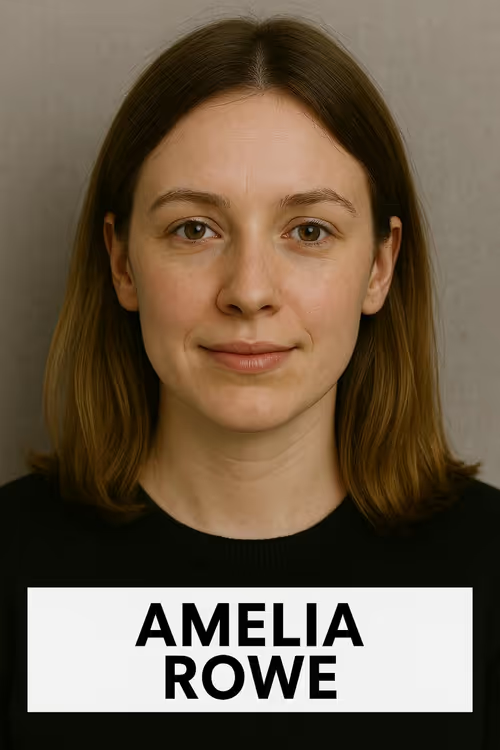
Amelia Rowe
Senior correspondent · Banking & Economy
Amelia spent eight years inside a sovereign wealth fund before deciding she'd rather write about institutional money than allocate it. She covers central banking, insurance, and the macro decisions that quietly choose which markets get the next decade. Sharp on monetary policy; impatient with anyone who confuses noise with signal. Based in London. Reach out at amelia.rowe@theplatinumcapital.com.