

Sovereign Wealth Funds and Their Expanding Global Influence
Sovereign wealth funds now command more than ten trillion dollars in assets and are quietly reshaping global capital markets, from Silicon Valley startups to critical infrastructure projects across emerging economies. Their expanding reach raises urgent questions about the blurred boundaries between state power and market forces, challenging regulators and private investors alike to reckon with a new era of government-backed financial dominance.…
The New Power Brokers: How Sovereign Wealth Funds Are Reshaping Global Capital Markets
When Saudi Arabia's Public Investment Fund completed its $8.5 billion acquisition of a controlling stake in Nintendo earlier this year, it was more than a headline-grabbing deal. It was a declaration. Sovereign wealth funds are no longer passive allocators content to park petrodollars in Treasury bonds and blue-chip equities. They are active, ambitious, and increasingly willing to deploy capital in ways that reshape entire industries.
The combined assets of the world's sovereign wealth funds surpassed $13 trillion in the first quarter of 2026, according to the Sovereign Wealth Fund Institute. That figure has doubled in barely a decade. The concentration of this capital in a handful of Gulf-based vehicles carries profound implications for global finance, corporate governance, and geopolitical alignment. Traditional institutional investors in the West are grappling with demographic headwinds and regulatory constraints. Sovereign funds from Abu Dhabi, Riyadh, Singapore, and beyond are stepping into that vacuum with conviction and scale.
The Gulf's Ascendancy: Beyond Oil, Beyond Borders
No region exemplifies the transformation of sovereign capital more vividly than the Gulf Cooperation Council states. Abu Dhabi Investment Authority, with an estimated $1.1 trillion under management, remains the region's largest fund. But the Public Investment Fund of Saudi Arabia and Mubadala Investment Company have captured the market's attention through sheer velocity of deployment.
PIF, now managing approximately $930 billion, has committed over $45 billion in the first half of 2026 alone across sectors ranging from artificial intelligence infrastructure to European professional sports. Its investment in Waymo's $6.2 billion funding round in March, alongside a direct stake in Germany's SAP, signals a deliberate pivot toward technology platforms with global network effects. Crown Prince Mohammed bin Salman's Vision 2030 programme has evolved from a diversification blueprint into an active industrial policy underwritten by sovereign capital. That is a significant shift.
Mubadala, meanwhile, has deepened its relationship with private equity giants including Apollo Global Management and Silver Lake, co-investing in mid-market buyouts across North America and Southeast Asia. Its healthcare portfolio — anchored by Cleveland Clinic Abu Dhabi and expanded through a $2.3 billion commitment to biotech ventures in 2025 and 2026 — positions the fund as a genuine operator, not merely a financial sponsor.
Qatar Investment Authority, having digested the lessons of its high-profile European investments in Barclays, Volkswagen, and Harrods over the past fifteen years, has shifted focus toward data centre infrastructure and clean energy storage. It has deployed $7.8 billion across twelve transactions since January 2025.
Emerging Market Sovereigns: A Second Wave
Gulf funds dominate the headlines. But a second tier of sovereign investors is quietly building influence. Few outside the region have noticed. Indonesia's Ina, established only in 2021 with modest ambitions, now manages $24 billion and has become the anchor investor in the country's new capital city, Nusantara. Its partnership with the Abu Dhabi Development Holding Company on a $5 billion infrastructure platform shows how emerging market sovereigns are leveraging Gulf relationships to attract co-investment capital.
India's National Investment and Infrastructure Fund, backed by the central government and managing $7.4 billion, has accelerated investments in renewable energy transmission and logistics corridors connecting the subcontinent to the Middle East under the India-Middle East-Europe Economic Corridor framework. Turkey's sovereign fund, TVF, restructured in late 2025, has consolidated stakes in Turkish Airlines, Borsa Istanbul, and several state-owned banks into a more professionally managed vehicle now valued at approximately $90 billion.
These funds lack the firepower of their Gulf counterparts, but they serve a different strategic function — channelling domestic savings into priority sectors while signalling creditworthiness to foreign investors. Think of them as sovereign-level family offices.
The Convergence with Private Wealth and Family Offices
One of the most consequential trends of 2026 is the growing convergence between sovereign wealth funds and ultra-high-net-worth family offices. The structural similarities are striking: both operate with long time horizons, minimal liquidity constraints, and a preference for direct investment over intermediated products.
ADIA's partnership with the Walton family's holding company on a $3.6 billion logistics real estate platform, announced in February, exemplifies this convergence. Singapore's GIC has established formal co-investment arrangements with at least four European family offices managing over $5 billion each, according to people familiar with the arrangements.
The motivation runs both ways. Family offices gain access to deal flow and geopolitical intelligence that sovereign funds possess. Sovereign funds benefit from the operational expertise and local market knowledge embedded in multigenerational family enterprises. Dubai and Singapore have emerged as the primary hubs for these relationships, with the Dubai International Financial Centre reporting a 38 per cent increase in registered family office entities since 2024.
Henley & Partners estimates that over 6,700 millionaires relocated to the UAE in 2025, many establishing single-family offices that now co-invest alongside sovereign vehicles in venture capital, private credit, and trophy real estate. The line between state capital and private capital is blurring in ways that regulators in Washington and Brussels have yet to fully grasp.
Governance, Transparency, and Geopolitical Friction
This expanding influence has not gone unexamined. The European Commission's proposed Foreign Subsidies Regulation update, expected in the third quarter of 2026, would impose enhanced disclosure requirements on sovereign-backed acquirers of European companies with revenues exceeding €500 million. The United States Committee on Foreign Investment has blocked or forced divestiture of three sovereign-linked transactions since September 2025, including a GCC-backed bid for a semiconductor packaging firm in Arizona.
The Santiago Principles — the voluntary governance framework established in 2008 by the International Working Group of Sovereign Wealth Funds — face calls for revision. Norway's Government Pension Fund Global, long considered the gold standard for transparency, published a detailed review in April urging peer funds to adopt standardised ESG reporting and conflict-of-interest protocols. Only eleven of the thirty-seven signatory funds currently meet full compliance standards. That number should alarm anyone paying attention.
The tension is real but manageable. Sovereign wealth funds need access to Western capital markets, technology, and talent pipelines. Western economies need sovereign capital to finance the energy transition, infrastructure deficits, and the enormous fiscal demands of ageing populations. It is a relationship of mutual dependence, however uncomfortable that reality may be for politicians on either side.
What Comes Next
The trajectory is clear. Sovereign wealth funds will continue to grow in size, sophistication, and ambition. Their investment teams — increasingly staffed by alumni of Goldman Sachs, BlackRock, and McKinsey — operate with a professionalism that belies outdated stereotypes about state-directed capital. The question is no longer whether these funds will shape global markets. It is whether the institutional architecture of international finance can adapt quickly enough to accommodate their presence.
For corporate boards, private equity sponsors, and asset managers, the practical implication is straightforward: sovereign wealth funds are not optional counterparties. They are essential ones. Any serious capital formation strategy in 2026 that ignores Abu Dhabi, Riyadh, or Singapore is, by definition, incomplete.
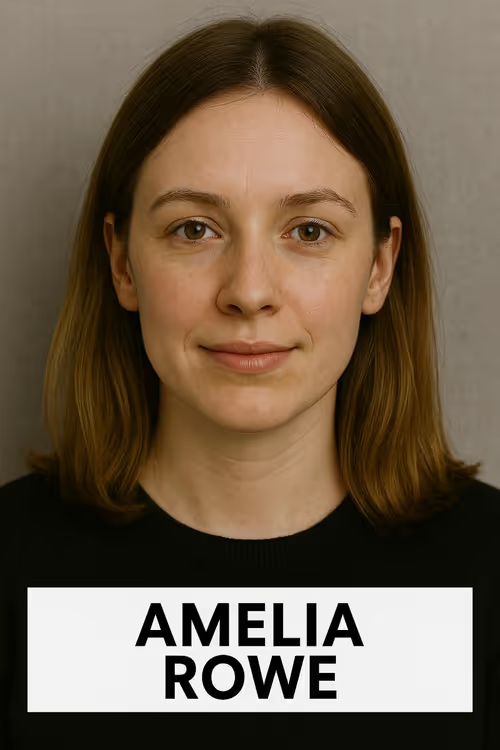
Amelia Rowe is a senior journalist at The Platinum Capital covering global finance, sovereign capital, and private wealth.
Written by
Amelia Rowe
Senior correspondent · Banking & Economy
Amelia spent eight years inside a sovereign wealth fund before deciding she'd rather write about institutional money than allocate it. She covers central banking, insurance, and the macro decisions that quietly choose which markets get the next decade. Sharp on monetary policy; impatient with anyone who confuses noise with signal. Based in London. Reach out at amelia.rowe@theplatinumcapital.com.