
Sovereign Wealth Funds and Their Expanding Global Influence
Sovereign wealth funds now command more than ten trillion dollars in assets and are quietly reshaping global capital flows, from Silicon Valley startups to critical infrastructure across emerging markets. Their growing appetite for strategic investments has transformed these state-backed vehicles from passive reserve managers into formidable geopolitical actors capable of tilting industries and redefining the balance of economic power.…
The New Power Brokers: How Sovereign Wealth Funds Are Reshaping Global Capital
When Saudi Arabia's Public Investment Fund completed its $7.5 billion acquisition of a controlling stake in Nintendo in early 2026, it wasn't just a headline-grabbing deal. It was a declaration. Sovereign wealth funds — once content to park petrodollars in safe Treasury bonds and blue-chip equities — have become the most consequential actors in global finance, wielding influence that rivals and often exceeds that of the largest private equity firms and investment banks combined.
The numbers are staggering. Global sovereign wealth fund assets surpassed $13.2 trillion by the first quarter of 2026, according to the Sovereign Wealth Fund Institute — a 14% jump from 2024. Elevated energy revenues, disciplined fiscal surpluses across Gulf states, and an aggressive pivot toward alternative assets have all fueled the expansion. But what sets this moment apart isn't simply the size of these capital pools. It's the sophistication, strategic ambition, and geopolitical calculus behind how the money gets deployed.
The Gulf's Ascendancy: From Passive Holdings to Strategic Control
The Gulf Cooperation Council states remain the epicentre of sovereign wealth power. Abu Dhabi Investment Authority, with estimated assets of $1.1 trillion, still holds the title of the world's largest sovereign investor. But it's ADIA's more agile sibling, Mubadala Investment Company, that has captured deal-makers' attention worldwide. Mubadala's $3.2 billion commitment to artificial intelligence infrastructure across Southeast Asia in 2026 — including data centre partnerships with Indonesia's Telkom and Singapore-based ST Telemedia — shows a fund thinking in ecosystems, not individual transactions.
Saudi Arabia's PIF, now managing approximately $930 billion, has arguably been the most transformative force of all. Under Governor Yasir Al-Rumayyan, the fund has moved well beyond its Vision 2030 domestic mandate. Its $45 billion commitment to NEOM remains the world's single largest sovereign-backed development project, but the international portfolio has diversified dramatically. PIF's 2026 investments span electric vehicle battery manufacturing in Morocco, semiconductor packaging in South Korea, and a reported $2.8 billion stake-building campaign across European luxury goods conglomerates, including significant positions in Kering and Richemont. That last move caught Paris and Geneva off guard.
Qatar Investment Authority, meanwhile, has quietly amassed one of the most formidable real estate portfolios in history, with holdings exceeding $85 billion across London, New York, Paris, and increasingly Mumbai. QIA's $4.1 billion investment in Adani Group's renewable energy subsidiary in late 2025 signalled a strategic bet on India's energy transition that few Western institutions were willing to make at that scale. Few outside the region have noticed just how quickly QIA has repositioned itself.
Emerging Market Funds Assert Themselves
The sovereign wealth story of 2026 extends far beyond the Persian Gulf. Singapore's GIC, managing an estimated $800 billion, has become the most active sovereign investor in private credit markets, committing over $18 billion to direct lending strategies since 2024 as traditional banks have retreated from mid-market corporate finance. Temasek Holdings, its Singaporean counterpart, reported a portfolio value of $395 billion and has concentrated its firepower on life sciences and climate technology, leading a $1.4 billion funding round for Germany's BioNTech subsidiary focused on oncology therapeutics.
Norway's Government Pension Fund Global, the world's largest at $1.7 trillion, remains philosophically distinct — a passive, index-tracking giant governed by strict ethical guidelines. Yet even Norges Bank Investment Management has been forced to adapt. Its 2026 decision to increase its allocation to unlisted renewable energy infrastructure to 5% of total assets, up from under 2%, amounts to an $85 billion mandate. That is a significant shift. It will reshape how wind, solar, and grid-scale battery projects get financed globally.
And then there are the newer entrants. Turkey's Wealth Fund, reorganised in 2025 under a mandate to attract foreign co-investment, has partnered with South Korean and Emirati counterparts on a $6 billion infrastructure corridor linking Istanbul to Central Asian markets. Indonesia's nascent sovereign fund, INA, has attracted $2.3 billion in co-investment from ADIA and CDPQ for toll road and port development across Java and Sumatra. These aren't bit players anymore.
The Family Office Convergence
One of the most striking structural shifts in 2026 has been the deepening relationship between sovereign wealth funds and ultra-high-net-worth family offices. These two pools of patient, long-duration capital have discovered a natural alignment — particularly in private markets where deal sizes often exceed the appetite of any single allocator.
Mubadala's partnership with the Walton family's Zoma Capital on agricultural technology investments, reported at $1.6 billion across precision farming and vertical agriculture platforms, exemplifies this convergence. PIF's co-investment vehicle with Mukesh Ambani's family office for digital infrastructure across sub-Saharan Africa has deployed approximately $3 billion since its inception in 2025.
The family office ecosystem in Singapore and Dubai has become the connective tissue for these arrangements. Dubai International Financial Centre reported 420 registered single-family offices by March 2026, up from 270 in 2024, with combined assets under advisement exceeding $145 billion. Many of these offices now serve as intermediaries, sourcing proprietary deal flow that sovereign funds increasingly prefer over club deals arranged by investment banks. The bulge-bracket firms should be paying closer attention.
Geopolitical Implications and Governance Questions
The expanding reach of sovereign capital hasn't gone unscrutinised. The European Commission's proposed revision of its foreign direct investment screening regulation, expected to be finalised by late 2026, would for the first time subject sovereign wealth fund acquisitions in technology, energy, and media to mandatory national security review across all 27 member states. The United States' CFIUS has already blocked or forced restructuring of three Gulf-backed transactions in 2026, including a proposed $2.1 billion acquisition of an American cybersecurity firm by a QIA-affiliated vehicle.
Governance standards within the funds themselves remain uneven. The Santiago Principles, established in 2008 to promote transparency and accountability among sovereign investors, are voluntary and lack enforcement mechanisms. Of the 37 signatories, fewer than half publish audited annual reports with full portfolio disclosure. Critics argue that the sheer scale of sovereign capital now flowing into Western economies demands a more rigorous framework — one that balances the genuine economic benefits of long-term investment against legitimate concerns about state-directed capital shaping market outcomes. They have a point.
What's beyond dispute is the structural permanence of this shift. Sovereign wealth funds are no longer peripheral actors or convenient sources of emergency liquidity during financial crises. They are principals — setting terms, shaping industries, and increasingly determining which technologies, regions, and companies will command the capital necessary to thrive. For corporate boards, asset managers, and policymakers alike, understanding how these funds think, invest, and compete has become less a matter of curiosity and more one of survival.
Amelia Rowe is a senior journalist at The Platinum Capital covering sovereign wealth, institutional investment, and global capital flows.
Written by
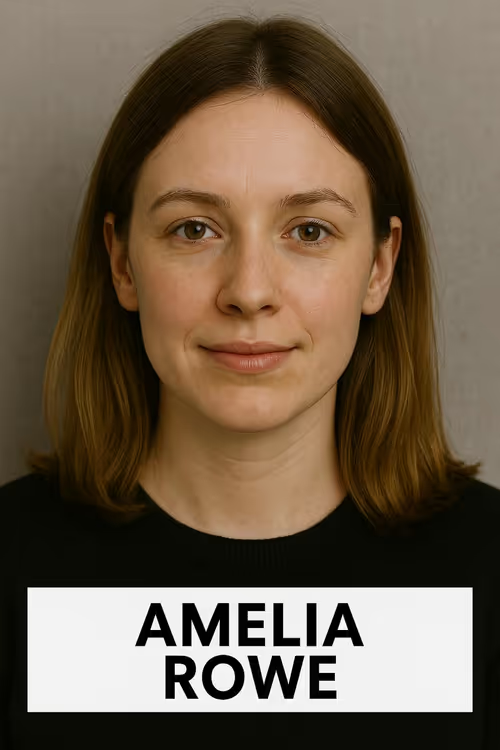
Amelia Rowe
Senior correspondent · Banking & Economy
Amelia spent eight years inside a sovereign wealth fund before deciding she'd rather write about institutional money than allocate it. She covers central banking, insurance, and the macro decisions that quietly choose which markets get the next decade. Sharp on monetary policy; impatient with anyone who confuses noise with signal. Based in London. Reach out at amelia.rowe@theplatinumcapital.com.