

Dubai's Luxury Real Estate Boom: Who Is Really Buying
The emirate's property market has surged past pre-pandemic peaks, driven not by local demand but by an unprecedented influx of capital from Russian oligarchs seeking sanctions-proof havens, Indian tech entrepreneurs diversifying offshore, and European family offices drawn to zero-income-tax residency structures. Behind the gleaming facades of Palm Jumeirah penthouses and Downtown Dubai towers lies a complex web of shell companies and golden visa incentives that regulators are only now beginning to scrutinize with any meaningful rigor.…
Dubai's Luxury Real Estate Boom: Who Is Really Buying
In the first quarter of 2026, Dubai recorded 5,200 residential transactions exceeding AED 10 million each — a 34% increase over the same period last year, according to data from the Dubai Land Department. The city's ultra-prime segment, properties priced above AED 50 million, surged even more dramatically, with 187 deals closed in Q1 alone. But behind the headline numbers sits a more complex and revealing question: who, exactly, is writing these cheques?
The answer has shifted considerably over the past eighteen months. A market once dominated by European buyers chasing tax efficiency and Russian capital fleeing sanctions has evolved into something more structurally significant. Dubai's luxury real estate market in 2026 is being reshaped by Gulf-based family offices, South Asian industrialists, and a new generation of African and Central Asian wealth — buyers whose motivations extend well beyond speculation.
The Gulf Family Office Surge
The most consequential shift in Dubai's buyer profile has been the growing dominance of single-family offices headquartered across the Gulf Cooperation Council states. The Dubai International Financial Centre reported in February 2026 that 340 family offices are now registered in the emirate, up from 220 at the end of 2024. Many of these entities, managing portfolios north of $500 million, have allocated between 15% and 25% of their assets to direct real estate holdings. That is a serious concentration bet on a single city.
Saudi family offices have been particularly aggressive. Following the Kingdom's economic diversification push under Vision 2030, a cadre of Saudi principals — many of whom built fortunes in construction, petrochemicals, and logistics — have treated Dubai as both a personal residence and a portfolio anchor. Emaar Properties reported that Saudi nationals accounted for 18% of its ultra-prime sales at Dubai Hills Estate and Rashid Yachts & Marina during the first half of the fiscal year, up from 11% in 2024.
Kuwaiti and Bahraini family offices have followed a similar trajectory, often acquiring entire floors in branded residences. The Dorchester Collection residences on Palm Jumeirah, developed by Omniyat, reportedly sold seven full-floor units to GCC-based family offices in Q1 2026, with individual transaction values ranging from AED 80 million to AED 145 million. These buyers are not flipping properties. They are building multi-generational portfolios in a jurisdiction that offers freehold ownership, zero income tax, and political neutrality.
South Asian Capital: From Diaspora to Dynasty
Indian nationals have topped Dubai's foreign buyer rankings for three consecutive years, and 2026 has only intensified the trend. Data from Property Finder shows that Indian buyers accounted for 22% of all luxury transactions above AED 15 million in Q1, with a notable concentration in branded residences and waterfront developments.
What sets the current wave apart from earlier cycles is the profile of the buyer. These are not non-resident Indians parking modest savings offshore. They are founders and promoters of publicly listed Indian companies — pharmaceuticals, technology, infrastructure — who have benefited from the BSE Sensex's sustained rally and India's surging GDP growth, which the IMF projects at 6.5% for 2026. Several have established UAE Golden Visas and now use Dubai as a secondary headquarters for international operations.
Sobha Realty, the Dubai-based arm of Indian conglomerate Sobha Group, reported that 40% of its $1.2 billion in sales during the first five months of 2026 came from Indian high-net-worth individuals. Pakistani buyers, though smaller in aggregate volume, have also emerged as a meaningful force in the AED 10–30 million segment, particularly in communities like Emirates Hills and District One.
Africa and Central Asia: The New Money Corridors
Less discussed but increasingly material is the capital flowing from sub-Saharan Africa and Central Asia. Few outside the region have noticed. Nigerian, Kenyan, and Ghanaian entrepreneurs — many in fintech, telecommunications, and commodity trading — have accelerated their acquisitions in Dubai's premium market. DAMAC Properties disclosed that African buyers represented 9% of its branded residence sales in partnership with Cavalli and de Grisogono during Q1 2026, nearly triple the proportion from two years prior. That is a significant shift.
Central Asian wealth, particularly from Kazakhstan and Uzbekistan, has followed a parallel path. The liberalisation of capital controls in Uzbekistan and the continued maturation of Kazakhstan's private sector have created a generation of newly liquid entrepreneurs seeking stable offshore assets. Azizi Developments noted a 60% year-on-year increase in inquiries from Central Asian buyers for its Riviera and Venice projects in MBR City.
For these buyer cohorts, Dubai functions as a financial safe harbour — a jurisdiction where property rights are enforced, currency is pegged to the US dollar, and residency can be secured through investment. The emotional and strategic calculus is remarkably consistent across geographies.
The Branded Residence Premium
One structural feature of the current boom deserves particular attention: the explosive growth of branded residences. Knight Frank's 2026 Global Branded Residences Report ranked Dubai as the world's largest market for such properties, with over 100 branded schemes either delivered or under construction. Brands ranging from Bulgari and Four Seasons to Armani and Pagani have attached their names to projects commanding premiums of 30% to 75% over comparable non-branded inventory.
The appeal to Gulf and emerging-market buyers goes beyond aesthetics. Branded residences offer a layer of institutional governance — professional management, maintained common areas, service guarantees — that reduces the operational burden of cross-border property ownership. Think about it this way: for a Saudi family office managing assets across four countries, or a Nigerian tech founder splitting time between Lagos and Dubai, that operational simplicity commands real economic value.
Select Group's partnership with the St. Regis brand for a 60-storey tower on Palm Jumeirah, announced in March 2026, sold out its 220 units within eleven days. Prices started at AED 23 million. The developer confirmed that 68% of buyers were GCC nationals or residents, with the remainder split between South Asian and European purchasers. Eleven days. For a building that hadn't broken ground.
What the Smart Money Is Signalling
Sceptics will note that Dubai has experienced luxury booms before — in 2008 and again in 2014 — both of which ended in sharp corrections. Fair enough. But the current cycle differs in several important respects. Buyer leverage is substantially lower; the Central Bank of the UAE's mortgage cap regulations, introduced in 2013 and tightened in 2024, mean that most ultra-prime transactions are completed with cash or minimal financing. Supply, while robust, is being absorbed by genuine end-users and long-term holders rather than speculative flippers.
The demographic composition of buyers has also diversified to a degree that insulates the market from single-source shocks. The departure of Russian capital, which contracted by an estimated 40% following intensified secondary sanctions in late 2025, barely registered in aggregate transaction volumes. Gulf, South Asian, and African capital filled the vacuum almost immediately.
Dubai's luxury real estate market in 2026 is not a speculative frenzy. It is a structural reallocation of private wealth from volatile and opaque jurisdictions toward a city that has systematically engineered itself as the world's most accessible hard-asset vault. Whether that engineering proves durable through the next global downturn remains the only question that matters.
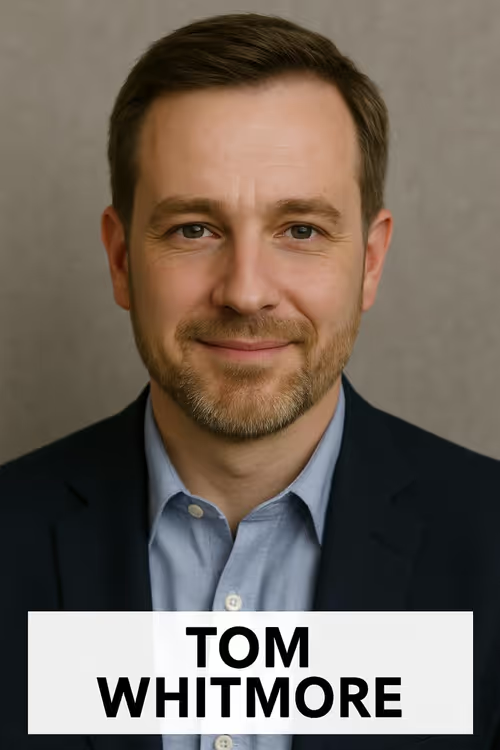
Written by
Tom Whitmore
Senior correspondent · Real Estate & Private Companies
Tom has interviewed most of the operators reshaping the Gulf skyline — and a few of the ones who tried and didn't. His beat is real estate, commodities, manufacturing, and the founder-led private companies that never bother to list. He knows which buildings and balance sheets survive a downturn before the spreadsheet does. Based in Dubai. Reach out at tom.whitmore@theplatinumcapital.com.