

Riyadh's Commercial Property Market and Vision 2030
Riyadh's commercial property market is experiencing unprecedented demand as multinational corporations establish regional headquarters in the Saudi capital, driven by government mandates and generous incentive packages that have fundamentally reshaped the competitive landscape of Gulf real estate. With Vision 2030 catalysing more than $100 billion in planned mega-developments and infrastructure projects, the city is rapidly positioning itself as the Middle East's preeminent business hub, though questions around oversupply and absorption rates will ultimately determine whether valuations can sustain their current trajectory.…
Riyadh's Commercial Property Market Reaches Inflection Point as Vision 2030 Enters Critical Phase
The Saudi capital's Grade A office vacancy rate has fallen below 2 per cent. Rental prices for premium commercial space in the King Abdullah Financial District have surged more than 30 per cent since 2023. International corporations, compelled by the kingdom's regional headquarters mandate, are fighting over a finite supply of institutional-quality floor plates in a city that is simultaneously trying to reinvent itself as a global business hub. Riyadh's commercial property market in 2026 comes down to one extraordinary tension: demand that far outstrips the capacity of developers to deliver.
The Regional Headquarters Effect
When Saudi Arabia announced in 2021 that foreign companies would need to establish regional headquarters in the kingdom by January 2024 to qualify for government contracts, sceptics questioned enforcement. Those doubts have been decisively answered. By early 2026, more than 540 multinational companies have relocated or established substantial regional headquarters operations in Riyadh, according to the Royal Commission for Riyadh City. The list includes PwC, Deloitte, Baker Hughes, Unilever, and SAP — firms that have moved not merely brass plates but senior decision-makers and operational teams.
The effect on commercial real estate has been transformative. Knight Frank's 2026 Saudi Arabia market report recorded prime office rents in Riyadh at SAR 2,400 per square metre — a figure that would have seemed implausible five years ago. CBRE estimates that Riyadh requires an additional 3 million square metres of commercial office space by 2030 to absorb projected demand. The pipeline, while substantial, remains insufficient. Roughly 1.8 million square metres of new supply is under construction or in advanced planning, leaving a structural deficit that keeps pushing rents upward.
Mega-Projects and the Reshaping of Supply
The kingdom's response to this supply crunch is characteristically ambitious. The Public Investment Fund, Saudi Arabia's $930 billion sovereign wealth vehicle, is deploying capital across several transformational developments that will fundamentally alter Riyadh's commercial geography. King Salman Park, a 16-square-kilometre development in the city's centre, includes substantial mixed-use commercial components expected to deliver initial phases from 2027. The New Murabba project, anchored by the 400-metre cubic structure known as the Mukaab, will add approximately 104,000 square metres of premium commercial space to the market upon completion.
ROSHN, the PIF-backed real estate developer, has expanded beyond its residential mandate into mixed-use developments that incorporate commercial elements designed to serve Riyadh's growing suburban business districts. Diriyah Gate Company, meanwhile, continues construction on the $63 billion Diriyah project, which includes boutique commercial and hospitality-adjacent office offerings targeting luxury brands and family office operations.
Private developers are responding too. Olayan Saudi Holding Company has committed to expanding its commercial portfolio in the northern corridor, while the Fawaz Alhokair Group has pivoted portions of its retail-oriented portfolio toward mixed-use commercial configurations. Saudi-listed developer Dar Al Arkan reported a 41 per cent increase in revenue for 2025, driven partly by commercial project sales in the Riyadh metropolitan area.
Family Offices and Private Wealth Enter the Market
The most striking shift in Riyadh's commercial property market during 2025-2026 has been the arrival of Gulf-based and international family offices as direct investors. That is a significant shift. Traditionally, Saudi commercial real estate was dominated by domestic conglomerates and sovereign-linked entities. That profile is changing fast.
Emirati and Kuwaiti family offices have been particularly active. Abu Dhabi-based Multiply Group acquired a minority stake in a Riyadh office development during Q4 2025, while several Kuwaiti family offices — operating through locally licensed vehicles — have taken positions in income-generating commercial assets along King Fahd Road and the Olaya district. Savills reported that cross-border capital flows into Saudi commercial real estate reached $4.2 billion in 2025, a threefold increase from 2022. Few outside the region have noticed.
The appeal is straightforward: institutional-quality yields in Riyadh's prime office segment are running between 7 and 8.5 per cent, well above comparable assets in Dubai (5.5-6.5 per cent) and comfortably ahead of London or Singapore. For family offices seeking real asset diversification with meaningful income returns, Riyadh offers a rare combination of yield compression potential and rental growth trajectory.
The Capital Market Authority's liberalisation of real estate investment trust regulations has helped accelerate this trend. Riyad REIT and Jadwa REIT Saudi expanded their commercial portfolios during 2025, providing listed vehicles through which international private wealth can gain Saudi commercial exposure without direct ownership complexities.
Infrastructure and the Liveability Question
Commercial property markets do not operate in isolation. Riyadh's capacity to sustain its current growth trajectory depends on whether the city can simultaneously solve its liveability deficit for the expatriate professionals these corporations are importing. Progress here has been uneven but measurable.
The Riyadh Metro, with six lines spanning 176 kilometres, commenced phased public operations in late 2025 after years of delays. Full operational capacity across all lines is anticipated by mid-2027. For commercial landlords, proximity to metro stations has become a meaningful rental premium driver — CBRE recorded a 12-15 per cent rental uplift for office buildings within 500 metres of operational stations.
Entertainment and social infrastructure — once Riyadh's most conspicuous weakness for international talent — has improved materially. The Qiddiya entertainment mega-project outside Riyadh is on track for initial openings in 2027, while the city now hosts regular international sporting events, concerts, and cultural programming that would have been unthinkable a decade ago. The General Entertainment Authority reported that Riyadh hosted over 7,500 licensed entertainment events in 2025.
Risks and the Question of Sustainability
Euphoria, however, deserves tempering. Riyadh's commercial market carries identifiable risks that sophisticated investors are pricing carefully. Oil revenue remains the ultimate underwriter of Vision 2030's ambitions. Brent crude is trading in the mid-$70s per barrel range in early 2026 — below the estimated fiscal breakeven of approximately $90 — and the kingdom is running budget deficits that, while manageable given sovereign reserves, constrain the pace of public spending.
Then there's the question of whether current rental growth is sustainable or whether the substantial supply pipeline will eventually trigger an overcorrection. JLL's 2026 outlook projects that Riyadh office rents may plateau in 2028-2029 as major new developments reach completion, potentially compressing yields for investors who entered at peak pricing. That should give some buyers pause.
Execution risk across mega-projects remains real. Several Vision 2030 developments have been rescoped or delayed, including elements of NEOM. Investors are increasingly distinguishing between projects with clear delivery timelines and those that remain aspirational. The market is maturing, and with maturity comes selectivity.
For now, the fundamentals remain compelling. A city of 7.6 million growing toward a target population of 15 million, backed by sovereign capital commitment measured in hundreds of billions of dollars, with structural demand drivers embedded in regulatory mandates — Riyadh's commercial property market is not a speculative bet. It is a once-in-a-generation urbanisation programme where the principal risk may be underestimating the scale of what is already underway.
Tom Whitmore is a senior journalist at The Platinum Capital covering real estate and Gulf capital markets.
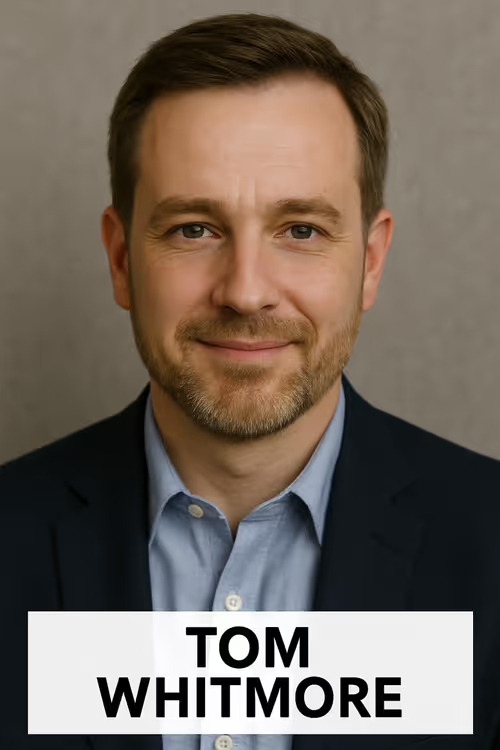
Written by
Tom Whitmore
Senior correspondent · Real Estate & Private Companies
Tom has interviewed most of the operators reshaping the Gulf skyline — and a few of the ones who tried and didn't. His beat is real estate, commodities, manufacturing, and the founder-led private companies that never bother to list. He knows which buildings and balance sheets survive a downturn before the spreadsheet does. Based in Dubai. Reach out at tom.whitmore@theplatinumcapital.com.