

Dubai's Luxury Real Estate Boom: Who Is Really Buying
Dubai's luxury property market has surged to unprecedented heights, with transactions above the ten million dollar threshold more than tripling since 2021, driven largely by an influx of ultra-high-net-worth individuals from Russia, India, and Western Europe seeking tax efficiency, residency pathways, and geopolitical insulation for their capital. Yet behind the headline-grabbing penthouse sales lies a more complex picture of shell company acquisitions, fractional ownership structures, and sovereign wealth fund activity that obscures the true beneficial ownership reshaping the emirate's glittering skyline.…
Dubai's Luxury Real Estate Boom: Who Is Really Buying
In the first quarter of 2026, Dubai recorded over AED 120 billion in real estate transactions — a figure that would have seemed fantastical a decade ago. But behind the headline numbers lies a more nuanced story, one defined not by speculative excess, as critics often suggest, but by a structural shift in who holds wealth globally and where they choose to park it. The emirate's luxury property market, particularly transactions above the AED 15 million threshold, has become a mirror reflecting the redistribution of private capital from East to West, from old money to new, and from traditional financial centres to jurisdictions that offer something legacy markets increasingly cannot: frictionless access and fiscal neutrality.
The Gulf Capital Recycling Machine
The most significant — and often underreported — driver of Dubai's luxury property surge is intra-Gulf capital reallocation. Saudi nationals have emerged as the single largest group of Arab buyers in the emirate's prime residential segment, accounting for an estimated 18% of all transactions above AED 20 million in 2025, according to data compiled by Property Monitor. That is a significant shift. And the trend has only intensified in early 2026, propelled by two forces: the maturation of Saudi Arabia's own Vision 2030 reforms, which have generated substantial private-sector wealth, and the pragmatic recognition among Saudi family offices that Dubai offers portfolio diversification with geographic proximity.
Emaar Properties, which dominates Dubai's branded residency pipeline, reported that Gulf Cooperation Council nationals represented 31% of its ultra-premium sales in Q4 2025, up from 22% the previous year. The company's Address Residences Dubai Opera and the forthcoming The Heights Country Club development have both drawn heavy uptake from Kuwaiti and Bahraini buyers seeking second homes and investment-grade assets. DAMAC Properties, led by Hussain Sajwani, has similarly flagged a sharp rise in Qatari and Omani purchasers for its Cavalli-branded towers on the Dubai Canal.
What distinguishes this wave from earlier cycles is intent. These are not flippers. Property Monitor's 2026 analysis shows that average hold periods for GCC buyers in Dubai's luxury segment now exceed 5.7 years, compared with 2.3 years during the 2013–2014 boom. This is wealth preservation capital, not speculation.
The Indian Ultra-High-Net-Worth Corridor
Indian nationals have topped Dubai's overall buyer nationality rankings for several consecutive years, but the composition of Indian capital flowing into the emirate has shifted decisively upmarket. In 2025, Indian buyers accounted for approximately AED 30 billion in total property transactions, per Dubai Land Department figures, with a growing share concentrated in the AED 10 million-plus bracket.
The catalyst is structural. India's Liberalised Remittance Scheme permits individuals to transfer up to $250,000 annually, and affluent Indians have increasingly used it to build offshore real estate portfolios. But the true high-end activity comes from Indian family offices and entrepreneurs who have established UAE residency — a cohort Knight Frank estimates at over 6,500 families with investable assets exceeding $10 million each. Few outside the region have noticed just how large this pipeline has become.
Sobha Realty, founded by Indian billionaire P.N.C. Menon, has become a direct beneficiary of this corridor. Its Sobha Hartland II development on the Mohammed Bin Rashid Al Maktoum City has attracted significant Indian HNW demand, and the company reported revenue of AED 7.8 billion in 2025 — a 40% year-on-year increase — with Indian-origin buyers comprising a substantial portion of its premium villa sales.
Russian and CIS Capital: Still Present, More Discreet
The narrative around Russian money in Dubai has become politically fraught, but the data tells a clear story. Russian and CIS-origin buyers remain a measurable force in the luxury segment, though their purchasing patterns have evolved considerably since the initial post-2022 surge. According to Betterhomes' 2026 market intelligence report, Russian-speaking buyers accounted for approximately 9% of luxury transactions in Palm Jumeirah and Emirates Hills during 2025, down from a peak of nearly 15% in late 2022 but still well above pre-conflict levels.
The shift is toward discretion and corporate structuring. A growing proportion of these transactions run through UAE-domiciled holding entities or family office vehicles, making precise attribution difficult. Compliance frameworks have tightened — the UAE's Financial Intelligence Unit processed over 7,400 suspicious transaction reports in 2025, a threefold increase from 2021 — but the jurisdiction maintains its position that legitimate capital is welcome regardless of origin.
Luxury developers have adapted accordingly. Omniyat, the boutique developer behind the Dorchester Collection residences and the Alba tower on Palm Jumeirah, has implemented enhanced due diligence protocols while continuing to court CIS wealth through private viewings in Istanbul and Tbilisi — cities that have become secondary hubs for relocated Russian capital.
Family Offices and the Institutional Creep
Perhaps the most consequential trend is the entry of multi-family offices and quasi-institutional private wealth vehicles into Dubai's residential market. The Dubai International Financial Centre reported that over 120 single-family offices registered in the free zone during 2025 alone, bringing the total to approximately 540. A significant proportion of these entities — predominantly serving European, South Asian, and African principals — have allocated between 15% and 25% of their portfolios to UAE real estate, according to a survey conducted by Henley & Partners in partnership with the DIFC.
These offices are not buying penthouses for personal use. They are assembling portfolios of two to eight premium units, often across multiple developments, managed as yield-generating assets with potential residency utility. The Dubai golden visa programme, which grants 10-year residency to property investors meeting the AED 2 million threshold, has become a strategic tool rather than merely a lifestyle perk.
Then there is the institutional signal. Brookfield Asset Management entered Dubai's residential development pipeline in 2025 through a joint venture with Meraas. The venture's initial project — a 200-unit ultra-premium development on Bluewaters Island — was 60% sold within eight weeks of launch, predominantly to family office buyers from sub-Saharan Africa and Southeast Asia. That kind of velocity turns heads, and it tells traditional gateway market incumbents that the competitive map has been redrawn.
What the Buyer Profile Reveals About Dubai's Trajectory
Strip away the glossy marketing and the buyer composition of Dubai's luxury market reveals something the emirate's leadership has engineered deliberately: a city that functions as a wealth convergence point for the non-Western world. The typical buyer of an AED 25 million property in Dubai in 2026 is not a Wall Street financier or a London hedge fund manager. It is a Lahore-based industrialist, a Lagos-based energy executive, a Riyadh-based family office principal, or a Nairobi-based tech entrepreneur — individuals for whom London's regulatory burden, Singapore's foreign ownership restrictions, and New York's tax obligations represent friction that Dubai has systematically eliminated.
The risk, naturally, is concentration. Dubai's luxury segment is now deeply exposed to geopolitical and regulatory shifts across a dozen source markets simultaneously. A tightening of India's capital controls, a reversal in Saudi outbound investment policy, or intensified international pressure on UAE compliance standards could each independently cool the market. But for now, the capital keeps arriving — not because Dubai is fashionable, but because for a growing class of globally mobile wealth holders, it is simply the most rational choice available.
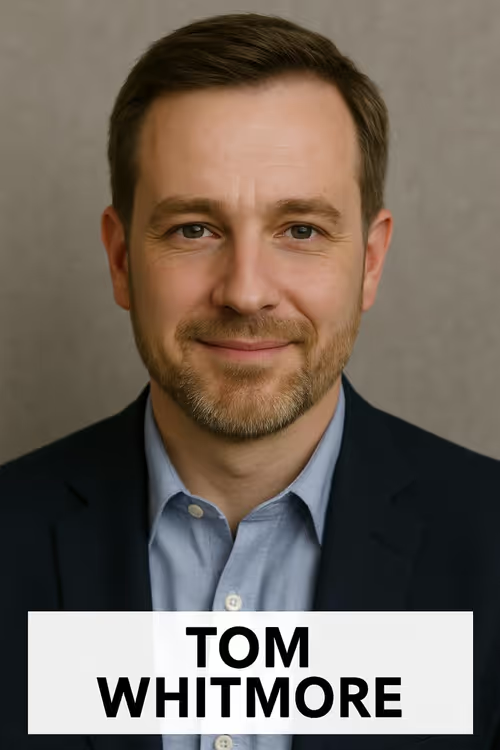
Written by
Tom Whitmore
Senior correspondent · Real Estate & Private Companies
Tom has interviewed most of the operators reshaping the Gulf skyline — and a few of the ones who tried and didn't. His beat is real estate, commodities, manufacturing, and the founder-led private companies that never bother to list. He knows which buildings and balance sheets survive a downturn before the spreadsheet does. Based in Dubai. Reach out at tom.whitmore@theplatinumcapital.com.