

Family Offices and the Shift Toward Alternative Investments
Family offices worldwide are accelerating their migration away from traditional equity and bond portfolios, channeling unprecedented allocations into private equity, real assets and venture capital in pursuit of uncorrelated returns and generational wealth preservation. This structural reallocation, now accounting for nearly half of typical family office portfolios, is fundamentally reshaping capital flows and conferring on these private institutions an outsized influence over markets once dominated by institutional giants.…
The Quiet Revolution in Family Office Portfolios
When the Abu Dhabi-based Al Fahim Group disclosed in February 2026 that it had shifted 62 percent of its investable assets into alternative strategies — up from 41 percent just three years prior — it wasn't just one family making a bold bet. It was a signal. Across the world's wealthiest dynasties, a structural reorientation is underway, redirecting capital flows into private equity, real estate, infrastructure, and venture capital at a speed that has few historical precedents.
The numbers back it up. The 2026 Global Family Office Report published by UBS in March found that family offices worldwide now allocate an average of 52 percent of their portfolios to alternatives, overtaking traditional equity and fixed-income holdings for the first time in the survey's history. The shift runs deepest in the Gulf Cooperation Council states and across emerging markets in Southeast Asia and Africa, where new wealth creation and sovereign ambition are converging to produce a distinctive class of institutional-grade private investors.
Gulf Family Offices Lead the Charge
The Gulf region sits at the epicenter of this transformation. Dubai alone counted more than 1,100 registered single-family offices by Q1 2026, according to figures from the Dubai International Financial Centre — a 38 percent jump from 2024. The emirate's regulatory framework, particularly the DIFC's dedicated family office regime introduced in late 2023, has pulled in ultra-high-net-worth families from Saudi Arabia, Egypt, India, and Central Asia. Few outside the region have noticed just how fast this buildup has been.
Saudi Arabia's own family office ecosystem is expanding rapidly under the National Investment Strategy. The Olayan Group, one of the kingdom's most established conglomerates, reportedly committed $2.4 billion to private credit and infrastructure funds in 2025, with a particular focus on logistics assets linked to NEOM and the Red Sea development corridor. The Dallah Albaraka Group, meanwhile, has been building positions in Shariah-compliant private equity vehicles targeting healthcare and education across the MENA region.
Here's what matters most: these families are no longer passive limited partners. Jameel Investment Management, the investment arm of the Abdul Latif Jameel family, has been co-investing directly alongside firms like General Atlantic and KKR in growth-stage technology companies across the Middle East and South Asia. That is a significant shift. This move toward direct and co-investment models is compressing fee structures and handing family offices greater control — a trend that Preqin estimates now accounts for 29 percent of all family office alternative allocations globally.
Private Credit and Infrastructure: The New Core Holdings
Within the alternatives bucket, the most striking migration has been toward private credit and real assets. Central banks in the United States and Europe have maintained interest rates above 4 percent through early 2026. Public credit spreads offer limited compensation for risk. Family offices have responded by chasing yields in direct lending, mezzanine financing, and asset-backed strategies.
Apollo Global Management reported in its January 2026 investor update that family office commitments to its credit funds rose 44 percent year-on-year, with particularly strong inflows from Middle Eastern and Asian families. Ares Management told a similar story, noting that its $3.8 billion fundraise for its latest European direct lending vehicle drew nearly a fifth of its capital from family offices — a record proportion.
Infrastructure has also become a core allocation. The energy transition, digital infrastructure buildout, and supply chain reconfiguration have created a pipeline of projects that offer inflation protection and long-duration cash flows — precisely the characteristics that multigenerational wealth holders prize. Singapore's Temasek-linked family offices and Hong Kong-based dynasties have been particularly active in data center investments across Southeast Asia, while Gulf families have committed significant capital to renewable energy projects in Morocco, Egypt, and Uzbekistan through platforms like ACWA Power and Masdar.
Emerging Market Families: From Operators to Allocators
A parallel development is playing out in emerging markets, where first-generation and second-generation entrepreneurs are professionalizing their wealth management. In India, the surge of IPO-driven liquidity — Bombay Stock Exchange data shows 87 companies raised over $18 billion in 2025 — has minted a new cohort of families sitting on $500 million or more in liquid assets and hungry for diversification beyond domestic equities.
Firms like Waterfield Advisors and 360 ONE WAM (formerly IIFL Wealth) have reported substantial increases in alternative investment mandates from Indian family offices. Azim Premji's PremjiInvest has expanded its venture and growth equity portfolio to more than 45 active positions, with recent bets on climate technology and artificial intelligence infrastructure. The Burman family, majority shareholders of Dabur, has channelled capital through its Burman Holdings vehicle into global private equity and direct real estate in London and Dubai.
In Africa, Nigeria's Dangote family and South Africa's Oppenheimer family through Tana Africa Capital have been anchoring private equity strategies that blend financial returns with regional development objectives. The African Development Bank estimates that family office capital deployed on the continent reached $7.2 billion in 2025. That figure remains modest by global standards, but it represents a tripling from 2020.
Governance, Talent, and the Institutional Imperative
The rush into alternatives has exposed a glaring gap: governance and talent. Running a sophisticated alternatives portfolio demands investment professionals with private equity, credit analysis, and operational due diligence capabilities that many family offices simply never had. A 2026 survey by Campden Wealth found that 61 percent of family offices with more than $1 billion in assets had hired at least one senior investment professional from a bulge-bracket bank or private equity firm in the preceding 18 months.
The governance challenge is just as pressing. Unlike institutional investors with established investment committees and risk frameworks, many family offices — particularly in the Gulf and Asia — are still formalizing decision-making structures. The risk of concentration, illiquidity mismatch, and inadequate due diligence is real and growing. The collapse of several mid-market private credit funds in late 2025, which caught a number of family offices without sufficient workout expertise, served as a pointed reminder: alternatives demand institutional discipline, not merely institutional ambition.
One thing is clear. This reallocation is structural, not cyclical. Family offices are not temporarily parking capital in alternatives while waiting for public markets to cheapen. They are building permanent allocations rooted in a fundamental conviction: the most compelling risk-adjusted returns over the next decade will come from private markets, real assets, and direct ownership. The families with the infrastructure to access them will compound their advantage over those that remain tethered to traditional portfolios. The gap, once it opens, will be hard to close.
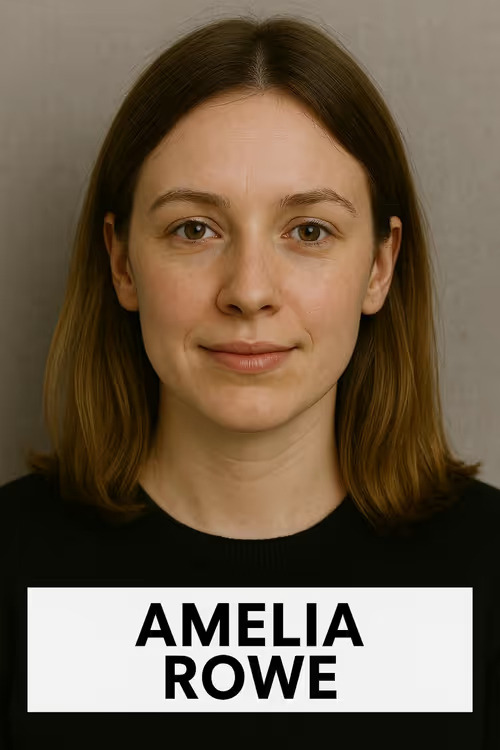
Amelia Rowe is a senior journalist at The Platinum Capital covering family offices, private wealth, and alternative investments.
Written by
Amelia Rowe
Senior correspondent · Banking & Economy
Amelia spent eight years inside a sovereign wealth fund before deciding she'd rather write about institutional money than allocate it. She covers central banking, insurance, and the macro decisions that quietly choose which markets get the next decade. Sharp on monetary policy; impatient with anyone who confuses noise with signal. Based in London. Reach out at amelia.rowe@theplatinumcapital.com.