

Family Offices and the Shift Toward Alternative Investments
Family offices worldwide are accelerating their migration away from traditional equity and fixed-income portfolios, channeling unprecedented allocations into private equity, venture capital, real estate and infrastructure assets in pursuit of uncorrelated returns and long-term wealth preservation. This structural rebalancing, driven by persistent inflation concerns and diminished confidence in public market valuations, is fundamentally reshaping capital flows and granting family offices outsized influence in markets once dominated by institutional heavyweights.…
The Quiet Revolution in Family Office Portfolios
When the Abu Dhabi-based Al Fahim Group disclosed in February 2026 that it had moved 58 percent of its family office assets into alternative investments — up from 34 percent just three years earlier — it was not an anomaly. It was a signal. Across the Gulf, Southeast Asia, and Latin America, ultra-wealthy families are executing the most aggressive portfolio rebalancing in a generation, turning sharply away from public equities and fixed income toward private equity, real assets, venture capital, and digital infrastructure.
The shift is structural, not cyclical. The 2026 UBS Global Family Office Report puts the average allocation to alternatives among single-family offices worldwide at 52 percent as of the first quarter of 2026 — surpassing traditional asset classes for the first time in the survey's history. In the Gulf Cooperation Council states, that figure hit 61 percent, propelled by sovereign ambition, demographic change, and a deep skepticism toward the volatility of listed markets after the corrections of 2022 and 2025.
The Gulf as Ground Zero for Alternative Allocation
The Gulf region sits at the epicenter of this transformation. Saudi Arabia's Vision 2030 programme has produced a generation of family offices that see themselves less as passive custodians of inherited wealth and more as active capital deployers working alongside sovereign wealth funds. The Olayan Group, one of the kingdom's most established family conglomerates, confirmed in its March 2026 investor update that its family office arm had committed $2.4 billion to co-investment vehicles with the Public Investment Fund, targeting logistics, healthcare, and entertainment infrastructure within NEOM and the Riyadh metro expansion. That is not wealth preservation. That is nation-building with a private chequebook.
In the UAE, DIFC-registered family offices grew to 540 by the end of Q1 2026, a 40 percent increase from 2024, according to the Dubai International Financial Centre Authority. Many of these entities are first-generation wealth holders from India, Pakistan, and sub-Saharan Africa who relocated to Dubai specifically to access alternative deal flow. Ravi Bhagchandka, whose Mumbai-founded sports media empire now operates through a DIFC family office, told The Platinum Capital that "the thesis is simple — listed markets give you returns, but private markets give you control, and control is what families want across generations."
Qatar's Al Masah Capital reported in January 2026 that its family office advisory division had facilitated $780 million in alternative commitments during 2025, with the bulk flowing into Middle Eastern and North African private credit — a sector that barely existed in the region five years ago. Few outside the region have noticed. Private credit funds targeting GCC borrowers now manage an estimated $14 billion in aggregate, according to Preqin data, filling a gap left by conservative regional banks.
Emerging Market Families Rewrite the Playbook
The pattern stretches well beyond the Gulf. In Singapore, the Monetary Authority reported 1,650 licensed family offices operating as of December 2025, many of them Chinese and Indonesian in origin. The Hartono family, Indonesia's wealthiest, expanded the mandate of its Singapore-based office in late 2025 to include direct investments in Southeast Asian data centres, committing approximately $600 million to a joint venture with Digital Edge, the KKR-backed platform operator.
Brazilian family offices have been just as aggressive. Vinci Partners, the São Paulo-based alternative asset manager, raised $1.1 billion for its sixth private equity fund in January 2026, with roughly 45 percent sourced from Latin American family offices — a record proportion. Gilberto Sayão, Vinci's co-founder, said Brazilian families are "recalibrating their risk appetite" after years of holding government bonds yielding double digits, recognising that real returns on fixed income have compressed as the Selic rate declined to 10.75 percent.
In Africa, the Chandaria family office in Nairobi has committed $150 million to a pan-African venture fund targeting fintech and agritech startups, partnering with Partech Africa for deal sourcing. The move reflects a broader trend: African family offices, long constrained by limited local fund infrastructure, are now building bespoke vehicles to deploy capital on the continent rather than defaulting to London or New York managers. That is a significant shift.
What Alternatives Are They Buying?
The composition of alternative allocations has changed meaningfully. Private equity remains the largest single category — accounting for 22 percent of total family office assets globally, per UBS — but the fastest-growing segments in 2025-2026 have been private credit, real asset infrastructure, and venture capital.
Private credit has been the standout. With banks globally retrenching under Basel III endgame rules and higher capital requirements, family offices have stepped in as direct lenders. Ares Management reported in its Q4 2025 earnings call that family office capital now makes up 18 percent of its global direct lending fund commitments, up from 11 percent in 2023. The appeal is straightforward: floating-rate returns of 10 to 13 percent with senior secured protections offer a compelling risk-adjusted profile compared with high-yield bonds.
Infrastructure ranks as the second major theme. The energy transition, digital connectivity, and urbanisation in emerging markets have created a multi-trillion-dollar investment gap that governments cannot fill alone. Brookfield Asset Management's latest infrastructure fund, which closed at $30 billion in November 2025, drew approximately $4.2 billion from family offices and private wealth channels — a record for the firm. Gulf-based families have shown particular appetite for renewable energy projects in India and Egypt, where sovereign guarantees and long-term power purchase agreements reduce execution risk.
Venture capital, despite a bruising global correction in startup valuations through 2023-2024, has regained favour. Family offices are increasingly bypassing traditional VC funds in favour of direct investments, particularly in artificial intelligence infrastructure. Mubadala-linked family offices in Abu Dhabi reportedly participated in three AI-related Series B and C rounds in Q1 2026 alone, including a $200 million commitment to a Saudi-incorporated large language model company backed by SDAIA, the kingdom's data and AI authority. The line between sovereign capital and family capital in the Gulf is getting thinner by the quarter.
Governance and the Generational Imperative
Behind the allocation shift lies a deeper transformation in how family offices actually run themselves. The next generation of family principals — often Western-educated, technology-fluent, and more globally connected than their parents — are demanding institutional-grade operations. Deloitte's 2026 Family Office Governance Survey found that 67 percent of GCC-based family offices have hired at least one CFA or CAIA charterholder in the past two years, and 41 percent now employ a dedicated chief investment officer, up from 19 percent in 2021.
This professionalisation matters because portfolios have grown far more complex. Illiquid alternatives require rigorous cash-flow modelling, J-curve management, and vintage-year diversification — disciplines that were rare in family offices a decade ago. Firms like Eton Solutions, whose AtlasFive platform now serves over 350 family offices globally, have seen subscription revenues grow 60 percent year-on-year as families demand consolidated reporting across private and public holdings.
The stakes are enormous. The global transfer of wealth from baby boomers to their heirs — estimated by Cerulli Associates at $84 trillion over the next two decades — will be mediated largely through family office structures. How these entities allocate capital will shape private markets, emerging economies, and the broader architecture of global finance for years to come. The era of the family office as a passive bond-clipping operation is over. What has replaced it is something far more ambitious, and far more consequential.
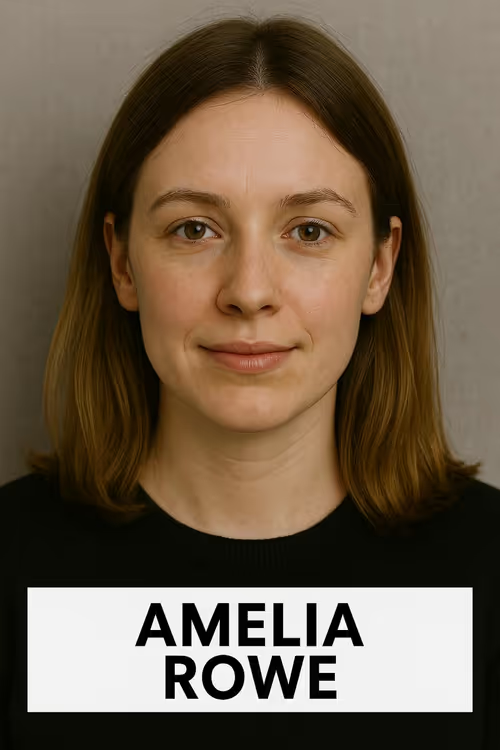
Amelia Rowe is a senior journalist at The Platinum Capital covering family offices, private wealth, and alternative investments.
Written by
Amelia Rowe
Senior correspondent · Banking & Economy
Amelia spent eight years inside a sovereign wealth fund before deciding she'd rather write about institutional money than allocate it. She covers central banking, insurance, and the macro decisions that quietly choose which markets get the next decade. Sharp on monetary policy; impatient with anyone who confuses noise with signal. Based in London. Reach out at amelia.rowe@theplatinumcapital.com.