

Family Offices and the Shift Toward Alternative Investments
Family offices worldwide are accelerating their exodus from traditional equity and fixed-income portfolios, channeling unprecedented capital into private equity, venture capital, and real assets as they pursue uncorrelated returns and generational wealth preservation. This structural reallocation, now accounting for nearly half of total family office assets under management, is fundamentally reshaping private capital markets and granting these ultra-wealthy stewards outsized influence over deal flow once dominated by institutional investors.…
The Quiet Revolution in Family Office Portfolios
When the Al Fahim family office in Abu Dhabi disclosed earlier this year that it had shifted 62% of its total portfolio into alternative investments — up from 38% just three years ago — it was not an outlier. It was a signal. Across the Gulf, Southeast Asia, and Latin America, family offices are executing one of the most significant asset allocation pivots in a generation, moving decisively away from traditional equity-bond portfolios toward private equity, real assets, venture capital, and infrastructure.
This isn't a tactical tweak. It reflects a structural rethinking of how dynastic wealth should be preserved, deployed, and grown in an era defined by persistent inflation, geopolitical fragmentation, and the declining reliability of public market returns. According to the 2026 UBS Global Family Office Report, alternative investments now constitute 52% of the average family office portfolio worldwide, up from 45% in 2023. Among Gulf-based family offices, that figure reaches 58%.
The Gulf as Ground Zero for the Alternatives Push
Nowhere is this transformation more pronounced than in the six nations of the Gulf Cooperation Council. Saudi Arabia's Vision 2030 programme and the UAE's aggressive economic diversification have created a fertile environment for private capital deployment. Family offices in Riyadh, Dubai, and Doha aren't just allocating to alternatives — they're building dedicated teams to source, evaluate, and manage direct investments.
The Olayan Group, one of the Gulf's oldest and most respected family enterprises, expanded its private equity division in early 2026, hiring twelve investment professionals from Goldman Sachs and Mubadala to focus exclusively on mid-market buyouts across the MENA region. The Mansour Group in Egypt, meanwhile, has committed approximately $400 million to infrastructure projects in East Africa, including logistics hubs in Kenya and Tanzania that complement its existing distribution businesses.
Dubai's emergence as a global family office hub has thrown fuel on the trend. The Dubai International Financial Centre reported in March 2026 that it now hosts over 540 registered single-family offices, a 35% increase from 2024. Many of these entities are relocating from Geneva, London, and Singapore, drawn by favourable tax treatment, regulatory clarity under the DIFC's dedicated family office framework, and proximity to deal flow across the Middle East, Africa, and South Asia. Few outside the region have noticed just how fast this migration is happening.
Abdulrahman Al Rashid, head of the family office advisory practice at Deloitte Middle East, put it bluntly during a February panel in Riyadh: "The 60/40 portfolio is dead for this client base. These families are thinking in decades, not quarters, and they want assets they can touch, influence, and pass to the next generation."
Private Credit and Infrastructure Take Centre Stage
Within the alternatives bucket, two asset classes have attracted disproportionate attention in 2026: private credit and infrastructure. The global private credit market, which Preqin estimates reached $2.1 trillion in assets under management by the end of Q1 2026, has become a go-to allocation for family offices seeking yield without the volatility of public fixed income.
Mumtalakat, Bahrain's sovereign wealth fund, partnered with three prominent Bahraini family offices in January to launch a $600 million private credit vehicle targeting mid-market lending opportunities across the GCC. The fund, managed by Investcorp, offers family office co-investors access to senior secured loans at spreads of 500-650 basis points over SOFR — returns that dwarf what's available in investment-grade bond markets. That kind of premium gets attention.
Infrastructure, particularly in energy transition and digital connectivity, has become another magnet. India's Godrej family office allocated $250 million to renewable energy projects in Maharashtra and Gujarat during the first half of 2026, while Mexico's Grupo Bal increased its infrastructure exposure to 22% of total family office assets, focusing on toll roads and water treatment facilities in central Mexico. Patient, inflation-linked cash flows — precisely the characteristics that multi-generational wealth holders prize.
Venture Capital: A Generational Bridge
The surge in venture capital allocations tells a different but related story. For many family offices, VC investments serve a dual purpose: generating outsized returns and engaging the next generation of family members in portfolio governance. The 2026 Campden Wealth Global Family Office Report found that 34% of family offices globally now allocate to venture capital, up from 24% in 2021, with the average commitment rising to $45 million.
In the Gulf, this trend has taken on particular momentum. Saudi Arabia's MISK Foundation, established by Crown Prince Mohammed bin Salman, has catalysed a broader ecosystem of family office venture investment, with families such as the Bin Laden Group and the Zamil family backing early-stage technology companies through dedicated vehicles. Turkey's Sabancı family office launched a $150 million venture fund in April 2026 targeting fintech and healthtech startups across Turkey, Egypt, and Pakistan — markets where demographics and digital adoption create compelling growth dynamics.
The generational dimension matters more than most observers appreciate. A survey by JP Morgan Private Bank, published in May 2026, found that 71% of next-generation family office principals — those aged 25 to 40 — ranked venture capital as their preferred asset class, compared with just 29% of the founding generation. That is a significant shift. This divergence is reshaping investment committee dynamics and, in many cases, speeding up the alternatives transition.
Risks, Governance, and the Road Ahead
The pivot is not without peril. Alternative investments carry liquidity risk, valuation opacity, and operational complexity that traditional portfolios simply don't. The collapse of several mid-tier private equity funds in Southeast Asia during late 2025, which trapped approximately $1.8 billion in investor capital including significant family office money, served as a harsh reminder: alternatives demand rigorous due diligence and real governance infrastructure. Enthusiasm alone won't cut it.
Family offices that have managed the transition most successfully tend to share certain characteristics: dedicated investment professionals with institutional backgrounds, formal investment committees with independent members, and clear co-investment frameworks that avoid concentration risk. The Mittal family's Amic Group, based in London and Delhi, is frequently cited as a model — it employs 28 investment professionals, maintains a formal risk committee, and caps any single alternative investment at 4% of total portfolio value.
The direction of travel is unmistakable. As public markets grow more volatile and yields on traditional fixed income remain compressed relative to inflation in many emerging economies, family offices will keep deepening their commitment to alternatives. The families that build institutional-grade capabilities around this shift will likely outperform. Those that chase alternatives without the governance to match may discover that illiquidity is a feature only when the underlying assets are sound.
Amelia Rowe is a senior journalist at The Platinum Capital covering private wealth, family offices, and alternative investments.
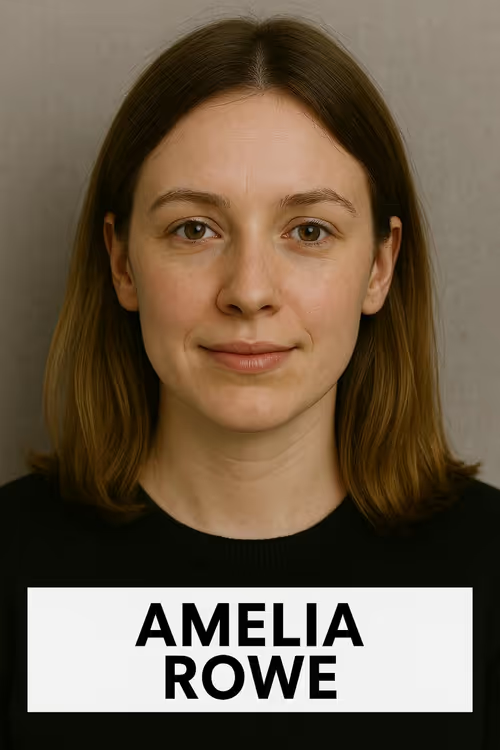
Written by
Amelia Rowe
Senior correspondent · Banking & Economy
Amelia spent eight years inside a sovereign wealth fund before deciding she'd rather write about institutional money than allocate it. She covers central banking, insurance, and the macro decisions that quietly choose which markets get the next decade. Sharp on monetary policy; impatient with anyone who confuses noise with signal. Based in London. Reach out at amelia.rowe@theplatinumcapital.com.