

Build-to-Rent Growth and Its Impact on Housing Markets
The build-to-rent sector has emerged as one of the fastest-growing asset classes in residential real estate, fundamentally reshaping housing supply dynamics as institutional capital flows into purpose-built rental communities at unprecedented scale. This structural shift is redrawing the boundaries between homeownership and tenancy, raising critical questions about affordability, market concentration and whether professionalised landlordism will stabilise housing markets or entrench a permanent renter class.…
The Rental Revolution: How Build-to-Rent Is Reshaping Global Housing Markets
In Dubai's Jumeirah Village Circle, a 1,200-unit residential tower completed in early 2026 will never see a single apartment sold. Every unit belongs to a single institutional owner, purpose-built for long-term renters, managed by a professional operator, and designed to generate steady yield for decades. This is the build-to-rent model — and it is quietly becoming the most consequential force in global housing markets since the post-war suburban expansion.
Build-to-rent (BTR) was, not long ago, a niche strategy confined to a handful of US and UK developers. It has now reached a tipping point. Global institutional capital allocated to the sector surpassed $82 billion in 2025, according to JLL's latest capital flows tracker, and early projections for 2026 suggest that figure could breach $100 billion. The Gulf states, Southeast Asia, and parts of Sub-Saharan Africa are now among the fastest-growing markets — driven by demographic pressure, regulatory reform, and the aggressive appetite of family offices hunting for alternatives to volatile equity markets.
The Gulf Becomes a BTR Powerhouse
The United Arab Emirates has emerged as the most dynamic BTR market outside the Anglo-Saxon world. Aldar Properties, Abu Dhabi's largest listed developer, announced in January 2026 that it would commit AED 4.5 billion ($1.23 billion) to expand its managed rental portfolio to over 9,000 units by 2028, up from approximately 5,500 at the end of 2025. The company's "Liv" branded rental communities, already operational in Yas Island and Saadiyat Grove, have reported occupancy rates above 94 percent. Those figures rival or exceed those of mature BTR operators in London and New York.
Dubai's Nakheel, now fully integrated into the Master Developer portfolio under Dubai Holding, has pivoted a significant portion of its pipeline toward purpose-built rental stock. Three projects totaling 2,800 units in Deira Islands and Jumeirah are scheduled for handover in 2026, all operated under a single management platform with amenity packages — co-working spaces, fitness centres, concierge services — that would feel right at home in a Greystar or Quintain development in London's Wembley Park.
Saudi Arabia is not far behind. The Kingdom's National Housing Company (NHC) has partnered with Japan's Daiwa House Industry and local conglomerate SEDCO Holding to deliver 6,000 BTR units across Riyadh and Jeddah as part of Vision 2030's homeownership and urban density targets. Saudi Arabia's stated goal remains raising homeownership to 70 percent, but officials have privately acknowledged that professionally managed rental stock is essential for the estimated 1.4 million expatriate workers the Kingdom expects to attract over the next five years. That is a telling admission.
Family Offices and Private Wealth Drive Capital Formation
What sets the 2026 BTR cycle apart from earlier iterations is where the money comes from. Institutional investors — pension funds, sovereign wealth vehicles, insurance companies — remain active, but family offices and ultra-high-net-worth individuals are rapidly increasing their allocations. Knight Frank's 2026 Wealth Report found that 31 percent of family offices in the Middle East and 27 percent in Asia-Pacific now hold direct BTR assets, up from 18 percent and 14 percent respectively just two years ago. That is a significant shift.
The appeal is straightforward. BTR generates predictable, inflation-linked income streams with lower correlation to public markets than REITs or listed equities. Gross yields in Dubai's mid-market rental segment sit between 7.2 and 8.5 percent, according to CBRE's Q1 2026 data — comfortably above the 4.5 to 5.5 percent available in London or Berlin. For family offices managing intergenerational wealth, the combination of yield, capital preservation, and currency diversification (particularly into dollar-pegged Gulf currencies) has proven hard to resist.
Singapore-based Mapletree Investments and Hong Kong's Gaw Capital have both raised dedicated BTR vehicles targeting Southeast Asian cities — Ho Chi Minh City, Jakarta, and Manila — where urbanisation rates exceed four percent annually and formal rental housing stock remains chronically undersupplied. Gaw Capital's $650 million Asia Living Fund, which held its final close in late 2025, has already deployed capital into three projects in Vietnam and the Philippines.
Impact on Traditional Housing Markets
BTR's growth is not happening in a vacuum. In markets where institutional rental stock is expanding rapidly, measurable effects on pricing, construction patterns, and consumer behaviour are starting to show. Research published by Oxford Economics in March 2026 found that in UK cities where BTR penetration exceeded 8 percent of total rental stock — Manchester and Birmingham being the primary examples — rent growth moderated by 1.3 to 1.7 percentage points relative to comparable cities with lower BTR presence. The mechanism is simple: professionally managed, high-quality supply competes down rents in the broader market.
In the Gulf, the picture is messier. Dubai's population grew by an estimated 5.8 percent in 2025, and the emirate issued over 120,000 new residence visas in the first nine months of the year alone. BTR supply, while growing, has not yet reached the scale necessary to moderate rent inflation, which averaged 18 percent year-on-year across prime and mid-market segments. Developers argue that without institutional rental construction, the supply deficit would be far worse. Aldar's chief development officer, Rashed Al Omaira, told investors in February that "the for-sale model alone cannot absorb the demand velocity we are seeing across Abu Dhabi and Dubai." He has a point.
Emerging Markets: The Next Frontier
Beyond the Gulf and Asia, BTR capital is beginning to flow into African cities that few institutional investors would have touched five years ago. Lagos, Nairobi, and Accra are attracting early-stage commitments from development finance institutions and private equity firms. Actis, the London-based emerging markets investor, disclosed in its 2026 strategy update that it had committed $180 million to residential rental projects in Nairobi and Lagos, targeting middle-income professionals — a demographic segment growing at roughly 9 percent annually across urban Sub-Saharan Africa. Few outside the region have noticed.
The challenges are formidable. Land title systems remain opaque in many African jurisdictions. Construction costs have risen sharply due to dollar-denominated materials imports. Exit liquidity is uncertain. But the demographic arithmetic is overwhelming. The United Nations projects that Lagos alone will add 10 million residents by 2035. Formal rental housing currently accounts for less than 3 percent of available stock in most Sub-Saharan cities, compared with 15 to 25 percent in mature markets.
A Structural Shift, Not a Cycle
The temptation is to view BTR's expansion as a cyclical trade — capital chasing yield in a particular asset class before rotating elsewhere. The evidence says otherwise. Demographic trends, regulatory reforms favouring institutional landlords, and the professionalisation of property management across emerging markets all point toward a durable structural change. For housing markets long dominated by individual ownership and fragmented landlordism, the consequences — for pricing, for quality, and for the very concept of what it means to have a home — will be profound and lasting.
Tom Whitmore is a senior journalist at The Platinum Capital covering global real estate and housing markets.
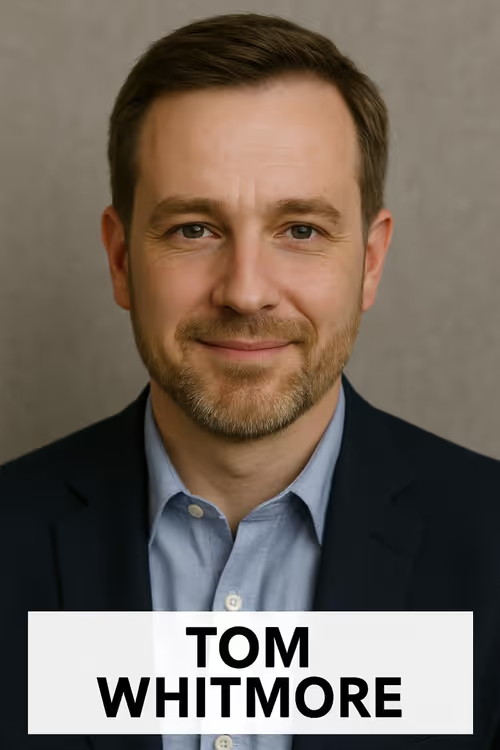
Written by
Tom Whitmore
Senior correspondent · Real Estate & Private Companies
Tom has interviewed most of the operators reshaping the Gulf skyline — and a few of the ones who tried and didn't. His beat is real estate, commodities, manufacturing, and the founder-led private companies that never bother to list. He knows which buildings and balance sheets survive a downturn before the spreadsheet does. Based in Dubai. Reach out at tom.whitmore@theplatinumcapital.com.