

Office Market Restructuring: From Vacancy to Conversion
The office sector faces its most profound structural recalibration in a generation, as persistent vacancy rates in secondary and tertiary buildings force investors and municipalities to confront an uncomfortable truth about permanently diminished demand for traditional workspace. Adaptive reuse and residential conversion pipelines are now reshaping urban land economics, turning what was once considered a cyclical downturn into an irreversible repricing of commercial real estate fundamentals.…
Office Market Restructuring: From Vacancy to Conversion
In downtown Riyadh, a 40-storey office tower that sat half-empty for the better part of three years is being gutted and rebuilt as a mixed-use complex combining luxury residences, a boutique hotel, and co-working floors. The project, backed by a Saudi family office with deep ties to the Kingdom's real estate establishment, is one data point in a much larger story reshaping commercial property markets across the Gulf and beyond: the systematic conversion of obsolete office stock into higher-value assets.
The global office vacancy rate remains stubbornly elevated in 2026. In the United States, Moody's Analytics reported a national office vacancy rate of 20.4 per cent in the first quarter — a record high. Dubai's secondary office stock tells a similar story, with Grade B and C buildings in older districts such as Deira and Bur Dubai registering vacancies above 25 per cent. But within this distress lies a generation-defining investment opportunity. Capital flowing into office-to-residential and office-to-mixed-use conversions is accelerating at a pace few anticipated even 18 months ago.
The Economics of Conversion Over Demolition
The arithmetic underpinning conversion has shifted decisively. Construction costs across the GCC rose approximately 12 per cent between 2023 and 2025, driven by materials inflation and labour market tightness ahead of Saudi Arabia's Vision 2030 mega-projects. Building from scratch has become prohibitively expensive for all but the most capitalised developers. Conversion, by contrast, typically costs 60 to 70 per cent of equivalent new-build, according to estimates from JLL's Middle East research division. That gap changes everything.
Brookfield Asset Management has emerged as a bellwether. The Canadian firm's $2 billion office conversion programme in North America, announced in late 2024, has since expanded to include exploratory projects in Abu Dhabi, where it is working with Mubadala Investment Company on repurposing two commercial towers in the Al Maryah Island financial district. The structures, originally designed for banking tenants who have since consolidated operations, are being assessed for conversion into serviced apartments targeting the emirate's growing population of long-term resident visa holders.
Gaw Capital Partners, the Hong Kong-based private equity firm, has taken a parallel approach in Southeast Asia, committing $450 million to convert underperforming office assets in Bangkok and Kuala Lumpur into co-living and extended-stay hospitality formats. The firm's thesis is blunt: in markets where residential supply remains constrained and young professional populations are expanding, the highest and best use of a 1990s-era office building is almost certainly not as an office.
Gulf Family Offices as First Movers
Private wealth has moved faster than institutional capital in many of these markets. Few outside the region have noticed. The Al Ghurair family's investment arm in Dubai has quietly acquired four ageing office buildings in the Karama and Trade Centre districts over the past 18 months, with conversion plans that include student housing and affordable residential units — segments where demand far outstrips supply. The total outlay is estimated at AED 1.2 billion ($327 million).
In Kuwait, the Alghanim family's real estate division has partnered with architecture firm Gensler to redesign a 22,000-square-metre office complex in Kuwait City's Sharq district as a wellness-oriented residential development. The project, expected to complete in late 2027, reflects a growing recognition among Gulf family offices that conversion projects offer not only attractive risk-adjusted returns — typically 14 to 18 per cent IRR on a five-year hold — but also alignment with national housing strategies that can smooth regulatory approvals. Smart money reads the political winds.
Bahrain's Investcorp has taken a more diversified approach, allocating $600 million across its global real estate portfolio specifically for what it terms "adaptive reuse opportunities." Chief Executive Rishi Kapoor told investors in March 2026 that the firm views office conversion as "the most compelling dislocation in commercial real estate today," citing the structural mismatch between where capital was deployed in the 2010s and where demand has since migrated.
Regulatory Frameworks Catching Up
Governments are beginning to grease the wheels. Dubai's Real Estate Regulatory Agency introduced revised zoning guidelines in January 2026 that permit office-to-residential conversion in designated "urban renewal zones" without requiring a full change-of-use application — a process that previously took 12 to 18 months. That is a significant shift. Abu Dhabi's Department of Municipalities and Transport followed with similar provisions in April.
Saudi Arabia's Royal Commission for Riyadh City has gone further, offering developers tax holidays and expedited permitting for conversion projects that include an affordable housing component of at least 20 per cent. The incentive structure is designed to address two problems simultaneously: the Kingdom's estimated shortage of 1.5 million housing units and a growing surplus of commercial office space in secondary locations as tenants consolidate into Grade A towers in the King Abdullah Financial District.
In Egypt, where Cairo's office vacancy rate in non-prime districts exceeds 30 per cent, the government has partnered with the International Finance Corporation to develop a framework for office conversion financing. The programme, announced in February 2026, provides partial credit guarantees to local banks lending to developers undertaking adaptive reuse projects — a mechanism designed to overcome the risk aversion that has historically constrained such activity in emerging markets.
Structural Challenges Remain
Not every office building is a viable conversion candidate. Floor plate depth, structural load capacity, plumbing infrastructure, and window-to-core distances all determine feasibility. CBRE estimates that only 25 to 30 per cent of vacant office stock globally meets the basic structural criteria for residential conversion without prohibitive modification costs. In the Gulf, where many commercial buildings were constructed with deep floor plates optimised for open-plan banking halls, the figure may be lower still.
Financing remains uneven. Family offices and sovereign-adjacent vehicles can deploy patient capital, but mid-market developers in markets such as Oman and Jordan report real difficulty securing construction financing for conversion projects. Banks remain wary of underwriting assets mid-transition — when the building generates no income and the end-use valuation is speculative, lenders get nervous. The IFC's guarantee programme in Egypt may provide a template, but replication across the region will require sustained regulatory commitment.
A Market in Permanent Transition
The office market of 2026 is not experiencing a cyclical downturn from which it will snap back to previous norms. Remote and hybrid work, artificial intelligence-driven productivity gains, and corporate consolidation have permanently reduced demand for traditional office space per employee. McKinsey's Global Institute estimates that by 2030, demand for office space in major global cities will be 13 per cent below 2019 levels even after accounting for employment growth. That number is not going to reverse.
For investors willing to underwrite the complexity — structural, regulatory, and operational — conversion represents one of the few genuine value-creation opportunities in a real estate market otherwise characterised by compressed yields and elevated construction costs. The family offices and sovereign wealth vehicles of the Gulf, with their long time horizons and tolerance for illiquidity, are positioned to capture a disproportionate share of that value. The buildings are already standing. The only question is what they become next.
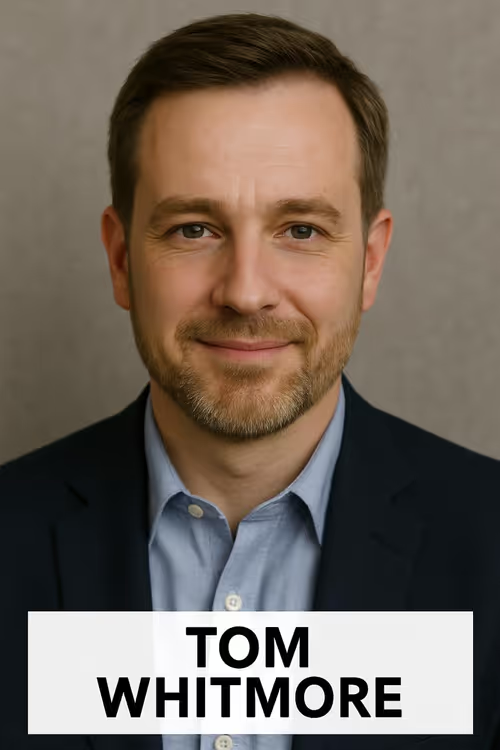
Written by
Tom Whitmore
Senior correspondent · Real Estate & Private Companies
Tom has interviewed most of the operators reshaping the Gulf skyline — and a few of the ones who tried and didn't. His beat is real estate, commodities, manufacturing, and the founder-led private companies that never bother to list. He knows which buildings and balance sheets survive a downturn before the spreadsheet does. Based in Dubai. Reach out at tom.whitmore@theplatinumcapital.com.
