

Riyadh's Commercial Property Market and Vision 2030
Riyadh's commercial property market is undergoing a structural transformation as Vision 2030 drives an unprecedented influx of multinational headquarters, megaproject developments, and institutional capital into a city rapidly repositioning itself as the Middle East's preeminent business hub. Vacancy rates in prime Grade A office space have tightened sharply amid surging demand, pushing rental values to levels that now rival established regional centres and signalling a fundamental repricing of risk in the Saudi capital's real estate landscape.…
Riyadh's Commercial Property Market Surges as Vision 2030 Reshapes the Saudi Capital
Grade A office space in Riyadh now commands rents exceeding SAR 2,500 per square metre annually — a figure that would have seemed improbable five years ago. Yet the Saudi capital's commercial property market has entered a phase of sustained intensity, driven by multinational relocations, sovereign-backed megaprojects, and a regulatory environment deliberately engineered to attract global capital. For investors across the Gulf and beyond, the question is no longer whether Riyadh represents a serious commercial real estate opportunity, but how long the current supply-demand imbalance will persist and who stands to benefit most.
The Regional Headquarters Effect
The January 2024 deadline imposed by Saudi Arabia's Regional Headquarters Programme — requiring foreign companies doing business with the government to establish their regional base in the kingdom — has produced measurable consequences that continue to reverberate through 2026. More than 540 multinational corporations had secured RHQ licences by late 2025, according to the Ministry of Investment, with the number expected to exceed 700 by year-end 2026. PwC, Deloitte, Boston Consulting Group, Siemens, and Unilever have all committed to significant Riyadh presences.
That policy-driven influx has created acute pressure on the office market. Knight Frank's latest Saudi Arabia Commercial Market Review, published in Q1 2026, reported Grade A office vacancy rates in Riyadh's central business districts falling below 2 per cent, compared with roughly 8 per cent in 2022. That is a dramatic swing. The King Abdullah Financial District, once criticised for sluggish uptake, now operates at near-full occupancy, with anchor tenants including Saudi Aramco's expanded corporate functions, the Public Investment Fund's operational hub, and a growing roster of international financial institutions.
JLL's Riyadh Real Estate Market report noted that average Grade A rents jumped approximately 30 per cent between 2023 and 2025, with prime assets in KAFD and the Olaya district experiencing even sharper appreciation. For family offices and private wealth allocators based in Abu Dhabi, Dubai, and Bahrain, those rental growth trajectories have made Riyadh commercial assets increasingly compelling relative to more mature Gulf markets.
Supply Pipeline and the Race to Build
Developers have responded. But not swiftly enough to close the gap. Riyadh's total Grade A office stock stood at approximately 5.2 million square metres at the end of 2025, according to CBRE's Kingdom of Saudi Arabia Market Outlook. An additional 3.1 million square metres of commercial office space is under construction or in advanced planning stages, with significant completions expected between 2027 and 2030.
Several marquee projects define this pipeline. The Saudi Entertainment Authority's new headquarters complex in the Diriyah Gate development, being executed by a consortium involving Henning Larsen Architects and AECOM, will deliver approximately 120,000 square metres of commercial space alongside cultural and hospitality components. Roshn, the PIF-backed real estate developer, has expanded its mandate beyond residential into mixed-use developments, with its Sedra community in northern Riyadh incorporating commercial zones targeting mid-market corporate tenants.
But the most consequential project may be New Murabba — the PIF's 19-square-kilometre downtown development anchored by the Mukaab, a 400-metre cubic structure designed to become Riyadh's defining architectural landmark. The masterplan includes over 600,000 square metres of commercial and retail space, with first-phase delivery now scheduled for 2030. New Murabba Development Company reported in early 2026 that it had commenced foundation works on the initial commercial parcels and was in advanced discussions with several Fortune 500 companies regarding pre-lease arrangements. Few outside the region have noticed just how quickly that timeline has accelerated.
Capital Flows and Investor Appetite
The investment case for Riyadh commercial property has attracted a diverse cohort of capital providers. Saudi Arabia's Real Estate Investment Traded Funds — the kingdom's equivalent of REITs — have expanded considerably. Riyad REIT, managed by Riyad Capital, and Al Rajhi REIT both increased their Riyadh commercial allocations during 2025, reflecting confidence in sustained rental growth. The Tadawul-listed REIT sector's total market capitalisation exceeded SAR 25 billion by Q4 2025, with commercial assets representing an increasing proportion of underlying portfolios.
International institutional investors have also moved decisively. Brookfield Asset Management expanded its Saudi operations through a joint venture with Aldar Properties, targeting mixed-use developments in Riyadh's emerging northern corridor. Hines, the Houston-based developer, confirmed in 2025 that it was pursuing its first Saudi development — a 65,000-square-metre commercial complex near the diplomatic quarter. That is a significant shift for a firm that had long watched the kingdom from the sidelines.
For Gulf-based family offices — particularly those in the UAE and Kuwait — Riyadh represents a diversification play away from saturated Dubai and Abu Dhabi markets. Several prominent Kuwaiti family investment vehicles, including Mabanee Company, have disclosed increased Saudi allocations. The appeal is not merely yield but also the potential for capital appreciation in a market where valuations remain below those of comparable assets in Dubai International Financial Centre or Abu Dhabi Global Market.
Structural Risks and Execution Challenges
The optimism surrounding Riyadh's commercial market warrants tempering with some clear-eyed risk assessment. Construction cost inflation remains a persistent concern; building materials costs in Saudi Arabia rose approximately 12 per cent year-on-year through mid-2025, driven by simultaneous demand from NEOM, the Red Sea developments, and Riyadh's own expansion. Labour availability — despite reformed visa policies — continues to constrain delivery timelines.
Then there is the oversupply question looming beyond 2028. If the full pipeline of announced projects materialises, Riyadh could add more than 8 million square metres of commercial space by 2032, effectively doubling current stock. Should the pace of corporate relocations slow, or should the global economy contract meaningfully, absorption rates may falter. The kingdom's non-oil GDP growth, which the International Monetary Fund estimated at 4.2 per cent for 2025, would need to sustain similar levels to validate current development ambitions.
Regulatory unpredictability, while diminished, has not been eliminated. Changes to Saudisation requirements — the Nitaqat programme mandating Saudi national employment quotas — could increase occupancy costs for multinational tenants and reshape demand patterns. Investors with long time horizons and local operating partners are better positioned to manage these variables than those seeking short-duration exposure.
The Decade Ahead
Riyadh's commercial property market in 2026 reflects something more fundamental than a cyclical upswing. What we are watching is the physical manifestation of Saudi Arabia's most ambitious economic restructuring in modern history. The capital city's population, currently estimated at 8.2 million, is projected by the Royal Commission for Riyadh City to reach 15 million by 2040 — a growth trajectory that implies sustained demand across all commercial property segments.
For sophisticated investors — whether Gulf sovereign wealth funds, Asian institutional allocators, or European family offices — Riyadh offers a rare combination: a government backstop through PIF-anchored development, genuine demand driven by corporate migration, and a pricing environment that has not yet reached the frothy valuations seen in comparable global gateway cities. The risks are real. But so is the scale of the opportunity. Those who engage with rigour, local intelligence, and patience are likely to find that the Saudi capital rewards commitment over speculation.
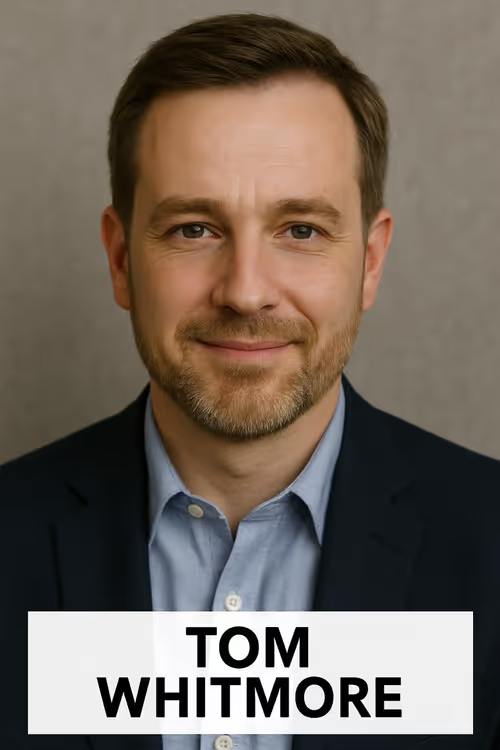
Written by
Tom Whitmore
Senior correspondent · Real Estate & Private Companies
Tom has interviewed most of the operators reshaping the Gulf skyline — and a few of the ones who tried and didn't. His beat is real estate, commodities, manufacturing, and the founder-led private companies that never bother to list. He knows which buildings and balance sheets survive a downturn before the spreadsheet does. Based in Dubai. Reach out at tom.whitmore@theplatinumcapital.com.