

Blockchain Beyond Crypto: Real-World Financial Applications
Distributed ledger technology is quietly reshaping the plumbing of global finance, from instantaneous cross-border settlement and tokenised securities to fraud-resistant trade finance, delivering efficiencies that legacy infrastructure has failed to achieve for decades. As central banks, multinational insurers and major exchanges move beyond pilot programmes into full-scale deployment, blockchain is proving its most enduring value lies not in speculative digital assets but in the foundational modernisation of financial systems themselves.…
The Ledger That Rewired Finance
When JPMorgan Chase processed its first cross-border payment on its proprietary Onyx blockchain network in 2020, few outside the bank's technology division paid serious attention. Six years later, the platform settles more than $2 billion in daily transactions across 160 countries. That is a significant shift. And the trajectory tells a broader story: blockchain technology has decisively outgrown its cryptocurrency origins and is now restructuring the plumbing of global finance — from trade settlement in Dubai to private wealth management in Singapore and sukuk issuance in Riyadh.
None of this is theoretical anymore. Boston Consulting Group's March 2026 report pegged the total value of tokenised real-world assets on blockchain networks at more than $600 billion globally — a fivefold increase from 2024. McKinsey estimates that blockchain-based financial infrastructure could shave $20 billion in annual operational costs from capital markets by 2030. For institutions in the Gulf Cooperation Council states, where sovereign wealth funds and family offices manage trillions in combined assets, the implications are immediate and material.
Trade Finance: The Gulf's Proving Ground
The United Arab Emirates has positioned itself as the most aggressive state sponsor of enterprise blockchain adoption outside East Asia. Abu Dhabi's Mubadala Investment Company, which manages approximately $302 billion in assets, began piloting blockchain-based trade finance solutions in late 2025 through a partnership with R3, the enterprise software firm behind the Corda platform. The target: the $1.8 trillion annual trade corridor between the GCC and South and Southeast Asia, where documentary credit processes historically take seven to ten days and involve up to 20 intermediaries.
Early results have been striking. Settlement times on the Mubadala-backed platform dropped to under 36 hours for letters of credit involving UAE-India commodity trades, with processing costs falling by roughly 65 percent. Emirates NBD, the largest bank in Dubai by assets, reported in its Q1 2026 earnings that blockchain-enabled trade finance volumes rose 140 percent year-on-year, now representing 18 percent of its total trade finance book.
"The efficiency gains are no longer marginal — they are transformational," said Hana Al-Rostamani, group chief executive of First Abu Dhabi Bank, during a panel at the Abu Dhabi Finance Week in February 2026. FAB itself has integrated distributed ledger technology into its correspondent banking operations, processing over $9 billion in cross-border corporate payments through its blockchain rails in 2025.
Tokenisation and the Family Office Revolution
For family offices and ultra-high-net-worth individuals across the Gulf, Southeast Asia, and Latin America, blockchain's most consequential application may be the tokenisation of illiquid assets. Real estate, private equity stakes, fine art, infrastructure projects — historically locked into opaque, long-duration structures — are being fractionalised and placed on distributed ledgers. The result: secondary liquidity where none previously existed.
Singapore-based ADDX, the digital securities exchange backed by the Singapore Exchange, reported that tokenised private market offerings on its platform exceeded $3.2 billion in cumulative issuance by April 2026. Here's the telling detail: 43 percent of its investor base comprises family offices from the GCC and Asia-Pacific regions. The platform lets qualified investors access private credit funds, venture portfolios, and commercial real estate with minimum ticket sizes as low as $10,000 — a fraction of the $1 million to $5 million minimums typical in traditional private placements.
In Saudi Arabia, the Capital Market Authority approved a regulatory sandbox in January 2026 specifically for tokenised securities, with Riyad Capital and SNB Capital among the first licensed participants. The initiative aligns with Vision 2030's financial diversification agenda and responds to a domestic market where an estimated 250 family offices collectively hold more than $150 billion in assets, much of it concentrated in illiquid real estate and private business holdings.
Sovereign Debt Goes On-Chain
No development better illustrates blockchain's institutional maturity than its penetration into sovereign debt markets. Hong Kong's government issued a $756 million tokenised green bond in February 2026 — the largest government blockchain bond to date — using Goldman Sachs' GS DAP tokenisation platform. The issuance settled in one day rather than the conventional five and attracted 2.4 times oversubscription from institutional investors.
The GCC is watching closely. Bahrain's sovereign wealth fund, Mumtalakat, is reportedly in advanced discussions with HSBC and the Bahrain Economic Development Board to issue the region's first fully tokenised sukuk by Q3 2026, targeting $500 million in initial issuance. The structure would use smart contracts to automate profit distribution to sukuk holders, eliminating the complex chain of paying agents and trustees that currently adds 15 to 25 basis points in administrative costs to conventional Islamic bond issuances.
Nigeria, too, has entered the arena. Few outside the region have noticed. The Debt Management Office in Abuja completed a pilot $100 million tokenised federal government bond on the Stellar network in March 2026, designed to broaden access for the country's largely unbanked retail investor population. Over 12,000 individual investors participated with ticket sizes starting at 10,000 naira — roughly $6.
Infrastructure, Regulation, and the Road Ahead
The acceleration of real-world blockchain applications has forced regulatory frameworks to mature in parallel. The Dubai Financial Services Authority finalised its Distributed Ledger Technology regulatory framework in December 2025, creating licensing categories for tokenisation platforms, digital custodians, and on-chain settlement providers. Abu Dhabi Global Market followed in January 2026 with an expanded digital asset regime that explicitly covers tokenised securities, derivatives, and structured products.
These frameworks are pulling in institutional capital. Fireblocks, the digital asset custody and settlement platform valued at $8 billion, opened its Middle East headquarters in Abu Dhabi in March 2026, citing a 300 percent increase in institutional client onboarding from the region over the prior 18 months. Chainalysis, the blockchain analytics firm, expanded its Riyadh office to 85 staff, primarily serving compliance teams at Saudi banks integrating blockchain into their operations.
Challenges persist. Interoperability between competing blockchain protocols remains fragmented. Legal enforceability of smart contracts varies wildly across jurisdictions. And the energy consumption of certain consensus mechanisms continues to draw scrutiny from ESG-focused investors who dominate sovereign wealth fund governance.
Yet the direction of travel is unmistakable. Blockchain is no longer a speculative bet adjacent to cryptocurrency markets. It is becoming core financial infrastructure — and the institutions that recognise this earliest, particularly in the Gulf and across emerging markets, are building structural advantages that will compound for decades.
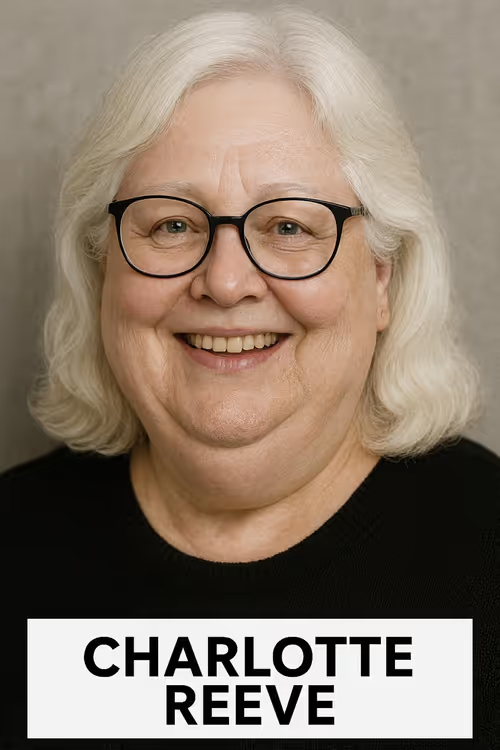
Written by
Charlotte Reeve
Senior correspondent · Capital Markets & Fintech
Charlotte cut her teeth on an equities desk before moving to the other side of the notebook. She covers capital markets, stock exchanges, and the fintech operators trying to disintermediate the banks that trained her. Sharpest on market microstructure and payments infrastructure; still reads a prospectus for fun. Based in Singapore. Reach out at charlotte.reeve@theplatinumcapital.com.