
Sovereign Wealth Funds and Their Expanding Global Influence
Sovereign wealth funds now command more than ten trillion dollars in assets and are quietly reshaping the architecture of global capital markets, from infrastructure megaprojects in emerging economies to strategic technology acquisitions in Silicon Valley. Their growing appetite for direct investments and increasingly assertive governance demands signal a fundamental shift in how state capital influences corporate strategy, geopolitical alliances, and the balance of economic power between nations.…
The New Power Brokers: How Sovereign Wealth Funds Are Reshaping Global Capital
When Abu Dhabi Investment Authority quietly accumulated a $1.4 billion stake in a consortium of European logistics firms in the first quarter of 2026, it barely registered in mainstream headlines. But the move told a bigger story — one that has come to define this era of global finance. Sovereign wealth funds are no longer passive custodians of national reserves. They are active, strategic, and increasingly decisive players in shaping the direction of capital markets, private enterprise, and geopolitical alignment.
Collectively, the world's sovereign wealth funds now manage an estimated $13.2 trillion in assets, according to the Sovereign Wealth Fund Institute's 2026 Global Report — up more than 18 per cent since 2022. Sustained commodity revenues in the Gulf, disciplined fiscal surpluses in parts of Asia, and a deliberate push by several governments to convert finite resource wealth into permanent, diversified portfolios have all fuelled the surge. The implications for markets, corporations, and the architecture of international finance run deep.
The Gulf's Ascendancy: Beyond Oil, Beyond Borders
No region has expanded its sovereign capital footprint more aggressively than the Gulf Cooperation Council states. Saudi Arabia's Public Investment Fund, now managing approximately $940 billion, has pressed ahead with its diversification offensive under Governor Yasir Al-Rumayyan, deploying capital across artificial intelligence infrastructure, professional sports, and advanced manufacturing. PIF's $3.5 billion commitment to a new semiconductor packaging facility in partnership with South Korea's Samsung SDI, announced in February 2026, sent a clear signal: Riyadh wants to be a node in the global chip supply chain, not merely a consumer of technology but a stakeholder in its production.
Meanwhile, Abu Dhabi-based Mubadala Investment Company, with assets surpassing $330 billion, has pushed deeper into private credit markets, committing $7 billion to direct lending strategies in 2025 alone. Its partnership with Apollo Global Management, expanded in late 2025, now spans co-investment vehicles across infrastructure debt in India, Brazil, and sub-Saharan Africa. The Qatar Investment Authority, for its part, increased its exposure to European luxury and hospitality assets, taking a significant position in Kering SA during the French conglomerate's share price correction in early 2026.
These are not speculative bets. They are calculated deployments by institutions with generational time horizons, minimal leverage constraints, and a strategic mandate that blends financial returns with national economic transformation.
Emerging Market Funds: The Quiet Contenders
Gulf funds grab the most attention. But a second tier of sovereign investors from emerging markets has grown substantially in both scale and sophistication. Few outside the region have noticed.
Singapore's GIC, managing an estimated $840 billion, has become one of the largest single investors in global private equity, with commitments to Blackstone, KKR, and Warburg Pincus funds totalling more than $45 billion across active vintages. GIC's 2026 allocation to climate transition infrastructure — including a $2.1 billion stake in a North American green hydrogen consortium — reflects the fund's conviction that decarbonisation represents the most significant capital reallocation opportunity of the decade.
Indonesia's nascent sovereign fund, the Indonesia Investment Authority (INA), has grown its assets under management to approximately $25 billion, up from $6 billion at its 2021 inception. That is a significant shift. INA's partnership with the Abu Dhabi Growth Fund to develop a $4 billion industrial corridor in East Java demonstrates an increasingly common pattern: South-South sovereign capital cooperation that bypasses traditional Western intermediaries altogether.
In Africa, the Nigeria Sovereign Investment Authority has expanded its mandate under a reformed governance structure, while the newly established East African Sovereign Development Fund, capitalised by Kenya and Rwanda, has begun deploying resources into regional fintech and agricultural logistics platforms. These are still small by global standards. But they represent a real change in how developing nations think about intergenerational wealth management.
Convergence with Family Offices and Private Wealth
One of the most consequential developments of 2025-2026 has been the deepening convergence between sovereign wealth funds and ultra-high-net-worth family offices. The structural similarities — long time horizons, tolerance for illiquidity, preference for direct investment — have created natural alignment. ADIA's partnership with the Walton family's investment arm on a $2.8 billion North American cold storage portfolio is one prominent example. Another is the Kuwait Investment Authority's co-investment alongside Mukesh Ambani's family office in a chain of speciality hospitals across Southeast Asia, a deal valued at $1.6 billion and closed in March 2026.
This convergence has also upended the competitive dynamics of deal-making. Private equity firms, once the dominant force in large-scale buyouts, now routinely find themselves competing against — or cap-in-hand seeking capital from — sovereign-family office consortia that can move faster, offer more flexible terms, and sidestep the fundraising cycles that constrain traditional fund structures. Goldman Sachs estimated in its April 2026 capital flows report that sovereign and family office co-investments accounted for 22 per cent of all global private market transactions above $500 million, up from 14 per cent in 2023.
Governance, Geopolitics, and the Question of Accountability
The expanding reach of sovereign capital has inevitably raised questions about governance, transparency, and political influence. The Santiago Principles, established in 2008 to promote best practices among sovereign funds, remain voluntary and unevenly observed. Critics point to PIF's involvement in professional golf and football as examples of "sportswashing," while concerns about data security have trailed Chinese sovereign investments in technology companies across Latin America and Southeast Asia.
The European Union's Foreign Subsidies Regulation, strengthened in early 2026, now requires enhanced disclosure when sovereign-backed entities participate in acquisitions of firms with annual EU revenues exceeding €500 million. The United States' Committee on Foreign Investment has similarly broadened its review scope, blocking or conditioning at least seven sovereign-linked transactions in the twelve months to June 2026.
Yet the regulatory response remains fragmented. For every jurisdiction tightening oversight, another is actively courting sovereign capital. India's liberalised foreign direct investment rules, announced in the 2026 Union Budget, explicitly carved out favourable treatment for sovereign wealth funds investing in infrastructure and renewable energy. Brazil has done the same for investments in its pre-salt oil basin and critical minerals sector. The result is a patchwork — part barrier, part welcome mat — that sovereign funds have proved adept at exploiting.
A Structural Shift, Not a Cyclical Trend
What sets this moment apart from previous waves of sovereign fund activity is the permanence and intentionality behind capital deployment. These institutions are not merely chasing returns. They are building ecosystems, forging bilateral economic relationships, and positioning their home nations within supply chains and industries that will define the next half-century. The $13 trillion question is not whether sovereign wealth funds will continue to expand their influence — that trajectory now looks irreversible. It is whether the global financial system's governance frameworks can evolve fast enough to match the ambitions of its most powerful new participants.
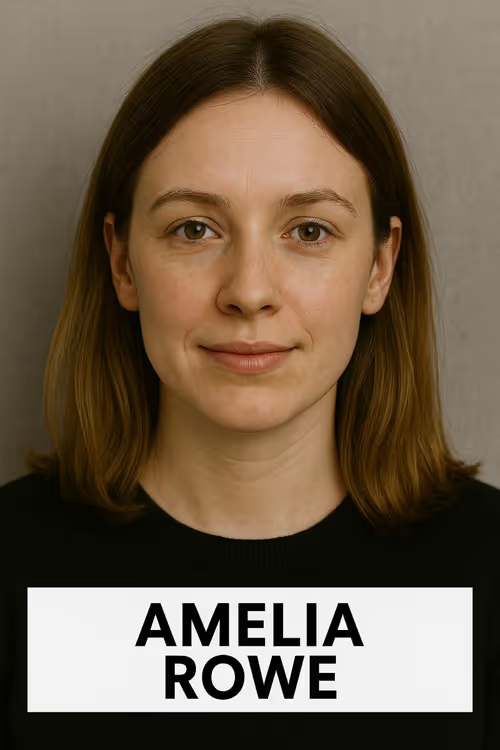
Amelia Rowe is a senior journalist at The Platinum Capital covering sovereign finance, private wealth, and emerging market capital flows.
Written by
Amelia Rowe
Senior correspondent · Banking & Economy
Amelia spent eight years inside a sovereign wealth fund before deciding she'd rather write about institutional money than allocate it. She covers central banking, insurance, and the macro decisions that quietly choose which markets get the next decade. Sharp on monetary policy; impatient with anyone who confuses noise with signal. Based in London. Reach out at amelia.rowe@theplatinumcapital.com.