

Sovereign Wealth Funds and Their Expanding Global Influence
Sovereign wealth funds now command more than ten trillion dollars in assets and have evolved far beyond passive investment vehicles into powerful geopolitical instruments capable of reshaping industries, propping up faltering economies, and quietly redrawing the global balance of financial power. Their growing appetite for strategic stakes in technology, infrastructure, and energy transition assets signals a fundamental shift in how state capital is deployed, raising urgent questions about transparency, market distortion, and the blurring line between national interest and commercial ambition.…
The New Sovereigns: How State-Backed Capital Is Reshaping the Global Order
When Abu Dhabi's Mubadala Investment Company closed its $1.2 billion stake in a European semiconductor manufacturer in February 2026, it barely registered as headline news. A decade ago, such a transaction would have triggered parliamentary debates about foreign state influence. Today, sovereign wealth funds have burrowed so deeply into global finance that their expanding reach is treated as unremarkable — which is precisely what makes it so consequential.
Sovereign wealth funds now command an estimated $13.2 trillion in combined assets under management, according to the Sovereign Wealth Fund Institute's April 2026 data. That figure has nearly doubled since 2018. The acceleration isn't just about commodity windfalls. It reflects a fundamental shift in how governments wield capital as an instrument of strategic power. From the Gulf to Southeast Asia, from Norway to Singapore, state-backed investment vehicles have stopped acting as passive custodians of national savings. They are now active architects of industrial policy, geopolitical alignment, and technological transformation.
The Gulf's Unprecedented Spending Spree
No region illustrates this shift more vividly than the Persian Gulf. Saudi Arabia's Public Investment Fund, chaired by Crown Prince Mohammed bin Salman, reported assets of approximately $930 billion in early 2026, cementing its position as one of the world's largest sovereign investors. PIF's strategy has grown markedly more aggressive: its $40 billion commitment to artificial intelligence infrastructure through 2030, announced alongside a partnership with Andreessen Horowitz in late 2025, signals a deliberate pivot from oil dependency toward technological sovereignty. That is not diversification. That is reinvention.
The Abu Dhabi Investment Authority, long the most discreet of the Gulf funds, has expanded its direct investment team by 35 per cent since 2024, according to people familiar with the matter. Its sister entity, ADQ, completed a $7.4 billion acquisition spree across healthcare, logistics, and food security assets in 2025 alone. Meanwhile, the Qatar Investment Authority has deepened its positions in European luxury and financial services, raising its stake in Credit Suisse's successor entity and acquiring a significant minority holding in a leading Italian fashion conglomerate.
What sets this latest wave of Gulf deployment apart is its coherence. These are not trophy acquisitions designed to burnish national prestige. They are calculated bets on supply chain control, energy transition infrastructure, and the digital economy — sectors where state capital can extract both financial returns and geopolitical leverage.
Emerging Market Funds Step Into the Arena
The Gulf's dominance tends to obscure a parallel story: the rapid maturation of sovereign wealth funds in emerging and frontier markets. Few outside the region have noticed. Indonesia's newly consolidated Daya Anagata Nusantara, the rebranded successor to the Indonesia Investment Authority, surpassed $25 billion in committed capital by March 2026, with a mandate spanning critical minerals processing and digital infrastructure across the archipelago.
India, which has historically lacked a formal sovereign wealth fund, has effectively built one through the backdoor. The National Investment and Infrastructure Fund, backed by the government and a consortium of Gulf sovereign investors, has deployed over $6 billion into Indian highways, ports, and renewable energy projects. Its co-investment model — blending state capital with Abu Dhabi and Saudi money — represents a template that other capital-hungry nations are studying closely.
In Africa, the Nigeria Sovereign Investment Authority has quietly assembled a $3.8 billion portfolio despite persistent fiscal pressures, while Botswana's Pula Fund — one of the continent's oldest sovereign vehicles — has diversified heavily into private credit and Asian equities. These funds remain modest by Gulf standards. But their growth trajectories suggest that sovereign capital is becoming a genuinely global phenomenon, not a privilege reserved for petrostates.
The Blurring Line Between Sovereign and Private Wealth
Perhaps the most significant development of 2026 is the accelerating convergence between sovereign wealth funds and the world of family offices and private capital. The boundaries that once separated these pools of money have become porous to the point of irrelevance.
Consider the partnership structures emerging in the Gulf. Mubadala's dedicated family office co-investment programme, launched in late 2025, has attracted commitments from over 40 ultra-high-net-worth families across Asia, Europe, and Latin America. The programme allows families with a minimum of $500 million in investable assets to participate alongside Mubadala in direct deals spanning private equity, venture capital, and real assets.
Singapore's GIC has pursued a similar approach, establishing a bespoke vehicle for Asian family offices seeking exposure to North American infrastructure. The $4 billion facility, structured as a blind pool with GIC as general partner, reached its hard cap within six weeks of its initial close. That speed tells you everything about how eagerly private wealth is chasing the deal flow and due diligence capabilities that sovereign funds can provide.
This convergence is reshaping fee structures, governance norms, and the competitive dynamics of asset management. Traditional private equity firms — from Blackstone to KKR — increasingly find themselves competing not just for deals but for the loyalty of limited partners who now have the option of investing directly alongside sovereign co-investors at significantly lower cost. That is a significant shift.
Strategic Implications and Regulatory Tensions
The expanding influence of sovereign wealth funds has not gone uncontested. The European Union's Foreign Subsidies Regulation, enforced with increasing rigour since mid-2025, has subjected several Gulf-backed transactions to prolonged scrutiny. A proposed $2.6 billion acquisition of a Dutch renewable energy company by a PIF subsidiary was delayed by four months in early 2026 pending a European Commission review — a process that Saudi officials privately described as politically motivated.
In the United States, the Committee on Foreign Investment has broadened its definition of critical technology to encompass artificial intelligence model training and advanced battery chemistry, effectively raising the bar for sovereign fund participation in American tech deals. Australia and Canada have implemented similar restrictions, creating a patchwork of regulatory barriers that sovereign funds must increasingly price into their deployment strategies.
Yet the leverage runs both ways. Western governments desperately need sovereign capital to finance energy transition, defence modernisation, and infrastructure renewal. The United Kingdom's courtship of Gulf investors — exemplified by the Treasury's February 2026 memorandum of understanding with ADQ on a £5 billion green infrastructure programme — illustrates the tension between security concerns and fiscal necessity. You cannot slam the door on the money you need to keep the lights on.
The sovereign wealth fund era is not approaching. It has arrived. The question confronting policymakers, asset managers, and corporate boards is no longer whether state-backed capital will reshape markets and industries, but whether existing institutions can adapt fast enough to govern its consequences.
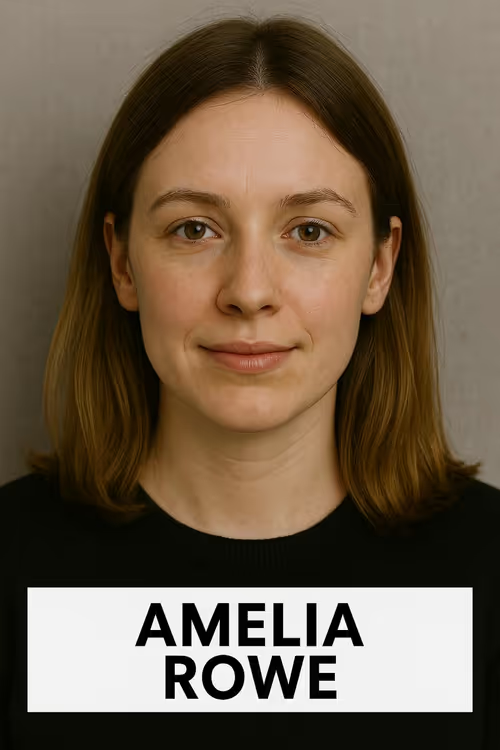
Amelia Rowe is a senior journalist at The Platinum Capital covering sovereign capital flows and institutional investment.
Written by
Amelia Rowe
Senior correspondent · Banking & Economy
Amelia spent eight years inside a sovereign wealth fund before deciding she'd rather write about institutional money than allocate it. She covers central banking, insurance, and the macro decisions that quietly choose which markets get the next decade. Sharp on monetary policy; impatient with anyone who confuses noise with signal. Based in London. Reach out at amelia.rowe@theplatinumcapital.com.