

Rola Abu-Manneh: Standard Chartered UAE CEO Redefines Regional Banking
Rola Abu-Manneh has emerged as one of the most influential figures reshaping the United Arab Emirates banking landscape, steering Standard Chartered's regional operations through a period of aggressive digital transformation and strategic realignment toward sustainable finance. Her leadership has positioned the bank as a critical conduit for international capital flows into the Gulf, capitalising on the UAE's ambitions to become a global financial hub while navigating an increasingly complex regulatory and geopolitical environment.…
The Architect of Standard Chartered's Gulf Ambition
When Rola Abu-Manneh took the helm of Standard Chartered's UAE operations in 2021, the bank's regional footprint was respectable but unremarkable. Five years later, the transformation she has engineered is one of the more compelling case studies in how a global institution can embed itself into the strategic fabric of a rapidly evolving economy. Standard Chartered UAE hasn't merely grown under her watch — it has repositioned itself as a critical intermediary between Gulf capital and the world's fastest-moving markets.
Abu-Manneh's tenure has coincided with extraordinary structural change across the Gulf Cooperation Council states. Sovereign wealth funds have deployed hundreds of billions of dollars. Family offices have proliferated at an unprecedented pace. The UAE has cemented its status as a global financial hub rivalling Singapore and London. Her ability to read these shifts — and move decisively in response — has set her apart from peers at competing institutions who have been slower to adapt.
Riding the Private Wealth Supercycle
The numbers tell a striking story. The UAE's private wealth pool surpassed $1 trillion in 2025, according to Boston Consulting Group's Global Wealth Report, with projections suggesting compound annual growth of 7-8% through the end of the decade. Dubai alone has attracted more than 6,700 high-net-worth individuals since 2022, per Henley & Partners data, many of them establishing single-family offices in the Dubai International Financial Centre and Abu Dhabi Global Market.
Abu-Manneh spotted this wave early. Standard Chartered UAE significantly expanded its private banking and wealth management division throughout 2024 and into 2026, poaching senior relationship managers from UBS, Julius Baer, and Credit Suisse's legacy operations. The bank launched a dedicated family office advisory desk in DIFC in the second quarter of 2025, offering bespoke structuring services, succession planning, and direct access to Standard Chartered's institutional-grade research across Asia and Africa — corridors where Gulf family offices have been deploying capital aggressively.
"The families we serve are not looking for a private bank in the traditional European sense," Abu-Manneh told delegates at the Future Investment Initiative in Riyadh in October 2025. "They want a partner that understands emerging markets with granularity — someone who can open doors in Jakarta, Nairobi, and Mumbai with the same fluency as in London or New York."
Corporate and Institutional Banking: The Cross-Border Advantage
While wealth management has generated headlines, the institutional banking franchise remains the engine of Standard Chartered UAE's revenue base. Abu-Manneh has leveraged the bank's distinctive network — spanning 53 markets with deep roots in Asia, Africa, and the Middle East — to capture a disproportionate share of cross-border trade and investment flows between the Gulf and the Global South.
In 2025, bilateral trade between the UAE and India exceeded $85 billion, while UAE-China non-oil trade continued climbing. Standard Chartered has positioned itself as a primary banking partner for corporates executing transactions along these corridors, particularly in trade finance, supply chain financing, and foreign exchange. The bank facilitated over $12 billion in trade finance flows through its UAE operations in fiscal year 2025 — a 22% increase year-on-year, according to disclosures made during the bank's annual results presentation in February 2026. That is a significant shift.
Abu-Manneh has also driven the bank's involvement in sustainable finance, an area where UAE institutions have moved with notable ambition following COP28 in Dubai. Standard Chartered UAE participated as a joint lead manager in Abu Dhabi's $5 billion green bond issuance in early 2026 and has built a dedicated ESG advisory capability servicing both sovereign and corporate clients across the region.
Digital Infrastructure and the Tokenisation Frontier
Perhaps the most forward-looking element of Abu-Manneh's strategy has been her commitment to digital banking infrastructure and the emerging tokenisation economy. The UAE Central Bank's digital dirham project, which entered advanced pilot phases in 2025, required participating banks to invest heavily in technological readiness. Standard Chartered has been among the most active participants, working alongside the central bank and the DIFC Innovation Hub on wholesale CBDC settlement trials.
The bank also launched its digital asset custody service for institutional clients in the UAE during the third quarter of 2025, placing itself alongside a small cohort of global banks — including HSBC and JPMorgan — that have moved beyond cautious experimentation into operational delivery. Abu-Manneh has framed this not as a speculative bet on cryptocurrency but as infrastructure-building for a financial system that will increasingly tokenise real-world assets, from real estate to trade receivables. Few outside the region have noticed.
Standard Chartered's partnership with Brevan Howard Digital and its involvement in Project Guardian — the Monetary Authority of Singapore's asset tokenisation initiative that now includes UAE-based participants — signal the seriousness of this commitment. Abu-Manneh has spoken publicly about her expectation that tokenised deposits and programmable payments will become standard features of institutional banking within three to five years.
A Leadership Model for the Region
Abu-Manneh's influence extends well beyond Standard Chartered's balance sheet. As one of the most senior female banking executives in the Gulf, she has become an important voice on financial sector governance, Emiratisation, and the integration of national talent into global banking operations. Standard Chartered UAE reported that Emirati nationals comprised 38% of its workforce by the end of 2025, exceeding the central bank's Emiratisation targets for the banking sector.
She sits on the board of the UAE Banks Federation and has been instrumental in shaping industry dialogue around regulatory modernisation, particularly concerning licensing frameworks for digital banks and virtual asset service providers. Her advocacy for proportional regulation — tough enough to maintain institutional credibility, flexible enough to encourage innovation — has earned her respect among both regulators and fintech founders operating in the UAE's increasingly crowded financial technology ecosystem.
What sets Abu-Manneh apart from many of her contemporaries is a refusal to treat the Gulf as a peripheral market requiring strategies designed elsewhere and then awkwardly adapted. She has consistently argued that the UAE's position at the intersection of capital flows between East and West, its regulatory sophistication, and its demographic dynamism make it a laboratory for the future of banking — not a satellite office awaiting instructions from headquarters in London.
For Standard Chartered, the results speak clearly. The UAE is now among the bank's top five markets globally by revenue contribution — a status that would have seemed improbable a decade ago. For the broader banking sector, Abu-Manneh's tenure offers a template: deep local understanding, combined with the disciplined deployment of a global network, can create a competitive position that neither purely local nor purely international rivals can easily replicate.
Amelia Rowe is a senior journalist at The Platinum Capital covering banking and financial services across the Gulf and emerging markets.
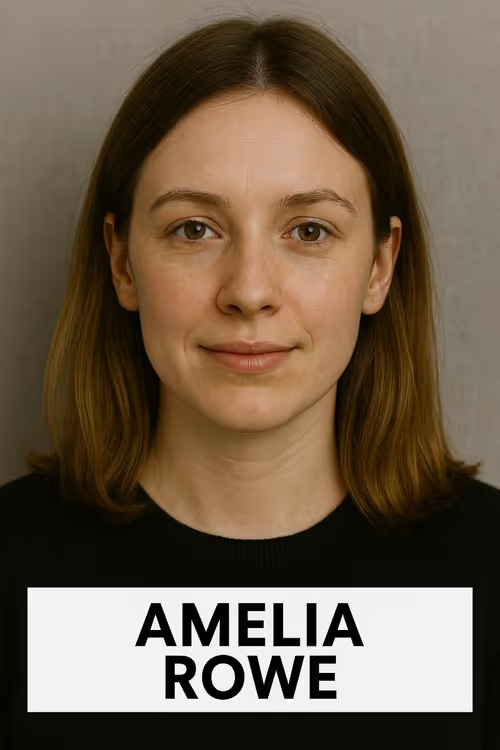
Written by
Amelia Rowe
Senior correspondent · Banking & Economy
Amelia spent eight years inside a sovereign wealth fund before deciding she'd rather write about institutional money than allocate it. She covers central banking, insurance, and the macro decisions that quietly choose which markets get the next decade. Sharp on monetary policy; impatient with anyone who confuses noise with signal. Based in London. Reach out at amelia.rowe@theplatinumcapital.com.