

Dubai's Luxury Real Estate Boom: Who Is Really Buying
The emirate's property market has surged to unprecedented heights, with transaction volumes shattering records as ultra-high-net-worth individuals from Russia, India and Western Europe aggressively diversify their portfolios into Dubai's tax-efficient skyline. Behind the headline-grabbing penthouse sales and branded residences, however, a more complex picture emerges of institutional capital, family offices and cryptocurrency-enriched buyers reshaping the ownership landscape of one of the world's most watched real estate markets.…
Dubai's Luxury Real Estate Boom: Who Is Really Buying
In the first quarter of 2026, Dubai recorded 12,780 property transactions exceeding AED 10 million each — a figure that would have seemed fantastical five years ago. The emirate's luxury real estate market hasn't merely recovered from pandemic-era uncertainty. It has entered a phase of sustained, structural demand that is reshaping who owns prime urban land in the Middle East. But behind the headline numbers lies a more complex story about the origins of capital, the motivations of buyers, and the quiet machinery of family offices and private wealth vehicles powering the boom.
The Capital Behind the Curtain
Dubai Land Department data for 2025 showed that non-resident foreign nationals accounted for roughly 62 per cent of all luxury transactions above AED 15 million, up from 54 per cent in 2023. The nationality breakdown, though, has shifted markedly. Indian and British buyers dominated headlines in prior years. The story in 2025 and early 2026 is different: a pronounced rise in capital flows from Central Asia, sub-Saharan Africa, and the former Soviet states.
Kazakh and Uzbek nationals collectively accounted for an estimated AED 8.4 billion in residential purchases in 2025, according to figures compiled by Property Monitor. Few outside the region have noticed. Nigerian and Kenyan high-net-worth individuals — many of whom built fortunes in fintech, telecommunications, and commodities — have emerged as a notable cohort in communities such as Dubai Hills Estate and District One. Russian-origin capital, though harder to trace following sanctions-related restructuring, continues to flow through corporate vehicles registered in the UAE, Turkey, and several Central Asian jurisdictions.
Emaar Properties, the emirate's largest listed developer, reported in its 2025 annual results that international buyers represented 78 per cent of sales in its premium portfolio, which includes the Burj Khalifa residences and the Address brand. DAMAC Properties, controlled by billionaire Hussain Sajwani, disclosed that its Cavalli-branded tower on Dubai's coast sold out within 72 hours of launch in January 2026, with average unit prices exceeding AED 4,200 per square foot. That set a new benchmark for branded residences in the market.
Family Offices as Market Architects
The most significant structural shift in Dubai's luxury property market isn't a change in nationality. It's a change in buyer type. Single-family offices — private wealth management entities serving ultra-high-net-worth clans — have become the dominant force in transactions above AED 50 million.
The Dubai International Financial Centre (DIFC) reported that 460 single-family offices were registered in its jurisdiction by the end of 2025, up from approximately 120 in 2022. That is a significant shift. Many of these entities deploy real estate allocations ranging from 15 to 40 per cent of total assets under management. The attraction is straightforward: Dubai offers zero income tax, a favourable residency framework through golden visas, and a property market that delivered annualised returns of 18.7 per cent in prime areas over the three years to December 2025, according to Knight Frank's Wealth Report.
Several prominent family offices have made their presence felt. The Burjeel Holdings-linked Al Masah family office acquired a portfolio of six villas on Palm Jumeirah in late 2025, valued collectively at approximately AED 380 million. The Ambani family's Reliance-affiliated investment arm reportedly secured a full floor in the forthcoming Baccarat Residences, though the company declined to confirm the transaction. Saudi family offices, many relocating operational headquarters from Geneva and London, have been particularly active in acquiring entire villa clusters in Jumeirah Bay and the new Rashid Yachts & Marina precinct.
The Branded Residence Phenomenon
Branded residences have become the primary vehicle through which developers capture the highest price premiums in Dubai. As of Q1 2026, the emirate hosts or has under construction more than 70 branded residential projects — more than any other city globally, surpassing both Miami and London by a wide margin.
Omniyat, the boutique developer behind the Dorchester Collection residences on Business Bay's waterfront, reported average sale prices of AED 5,800 per square foot in its latest phase. That puts its inventory on par with mid-tier London or Singapore pricing — but with none of the associated tax burden. Sobha Realty's partnership with the Armani/Casa brand for a forthcoming Palm Jumeirah tower has attracted early commitments reportedly totalling AED 2.1 billion before construction has broken ground.
The premium that branding commands is quantifiable. A 2026 analysis by Savills found that branded residences in Dubai sell at an average 42 per cent premium over comparable non-branded units, up from 31 per cent in 2022. This premium isn't merely aesthetic. It reflects the security of asset management, guaranteed service standards, and — just as important — resale liquidity in a market where secondary market depth has historically been thin.
Emerging Market Wealth and the Dubai Magnet
Dubai's appeal to emerging market wealth is no accident. The emirate has systematically positioned itself as a neutral jurisdiction for capital preservation, particularly for buyers from countries with volatile currencies, political instability, or capital controls.
Egyptian buyers, contending with continued pound devaluation, increased their share of Dubai luxury purchases by 34 per cent year-on-year in 2025. Pakistani nationals, many operating cross-border trading enterprises, have concentrated their activity in Business Bay and Jumeirah Village Circle. Ethiopian and Ghanaian entrepreneurs, a newer demographic, are beginning to appear in transaction records at the AED 20-30 million threshold. Watch this space.
Henley & Partners' 2026 Global Mobility Report estimated that Dubai attracted a net inflow of 6,700 millionaires in 2025, making it the world's top destination for mobile wealth for the third consecutive year. Many of these arrivals convert residency into property ownership within months of relocation, creating a self-reinforcing cycle of demand.
Risks Beneath the Surface
For all its momentum, Dubai's luxury market carries risks that sophisticated investors acknowledge privately even as they continue to buy. Supply remains a concern. An estimated 41,000 residential units are scheduled for delivery in 2026 and 2027 combined, according to JLL's latest market outlook. Should macroeconomic conditions deteriorate — whether through an oil price correction, a global recession, or a reversal in the favourable regulatory environment — absorption rates could fall sharply.
Then there are questions of transparency. Despite improvements to anti-money-laundering frameworks following the UAE's removal from the Financial Action Task Force grey list in early 2025, property transactions conducted through multi-layered corporate structures remain difficult to trace fully. The Dubai government has introduced beneficial ownership registries, but enforcement and verification lag behind jurisdictions such as Singapore and the United Kingdom.
What is clear is that Dubai's luxury real estate market has evolved beyond a speculative playground for short-term capital. It has become a strategic asset class for global wealth — a function of tax efficiency, geopolitical neutrality, and lifestyle infrastructure that few cities can replicate. The question is no longer whether the boom is real. It's whether the institutional foundations beneath it are strong enough to sustain what the market has built.
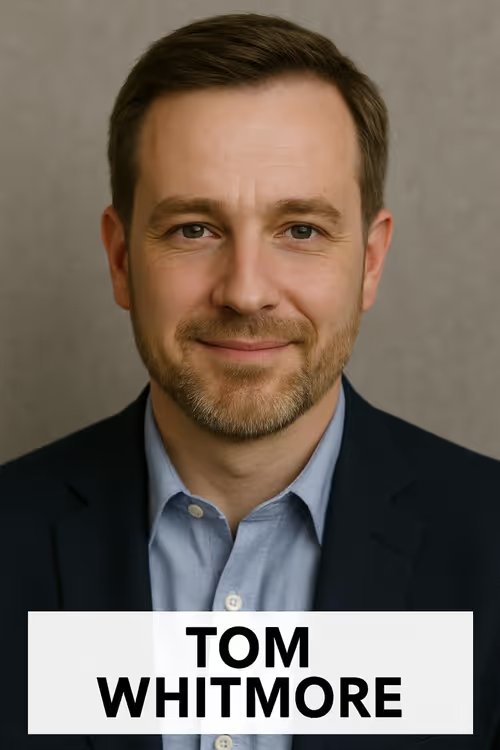
Written by
Tom Whitmore
Senior correspondent · Real Estate & Private Companies
Tom has interviewed most of the operators reshaping the Gulf skyline — and a few of the ones who tried and didn't. His beat is real estate, commodities, manufacturing, and the founder-led private companies that never bother to list. He knows which buildings and balance sheets survive a downturn before the spreadsheet does. Based in Dubai. Reach out at tom.whitmore@theplatinumcapital.com.