

Rola Abu-Manneh: Standard Chartered UAE CEO Redefines Regional Banking
Rola Abu-Manneh has quietly transformed Standard Chartered's UAE operations into a powerhouse of institutional and wealth management growth, leveraging the country's position as a global capital corridor between East and West. Her strategic pivot toward sustainable finance and digital infrastructure has not only strengthened the bank's competitive standing in a crowded Gulf market but also established a blueprint for how international lenders can deepen their relevance across the broader Middle East.…
The Architect of Standard Chartered's Gulf Ambitions
When Rola Abu-Manneh took the helm as Standard Chartered's UAE chief executive in 2021, the bank's regional footprint was respectable but unremarkable. Five years later, the institution she oversees has become one of the most consequential foreign banking operations in the Middle East, with UAE assets under management surging past $15 billion and a wealth management division that has doubled its client base since 2023. Sovereign wealth funds are reshaping global capital flows. Family offices are proliferating at a rate nobody predicted a decade ago. Abu-Manneh has positioned Standard Chartered as the bridge between Eastern capital and Western markets — a role that carries enormous strategic weight heading into the second half of the decade.
Her trajectory offers a case study in how a single executive's vision can reorient an entire institution's regional strategy. Under Abu-Manneh's leadership, Standard Chartered UAE has moved decisively beyond its traditional trade finance and corporate banking roots to become a full-spectrum wealth and advisory platform, competing directly with UBS, HSBC, and Julius Baer for the region's most coveted clients.
Capturing the Family Office Migration
The UAE's emergence as a global family office hub has been one of the defining financial stories of the 2020s. Dubai alone now hosts more than 1,500 single-family offices, according to the Dubai International Financial Centre's 2026 registry data, up from fewer than 400 in 2020. Abu Dhabi Global Market has attracted a further 700-plus wealth structures, buoyed by regulatory frameworks designed explicitly to court ultra-high-net-worth migration from Asia, Europe, and Latin America.
Abu-Manneh recognised this shift early. In 2024, she launched Standard Chartered's dedicated Family Office Advisory unit in the UAE, staffed with specialists recruited from Credit Suisse's former Asia private banking division and from Deutsche Bank's Middle East wealth arm. The unit now serves more than 200 family office relationships with investable assets exceeding $500 million each, offering bespoke solutions spanning succession planning, Shariah-compliant structures, and cross-border tax optimisation.
"The families relocating to the UAE are not looking for a private bank in the traditional sense," Abu-Manneh told delegates at the Global Family Office Summit in Dubai in February 2026. "They want an institution that understands regulatory arbitrage across jurisdictions, that can structure holdings from Singapore to São Paulo, and that has genuine emerging market expertise. That is precisely where we operate."
The comment was pointed — and deliberately so. Standard Chartered's heritage across Africa, South Asia, and Southeast Asia gives it a connectivity advantage that purely European or American competitors struggle to replicate. When an Indian industrialist family relocating to Dubai wants to restructure holdings spanning Mumbai, Nairobi, and Jakarta, few institutions can execute across all three corridors with local banking licences and on-the-ground teams. Few outside the region have noticed just how wide that moat has become.
Wealth Management as a Revenue Engine
The financial results validate Abu-Manneh's strategic bet. Standard Chartered's UAE wealth management revenues reached $380 million in 2025, a 34% year-on-year increase that now accounts for nearly 28% of the country unit's total income — up from just 16% in 2022. That is a significant shift. The bank's affluent and high-net-worth client segment in the Emirates grew by 19,000 accounts in the twelve months to March 2026, driven by digital onboarding capabilities and a premium banking proposition that Abu-Manneh overhauled in mid-2024.
Her unit has been particularly aggressive in structured products and alternative investments, areas where margins remain robust. Standard Chartered UAE distributed more than $2.1 billion in private credit and real estate fund allocations to its wealth clients in 2025, partnering with managers including Brookfield, Ares Management, and regional players such as Investcorp and Arcapita. Abu-Manneh also forged an exclusive distribution agreement with Abu Dhabi's Lunate Capital for select co-investment opportunities, giving her clients access to deal flow originating from one of the Gulf's most active sovereign-adjacent investment platforms.
Digital Infrastructure and the CBUAE Regulatory Alignment
Abu-Manneh's tenure has coincided with a period of aggressive regulatory modernisation by the Central Bank of the UAE. The CBUAE's 2025 framework for digital banking services, open finance protocols, and enhanced anti-money-laundering standards demanded substantial investment from foreign banks operating in the Emirates. Most banks treated this as a cost centre. Abu-Manneh treated it as a weapon.
Standard Chartered UAE invested approximately $120 million in technology infrastructure between 2023 and 2025, according to figures disclosed at the bank's investor day in March 2026. The bank's SC Mobile platform in the UAE now processes over 85% of retail transactions digitally, and its corporate banking portal — rebuilt on a cloud-native architecture in partnership with Microsoft Azure — has slashed trade finance processing times from five days to under eighteen hours for established clients.
The CBUAE's push toward a central bank digital currency, the Digital Dirham, has also found an enthusiastic participant in Abu-Manneh's operation. Standard Chartered was among the first three banks selected for the mBridge cross-border CBDC pilot, alongside First Abu Dhabi Bank and Emirates NBD, facilitating real-time settlement of trade flows between the UAE and China. The pilot processed $840 million in transactions during its first six months of operation, with Standard Chartered handling roughly a third of that volume.
Strategic Positioning in a Crowded Market
The competitive pressure Abu-Manneh faces is intensifying. HSBC, under its own UAE chief executive, has poured resources into Expat wealth services and commercial banking. JPMorgan Chase expanded its Dubai private banking team by 40% in 2025. Citigroup's renewed commitment to its UAE wealth franchise, following years of strategic ambiguity, adds yet another formidable rival.
Yet Abu-Manneh's advantage lies in institutional coherence. While competitors often run their UAE operations as subsidiaries of global divisions with fragmented reporting lines, she has consolidated corporate, commercial, retail, and wealth banking under a unified country leadership model. This structure lets her cross-refer a corporate banking relationship — say, a logistics conglomerate with operations across the Gulf and East Africa — into private wealth services for its founding family, and then into transaction banking for its subsidiaries. The integrated approach generated approximately $95 million in cross-segment revenue synergies in 2025, a metric the bank now tracks explicitly. That number, modest by group standards, tells you everything about where the model is heading.
Abu-Manneh has also cultivated political capital that extends well beyond commercial banking. She sits on the advisory board of the UAE's Ministry of Economy and has been an active voice in shaping the Emirates' Comprehensive Economic Partnership Agreements, particularly the financial services chapters of trade deals with India, Indonesia, and Kenya — markets where Standard Chartered maintains deep institutional roots.
At 48, Abu-Manneh is frequently cited in industry circles as a candidate for Standard Chartered's group-level leadership in the medium term. Whether or not that materialises, her immediate legacy is already substantial: she has turned a competent country operation into a strategic asset that the group's London headquarters now regards as central to its global growth narrative. In a Gulf banking market that rewards ambition and punishes complacency, that transformation speaks for itself.
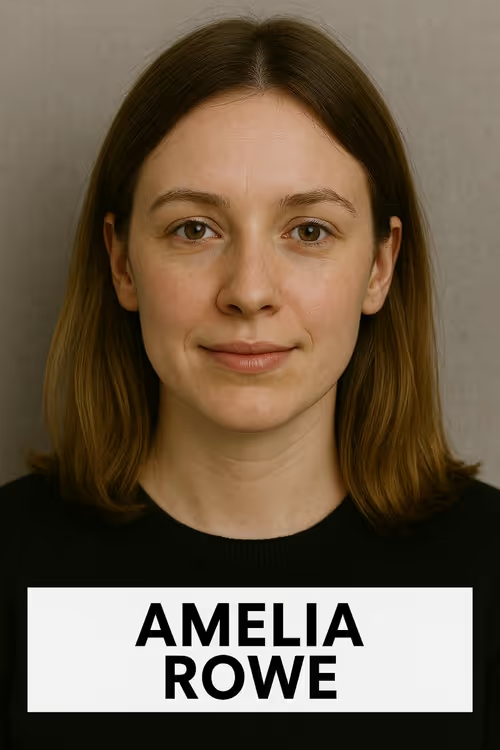
Amelia Rowe is a senior journalist at The Platinum Capital, covering banking and financial services across the Gulf and emerging markets.
Written by
Amelia Rowe
Senior correspondent · Banking & Economy
Amelia spent eight years inside a sovereign wealth fund before deciding she'd rather write about institutional money than allocate it. She covers central banking, insurance, and the macro decisions that quietly choose which markets get the next decade. Sharp on monetary policy; impatient with anyone who confuses noise with signal. Based in London. Reach out at amelia.rowe@theplatinumcapital.com.