

Rola Abu-Manneh: Standard Chartered UAE CEO Redefines Regional Banking
Rola Abu-Manneh has quietly transformed Standard Chartered's UAE operations into a powerhouse of institutional and wealth banking, steering the franchise through a period of aggressive growth that has cemented its relevance across the Gulf's most competitive financial market. Her tenure represents a masterclass in balancing global institutional discipline with the nuanced relationship-driven demands of regional banking, positioning the lender as a critical conduit between Middle Eastern capital and international markets.…
The Architect of Standard Chartered's Gulf Ambition
When Rola Abu-Manneh took the helm as Standard Chartered's UAE chief executive in 2021, the bank's regional footprint was respectable but unremarkable. Five years on, what she has built looks like a masterclass in strategic repositioning. Standard Chartered's UAE operations have grown into one of the most consequential international banking platforms in the Gulf. Assets under management in the wealth segment have surged past $12 billion. Corporate banking revenues in the Emirates have climbed by double digits year-on-year through 2025 and into the first half of 2026.
Abu-Manneh's tenure coincides with a period of extraordinary capital formation across the Gulf Cooperation Council states — sovereign diversification programmes, a boom in family office establishment, and a steady migration of high-net-worth individuals from Asia, Europe, and Africa into Dubai and Abu Dhabi. She positioned Standard Chartered at the intersection of all of it, leveraging the bank's historic strength in Asia and Africa while embedding deeply in UAE regulatory and commercial ecosystems. That combination has made her one of the most closely watched banking executives in the region.
Wealth Management as the Strategic Centre of Gravity
The most visible pillar of Abu-Manneh's strategy has been an aggressive expansion of Standard Chartered's private banking and wealth management capabilities in the UAE. In early 2026, the bank opened a dedicated private banking centre in the Dubai International Financial Centre, staffed with more than 40 relationship managers focused exclusively on ultra-high-net-worth clients with investable assets exceeding $5 million. That followed a string of senior hires poached from Credit Suisse's legacy Middle East operations, UBS, and Julius Baer throughout 2024 and 2025.
The timing was sharp. Dubai's family office sector has expanded at a staggering pace. The Dubai International Financial Centre Authority reported that over 900 single-family offices were registered within its jurisdiction by the end of 2025. Fewer than 100 existed just four years earlier. That is a remarkable shift. Abu Dhabi Global Market has seen comparable growth. Abu-Manneh recognised early that these entities needed banking partners capable of providing not merely custody and execution services but sophisticated cross-border structuring — particularly along the Asia-Middle East-Africa corridor, where Standard Chartered's network gives it a structural advantage over European and American rivals.
"The families moving capital into the UAE are not simply seeking a safe harbour," Abu-Manneh told delegates at the Global Financial Forum in Abu Dhabi in February 2026. "They are looking for platforms that connect them to growth markets in South and Southeast Asia, in sub-Saharan Africa, and increasingly in Central Asia. That is precisely where our network delivers something no competitor can replicate."
Corporate and Institutional Banking: Riding the Diversification Wave
Beyond wealth, Abu-Manneh has sharpened Standard Chartered's corporate banking proposition to capture revenue from the UAE's economic diversification agenda. The bank played a role in several landmark transactions in the renewable energy and technology infrastructure sectors, including acting as a joint lead arranger on a $1.4 billion green financing facility for a major Abu Dhabi-based clean energy developer in late 2025. It also served as a bookrunner on two significant sukuk issuances during the first quarter of 2026, reinforcing its credentials in Islamic capital markets.
Transaction banking revenues in the UAE grew approximately 18 percent in 2025, driven by increased trade finance flows between the Gulf and the Indian subcontinent — a corridor where Standard Chartered's presence in both India and the Emirates gives it a formidable competitive position. Abu-Manneh has invested heavily in digitising trade finance workflows. By the end of 2025, the bank processed over 60 percent of its UAE trade transactions through its digital platform, up from roughly 35 percent in 2023.
Her focus on the China-Gulf trade axis has also paid off. As Chinese firms deepen their presence in the UAE's free zones and logistics hubs, Standard Chartered has captured a meaningful share of renminbi-denominated trade settlement business. The bank reported a 25 percent increase in RMB transaction volumes through its UAE operations in 2025. Few outside the region have noticed, but that number reflects Abu-Manneh's emphasis on leveraging the bank's deep roots in mainland China and Hong Kong to serve a corridor most Western competitors barely touch.
Regulatory Capital and the Central Bank Relationship
Abu-Manneh's influence extends well beyond commercial strategy. She has cultivated a constructive relationship with the Central Bank of the UAE, serving on several advisory panels related to financial stability and digital assets regulation. When the CBUAE introduced its enhanced framework for stablecoin regulation in 2025, Standard Chartered was among the first international banks to secure a licence to offer regulated digital asset custody services to institutional clients in the Emirates.
That regulatory proximity has also helped the bank maintain a strong capital position. Standard Chartered's UAE subsidiary reported a Common Equity Tier 1 ratio comfortably above 14 percent through 2025, providing ample headroom for further balance sheet expansion. Abu-Manneh has signalled that the bank intends to grow its UAE loan book by 10 to 12 percent in 2026, with a particular emphasis on mid-cap corporate lending and secured wealth financing.
The Competitive Chessboard and What Comes Next
Abu-Manneh operates in an increasingly crowded competitive environment. HSBC has doubled down on its Gulf wealth strategy, hiring aggressively in Dubai and Riyadh. JPMorgan Chase expanded its UAE private banking presence in 2025. Regional champions such as Emirates NBD and First Abu Dhabi Bank continue to scale their own wealth platforms with ambitions that extend well beyond domestic borders. Citi's re-entry into consumer wealth in select Gulf markets adds further pressure.
Yet Standard Chartered's differentiation under Abu-Manneh remains clear. No other international bank in the UAE can offer comparable on-the-ground capabilities simultaneously across Africa, South Asia, Southeast Asia, and Greater China. For the growing cohort of Gulf-based family offices and corporates whose investment and trading interests span these geographies, this network effect is not merely convenient — it is essential infrastructure.
The question now is whether Abu-Manneh can sustain this momentum as the bank's group leadership, under CEO Bill Winters, evaluates broader strategic options for its global portfolio. Reports in early 2026 suggested that Standard Chartered's board had discussed further capital allocation toward the Middle East, potentially including an expansion into Saudi Arabia's rapidly liberalising financial sector. If Abu-Manneh is entrusted with leading that push, her influence within the group — and across Gulf banking — will only grow.
For now, the results speak clearly. In a region where international banks have historically struggled to move beyond transactional relevance, Rola Abu-Manneh has built something more durable: a platform that matters.
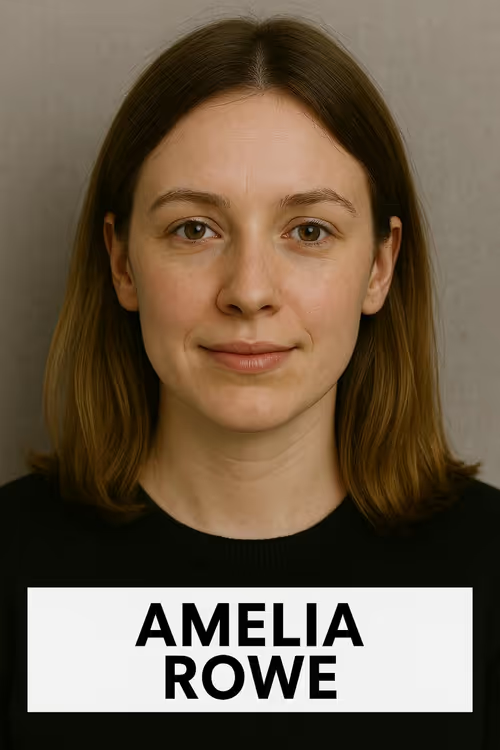
Written by
Amelia Rowe
Senior correspondent · Banking & Economy
Amelia spent eight years inside a sovereign wealth fund before deciding she'd rather write about institutional money than allocate it. She covers central banking, insurance, and the macro decisions that quietly choose which markets get the next decade. Sharp on monetary policy; impatient with anyone who confuses noise with signal. Based in London. Reach out at amelia.rowe@theplatinumcapital.com.