The New Energy Geopolitics: Oil, Gas, and Critical Minerals
The global energy transition is not diminishing resource competition but fundamentally reshaping it, as nations that once wielded influence through petroleum reserves now find themselves sidelined by countries controlling lithium, cobalt, and rare earth supply chains essential to the electrified economy. From the Congo's mineral corridors to China's refining dominance and the fractured politics of Middle Eastern oil producers seeking relevance in a decarbonising world, the struggle over energy resources remains the defining fault line of twenty-first-century geopolitics.…
The New Energy Geopolitics: Oil, Gas, and Critical Minerals
When Saudi Arabia's Aramco signed a $7 billion strategic partnership with China's Rongsheng Petrochemical in February 2026 to co-develop a mega-refinery complex in Zhejiang province, the deal carried significance far beyond barrels and basis points. It was the latest signal that the global energy order is being redrawn — not by ideology, but by the cold logic of resource control, supply chain dominance, and sovereign wealth preservation. For private capital, family offices, and Gulf-based investors, the implications are profound and immediate.
The old framework — in which oil and gas served as the primary currencies of geopolitical power — hasn't been replaced. It has been expanded. Critical minerals, from lithium and cobalt to rare earth elements and gallium, now sit alongside hydrocarbons in a broader matrix of strategic resources. The nations and companies that control these inputs will shape the next quarter-century of industrial policy, defence capability, and wealth creation.
The Gulf's Strategic Pivot: From Exporter to Energy Architect
The Gulf Cooperation Council states have moved decisively beyond their traditional role as hydrocarbon exporters. Abu Dhabi's ADNOC, under Sultan Al Jaber's continued leadership, has committed $23 billion in capital expenditure for 2026, with nearly 40 percent allocated to gas expansion, petrochemicals integration, and lower-carbon energy ventures. The company's acquisition of a 24.9 percent stake in Austria's OMV chemicals division, completed in late 2025, captures a broader strategy in miniature: move downstream, acquire technical capability, and embed Gulf capital into European industrial infrastructure.
Saudi Arabia's approach mirrors this ambition but adds a distinctive minerals dimension. The kingdom's $2.6 billion investment in the Mansourah-Massarah gold and copper project, operated by Ma'aden, reached full production capacity in early 2026. More telling, the Public Investment Fund has channelled approximately $15 billion into mining and processing assets across Africa, including significant lithium stakes in the Democratic Republic of Congo and a phosphate joint venture with Morocco's OCP Group. Crown Prince Mohammed bin Salman's stated objective — to make Saudi Arabia a global mining hub generating $75 billion in annual revenue by 2035 — is no longer aspirational rhetoric. It is a funded programme with real assets behind it.
Critical Minerals: The New Petroleum
The International Energy Agency's 2026 Global Critical Minerals Outlook reported that demand for lithium is projected to increase sixfold by 2035, while cobalt and nickel demand will more than triple. Yet production remains extraordinarily concentrated. The DRC accounts for roughly 73 percent of global cobalt output. China controls 65 percent of rare earth mining and approximately 90 percent of rare earth processing. Indonesia dominates nickel, producing over 55 percent of the world's supply. That kind of concentration doesn't just create supply risk — it creates leverage.
Indonesia proved the point in January 2026 when it imposed graduated export levies on processed nickel — ranging from 5 to 15 percent depending on value-added content — sending shockwaves through battery supply chains. Tesla, which sources significant volumes of Indonesian nickel through contracts with Vale Indonesia, disclosed in its Q1 2026 earnings call that input costs for its battery division had risen 8 percent year-on-year, partly attributable to the new levies.
For family offices and private wealth allocators with exposure to the energy transition, these dynamics demand granular attention. The Friedman Family Office in Zurich, which manages approximately $4 billion, disclosed in its annual letter that it had increased its allocation to critical minerals royalty companies — including Franco-Nevada and Wheaton Precious Metals — by 300 basis points during 2025, describing the sector as "the most asymmetric risk-reward opportunity in real assets today."
Gas as the Bridge Commodity — and a Geopolitical Weapon
Natural gas, frequently overshadowed by the drama of oil price cycles and the promise of renewables, has re-emerged as perhaps the most consequential commodity in global energy politics. Europe's painful decoupling from Russian pipeline gas — now effectively complete — has created structural demand for LNG that will persist for at least two decades. Qatar Energy's North Field expansion, which will boost the country's LNG capacity from 77 million to 126 million tonnes per annum by 2028, positions Doha as the single most important swing supplier for European and Asian buyers. That is a remarkable amount of leverage for a country of three million people.
The United States, meanwhile, has become the world's largest LNG exporter, shipping 105 billion cubic metres in 2025. But the Biden-era pause on new LNG export terminal approvals — partially reversed under the current administration — created uncertainty that pushed several major projects, including Sempra's Port Arthur Phase 2 and NextDecade's Rio Grande facility, into delayed timelines. The result: a projected supply gap in global LNG markets between 2027 and 2030 that Goldman Sachs estimates could push spot prices to $18-22 per MMBtu, compared with the current $12 range. That is a significant shift.
For Gulf sovereign wealth funds, this gap represents both a strategic advantage and an investment opportunity. The Qatar Investment Authority has increased its stakes in downstream gas infrastructure across Southeast Asia, including a reported $1.2 billion investment in Vietnam's Bac Lieu LNG import terminal project. Mubadala, Abu Dhabi's sovereign investor, has taken significant positions in US midstream gas companies, including a $900 million commitment to Enterprise Products Partners.
Private Capital's Role in the Resource Reordering
The reconfiguration of energy geopolitics is creating a distinctive set of opportunities for private capital that is patient, well-advised, and comfortable with jurisdictional complexity. Mining royalty streams, LNG offtake agreements, and downstream processing joint ventures offer yield profiles and inflation protection that traditional fixed income simply cannot match right now.
Several prominent multi-family offices in the Gulf have established dedicated natural resources allocation teams. The Olayan Group, with assets exceeding $10 billion, has reportedly built a portfolio of minority stakes in African mining concessions through a Luxembourg-domiciled vehicle structured specifically for long-duration resource exposure. The Al Ghurair family's investment arm in Dubai has pivoted a portion of its real estate gains into cobalt processing facilities in Zambia, partnering with Glencore's existing operations. Few outside the region have noticed.
But risk remains substantial. Resource nationalism, regulatory volatility, and the ever-present threat of technological substitution — solid-state batteries could dramatically reduce cobalt dependency, for instance — all require sophisticated scenario planning. The investors best positioned are those treating energy geopolitics not as a thematic allocation but as a permanent feature of portfolio architecture, one demanding the same rigour and continuous oversight as any core holding.
A World Defined by What Lies Underground
The energy transition has not diminished the geopolitical importance of extractive resources. It has multiplied it. Where once the conversation centred on a handful of oil-producing states, today's strategic map encompasses lithium fields in Chile, rare earth deposits in Myanmar, gas terminals on the Texas Gulf Coast, and copper mines in the Arabian Shield. For sovereign wealth funds, family offices, and private investors with generational time horizons, understanding this expanded resource geography is no longer optional. It is the prerequisite for preserving and growing wealth in an era where what lies beneath the earth's surface will determine who holds power above it.
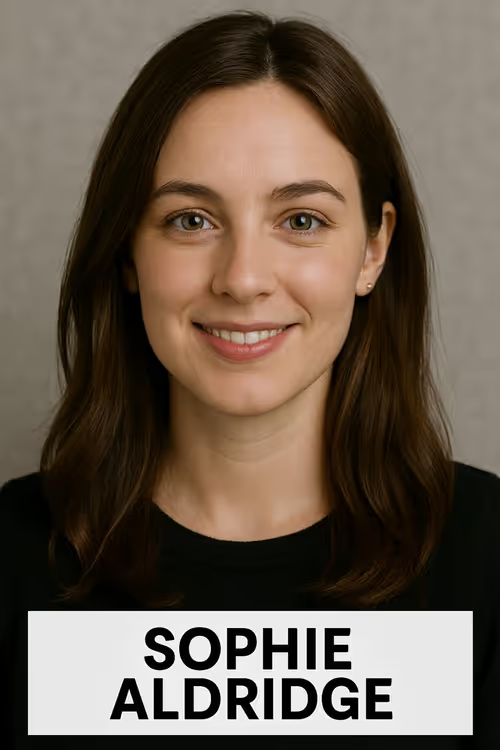
Written by
Sophie Aldridge
Global Economics Editor · Geopolitics
Sophie spent a decade advising governments on trade policy before deciding the story was more interesting than the memo. She covers global economics, geopolitics, and the power transitions reshaping emerging markets. Sharpest on sanctions, supply chains, and the politics behind the price of everything. Based in Washington, D.C. Reach out at sophie.aldridge@theplatinumcapital.com.