Sanctions as Economic Weapons: Effectiveness and Blowback
International sanctions have evolved into the primary coercive instrument of Western foreign policy, yet mounting evidence suggests their track record in achieving stated political objectives remains strikingly poor, succeeding in barely a third of cases while imposing severe humanitarian costs on civilian populations. Meanwhile, the aggressive weaponisation of the dollar-based financial system is accelerating precisely the kind of dedollarisation and alternative payment infrastructure development that threatens to erode the very leverage on which sanctions depend.…
The Sanctions Paradox: When Economic Weapons Rearm the Target
In March 2026, Russia's central bank reported foreign exchange reserves of $587 billion — roughly $4 billion more than it held the week before Western nations froze approximately $300 billion of its assets in 2022. The number is partially reconstructed through gold revaluation and yuan-denominated holdings. But it illustrates an uncomfortable truth that policymakers in Washington, Brussels, and London are only beginning to reckon with: sanctions, the West's preferred instrument of coercion short of war, are producing diminishing returns and accelerating the very multipolar financial architecture they were designed to prevent.
For investors across the Gulf, emerging markets, and the global private wealth ecosystem, the implications are structural, not cyclical. The question is no longer whether sanctions work. It's who ultimately bears the cost — and who profits from the friction.
The Effectiveness Debate: A Scorecard That Disappoints
The empirical record is sobering. A comprehensive study published in January 2026 by the Peterson Institute for International Economics found that of 204 sanctions episodes initiated since 2000, only 29 percent achieved their stated policy objectives. Target a major economy with diversified trade relationships, and the success rate drops to 13 percent. Russia's GDP, which contracted 2.1 percent in 2022, grew an estimated 3.6 percent in 2024 and 2.8 percent in 2025, according to IMF projections, buoyed by redirected energy exports, wartime fiscal stimulus, and a shadow fleet of over 600 tankers that continues to circumvent the G7 oil price cap.
Iran offers a longer-term case study. Despite being subject to the most comprehensive sanctions regime in modern history, Tehran's crude exports climbed to approximately 1.8 million barrels per day in late 2025, primarily routed through intermediaries in the UAE, Oman, and Malaysia. The Islamic Republic's economy remains stunted — per capita GDP sits roughly 30 percent below its 2011 peak — but regime change, the implicit maximalist goal, appears no closer. Meanwhile, the humanitarian toll on ordinary Iranians has been extensively documented by the UN Human Rights Council.
The pattern repeats with variations in Venezuela, Myanmar, and North Korea. Sanctions impose genuine economic pain but rarely alter the strategic calculus of determined authoritarian governments. What they do create is a compliance industry, a sanctions-evasion industry, and a geopolitical realignment that strengthens alternative financial networks.
Gulf States: The Art of Strategic Neutrality
Nowhere is the blowback more visible — or more profitable — than in the Gulf. The UAE processed an estimated $68 billion in redirected Russian trade flows in 2023 and 2024, according to data compiled by the Centre for Research on Energy and Clean Air. Dubai's real estate market absorbed roughly $4.2 billion in Russian-linked capital during the same period, much of it channeled through corporate structures in the DIFC and ADGM free zones that technically comply with local regulations while frustrating Western enforcement agencies. Few outside the region have noticed just how quickly these flows became routine.
Saudi Arabia, through its Aramco trading arm, has become a significant buyer of discounted Russian crude for domestic refining, freeing Saudi barrels for export at Brent-linked premiums. The kingdom's sovereign wealth fund, the Public Investment Fund, with assets now exceeding $930 billion, has steadily diversified its counterparty relationships away from exclusively Western financial institutions. In February 2026, PIF completed a $3.2 billion private credit facility arranged by China's CITIC Securities and Abu Dhabi's Mubadala. That is a significant shift. Five years ago, that transaction would have been routed through JPMorgan or Goldman Sachs.
Qatar's QIA has taken a subtler approach, maintaining its deep Western investment portfolio while simultaneously expanding bilateral investment treaties with sanctioned or semi-sanctioned jurisdictions. The calculus is pragmatic: Gulf sovereign wealth funds manage multi-generational capital and cannot afford to be locked into a single geopolitical bloc's financial infrastructure.
Family Offices and Private Wealth: Compliance as Competitive Moat
For the estimated 15,000 single-family offices worldwide managing combined assets north of $6 trillion, the sanctions environment has created both risk and opportunity. Compliance costs have surged — Deloitte's 2026 Global Family Office Survey reported a 340 percent increase in sanctions-related legal and advisory spending since 2021. Multi-jurisdictional families, particularly those with members holding passports from sanctioned or grey-listed nations, face escalating difficulties opening accounts, executing cross-border transactions, and maintaining relationships with prime brokers.
Yet for well-advised offices, the friction generates alpha. Lombard Odier's private markets division reported in its Q1 2026 investor letter that secondary market discounts on stakes in Russian-exposed private equity funds widened to 70-85 cents on the dollar, creating opportunities for buyers with appropriate legal clearance. Singapore-based family offices, which now number over 2,400 following the city-state's aggressive licensing push, have emerged as intermediaries for capital flows that no longer pass comfortably through London or Zurich.
The real risk, however, is reputational. In April 2026, HSBC's wealth division exited relationships with 14 family office clients in Dubai and Singapore after internal reviews flagged indirect exposure to sanctioned Russian metals and mining interests. That episode exposed a growing tension: Western banks are becoming more conservative precisely as their Gulf and Asian competitors become more accommodating.
The Dollar's Quiet Erosion and What Comes Next
The most consequential blowback may be systemic. The weaponisation of the dollar-based payments system — particularly the freezing of Russian central bank reserves, an action without modern precedent against a G20 economy — has catalysed a slow but measurable shift in global reserve composition. The dollar's share of allocated foreign exchange reserves fell to 57.3 percent in Q3 2025, down from 59.2 percent in 2021, according to IMF COFER data. China's Cross-Border Interbank Payment System processed $18.6 trillion in transactions during 2025, up from $13 trillion the prior year. That kind of growth doesn't reverse easily.
None of this suggests the dollar's imminent demise. No alternative currency offers comparable depth, liquidity, or institutional trust. But at the margins — and margins matter enormously in an $800 trillion global financial system — the plumbing is being duplicated. India's rupee settlement mechanism with Russia, Brazil's proposal for BRICS-denomination trade credits, and the UAE's digital dirham pilot with China's e-CNY all represent small but cumulative challenges to dollar hegemony.
For policymakers, the lesson is not that sanctions should be abandoned but that they must be deployed with far greater strategic precision and realistic expectations. For investors and wealth principals across the Gulf and emerging markets, the lesson is different but equally urgent: the financial order that prevailed from 1991 to 2022 is being stress-tested in real time, and portfolio construction must account for a world in which the rules of economic engagement are no longer written exclusively in Washington.
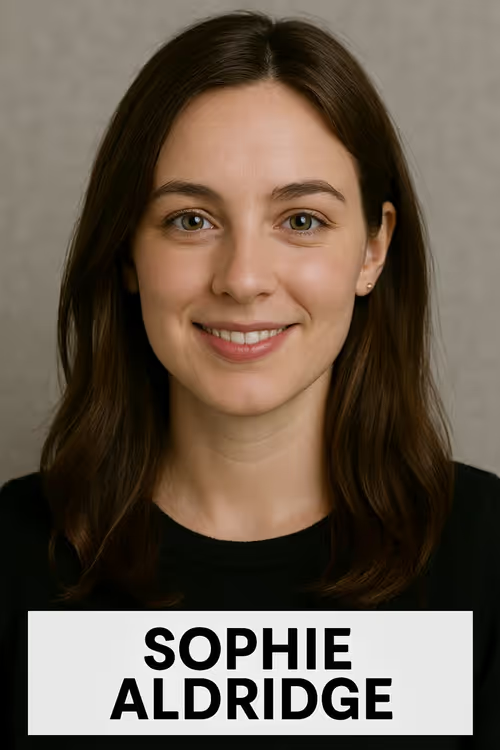
Written by
Sophie Aldridge
Global Economics Editor · Geopolitics
Sophie spent a decade advising governments on trade policy before deciding the story was more interesting than the memo. She covers global economics, geopolitics, and the power transitions reshaping emerging markets. Sharpest on sanctions, supply chains, and the politics behind the price of everything. Based in Washington, D.C. Reach out at sophie.aldridge@theplatinumcapital.com.