

Riyadh's Commercial Property Market and Vision 2030
Riyadh's commercial property market is undergoing a seismic transformation as Vision 2030 channels unprecedented capital into megaprojects, corporate relocations, and mixed-use developments that are fundamentally reshaping the kingdom's economic geography. With multinational firms now mandated to establish regional headquarters in the capital and Grade A office vacancy rates tightening sharply, the city is rapidly positioning itself as the Middle East's preeminent business hub, drawing institutional investors seeking exposure to one of the world's most ambitious urban reinventions.…
Riyadh's Commercial Property Market and Vision 2030
When Saudi Arabia's Public Investment Fund announced in early 2026 that office occupancy rates in Riyadh's Grade A commercial towers had surpassed 99 percent, it confirmed what global investors had been tracking for three years: the Kingdom's capital has become one of the most constrained — and consequently most lucrative — commercial property markets in the world. The mandatory regional headquarters programme and an unprecedented wave of state-backed megaproject spending have fundamentally altered the economics of Gulf real estate, pulling family offices, sovereign wealth vehicles, and private equity firms into an increasingly competitive arena.
The Supply-Demand Imbalance Reshaping Rents
Riyadh's commercial property market in 2026 operates under conditions of structural undersupply that show few signs of easing before 2028. Knight Frank's Saudi Arabia Market Review, published in Q1 2026, pegged Grade A office rents in the King Abdullah Financial District (KAFD) at roughly 30 percent above year-ago levels, with prime space commanding upwards of SAR 2,800 per square metre annually. JLL's regional team estimates the city needs an additional 3 million square metres of office space by 2030 to house the multinational headquarters mandated under the Regional Headquarters Programme. That programme has already compelled more than 540 companies — including PwC, Deloitte, BCG, and Unilever — to establish substantive operations in the capital.
The pressure doesn't stop at offices. Retail and mixed-use commercial space in districts such as Al Olaya and the Diplomatic Quarter commands premium rates, while hospitality assets get absorbed almost as quickly as they're delivered. Marriott International, Accor, and Hilton collectively have more than 15,000 rooms under development across Riyadh, yet average daily rates at five-star properties exceeded $350 in the first quarter of 2026, according to STR Global data. That is a striking number. For investors accustomed to the mature, yield-compressed markets of London or Singapore, these dynamics present an unusual combination of capital appreciation potential and income generation.
Megaprojects as Market Catalysts
Vision 2030's signature megaprojects are no longer speculative blueprints. They are active construction sites reshaping the commercial geography of northern and western Riyadh. The $500 billion NEOM development continues to absorb capital and contractor capacity, but the projects within Riyadh's metropolitan boundary are the ones most directly moving commercial property valuations.
King Salman Park, billed as the world's largest urban park, has triggered a ring of mixed-use commercial development across its perimeter. The New Murabba project, anchored by the 400-metre cubic structure known as the Mukaab, is designed to deliver 104,000 square metres of premium retail and 9,000 hotel rooms within a 19-square-kilometre precinct. The Diriyah Gate Company, meanwhile, has accelerated delivery timelines for its heritage-driven commercial and hospitality district, with Phase One handovers now scheduled for late 2026.
These projects act as gravitational centres for private capital. The Olayan Group, one of Saudi Arabia's most established family conglomerates, has reportedly increased its allocation to Riyadh commercial assets by 40 percent since 2024. Kingdom Holding, controlled by Prince Alwaleed bin Talal, continues to expand its Riyadh portfolio through its stake in the Four Seasons Hotel and Tower complex at KAFD. For Gulf-based family offices, proximity to these state-backed projects offers a degree of implicit risk mitigation that purely private developments simply cannot match.
Foreign Capital and the Institutional Bid
The entry of foreign institutional capital into Riyadh's commercial market has shifted from tentative to assertive. That is a significant shift. Brookfield Asset Management established a dedicated Saudi platform in 2024 and has since deployed more than $2 billion across logistics, office, and mixed-use assets in partnership with local entities. Abu Dhabi's Mubadala Investment Company, through its real estate arm, has taken positions in KAFD-adjacent developments. Goldman Sachs and JPMorgan, both of which relocated regional operations to Riyadh, have expanded their Saudi real estate advisory desks to service demand from European and Asian institutional allocators.
The regulatory architecture has evolved to accommodate this influx. The Saudi Capital Market Authority's updated REIT framework, revised in late 2025, now permits greater foreign ownership thresholds and has simplified listing requirements for commercial property trusts. Riyad REIT and Al Rajhi REIT, two of the Kingdom's largest listed vehicles, reported combined assets under management exceeding SAR 18 billion in their most recent filings. For private wealth clients and multi-family offices seeking Shariah-compliant exposure to Gulf real estate, these vehicles offer liquidity and governance structures that direct property ownership simply cannot replicate.
Risks Beneath the Surface
The trajectory is not without friction. Construction cost inflation remains a persistent headache, with reinforced steel and ready-mix concrete prices in Riyadh running 18 to 22 percent above 2023 levels, according to data from the Saudi Contractors Authority. Labour availability, despite reforms to the Kafala sponsorship system, continues to constrain project timelines. Several mid-tier commercial developments originally slated for 2026 completion have already slipped into 2027 or beyond. Few outside the region have noticed.
Then there's the question of absorption beyond 2030. Should the pipeline of roughly 5 million square metres of new commercial space — as estimated by CBRE's Riyadh office — deliver in concentrated fashion between 2028 and 2031, the market could tip from undersupply to a more balanced, or even temporarily oversupplied, state. Investors with shorter time horizons should model for rent stabilisation or modest correction in the early 2030s, particularly in secondary locations outside KAFD and the Diplomatic Quarter.
Currency risk, while structurally muted by the Saudi riyal's peg to the US dollar, introduces indirect exposure through interest rate transmission. The Saudi Central Bank's mirroring of Federal Reserve policy means financing costs for leveraged commercial acquisitions fluctuate with US monetary conditions — a dynamic that several family offices have addressed by deploying equity-heavy capital structures.
The Strategic Calculus for Private Wealth
For high-net-worth investors and family offices evaluating Riyadh's commercial property market in 2026, the opportunity reads less like a cyclical trade and more like a structural repositioning of capital toward one of the few emerging markets undertaking genuine economic diversification at scale. Saudi Arabia's non-oil GDP growth, which the International Monetary Fund projected at 4.2 percent for 2026, provides a macroeconomic foundation that few peer markets can match.
The most sophisticated allocators have already moved beyond direct office acquisitions. They're building hybrid strategies that combine REIT exposure, co-investment alongside sovereign-linked developers, and selective positions in logistics and last-mile commercial assets driven by the Kingdom's e-commerce expansion. Firms such as Sidra Capital and Hassana Investment Company have structured vehicles specifically designed for this multi-asset approach.
Riyadh's commercial market is no longer an emerging story. It is an arrived one — with all the complexity, competitive intensity, and rigorous underwriting demands that status implies. The capital flowing into the Saudi capital in 2026 is neither speculative nor sentimental. It is strategic, and it is substantial.
Tom Whitmore is a senior journalist at The Platinum Capital covering real estate and alternative assets across the Gulf and emerging markets.
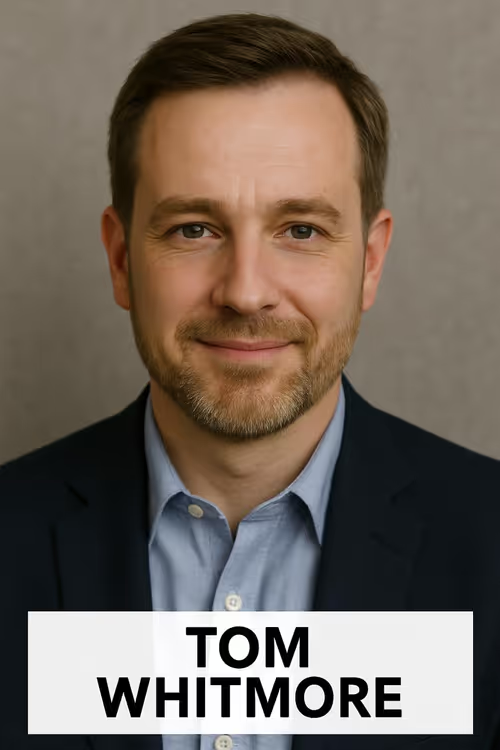
Written by
Tom Whitmore
Senior correspondent · Real Estate & Private Companies
Tom has interviewed most of the operators reshaping the Gulf skyline — and a few of the ones who tried and didn't. His beat is real estate, commodities, manufacturing, and the founder-led private companies that never bother to list. He knows which buildings and balance sheets survive a downturn before the spreadsheet does. Based in Dubai. Reach out at tom.whitmore@theplatinumcapital.com.