

Riyadh's Commercial Property Market and Vision 2030
Riyadh's commercial property market is undergoing a structural transformation as Vision 2030 drives unprecedented demand for Grade A office space, with multinational corporations establishing regional headquarters in the capital and vacancy rates in prime districts tightening sharply. The confluence of regulatory mandates requiring foreign firms to base operations in the kingdom, coupled with ambitious giga-project development pipelines, is reshaping valuations and positioning Riyadh as the Gulf's most consequential emerging commercial real estate market.…
Riyadh's Commercial Property Market Reaches Inflection Point as Vision 2030 Reshapes Capital Flows
The numbers tell a story that even the most cautious institutional investors can no longer ignore. Riyadh's commercial property market recorded transactions worth SAR 48 billion in 2025 — a figure that has doubled since 2022 — and one that is forcing a fundamental recalibration of how global capital allocates to Gulf real estate. Multinational corporations are rushing to establish regional headquarters in the Saudi capital, a requirement enforced since January 2024. The knock-on effects across Grade A office supply, mixed-use development, and hospitality infrastructure have created what may be the most consequential commercial real estate story in emerging markets today.
For family offices and private wealth managers with exposure to Gulf assets, the question is no longer whether Riyadh warrants attention. It's how to position within a market that is simultaneously overheating in certain segments and offering generational entry points in others.
The Regional Headquarters Programme: Structural Demand by Decree
The Public Investment Fund's Regional Headquarters Programme mandates that companies seeking Saudi government contracts maintain their Middle East base in Riyadh. The results have exceeded initial projections. By the first quarter of 2026, more than 540 multinational companies had relocated or established regional headquarters in the city, according to the Ministry of Investment. PwC, Deloitte, Bechtel, Unilever, Siemens Energy — firms that collectively require hundreds of thousands of square metres of prime office space — are among them.
This policy-driven demand has compressed Grade A office vacancy rates in Riyadh's King Abdullah Financial District (KAFD) to below 3 per cent. That is down from approximately 40 per cent as recently as 2019, when the district was widely written off as a white elephant. Knight Frank's 2026 Saudi Arabia Market Review reported prime office rents in KAFD rising 12 per cent year-on-year, reaching SAR 2,400 per square metre — levels that now rival Dubai International Financial Centre. That is a significant shift.
The transformation shows up most clearly in the pipeline. The Royal Commission for Riyadh City has approved commercial developments totalling over 3.2 million square metres of gross leasable area scheduled for delivery between 2026 and 2030. Yet even this ambitious supply trajectory may prove insufficient. JLL estimates that Riyadh faces a shortfall of approximately 1.5 million square metres of Grade A office space through 2030 if current absorption rates persist.
Giga-Projects and the Multiplication Effect
Riyadh's commercial ambitions extend well beyond conventional office towers. King Salman Park, the Diriyah Gate development, and the New Murabba — a SAR 50 billion project anchored by a cube-shaped structure called "The Mukaab" — are redrawing the city's commercial geography. New Murabba Development Company, a PIF subsidiary, broke ground in 2024 and has already pre-leased approximately 30 per cent of its 1.4 million square metres of commercial and retail space to international tenants.
Diriyah Gate, developed by the Diriyah Gate Development Authority, is positioning itself as a luxury mixed-use destination with commercial components targeting wealth management, private banking, and family office operations. Armani Hotels and Aman Resorts have signed on as anchor tenants for the hospitality segment. The commercial precinct, meanwhile, is courting Swiss and Singaporean private banks seeking a permanent Saudi presence. Few outside the region have noticed.
For private wealth allocators, the giga-projects present both opportunity and risk. The sheer scale of PIF-backed developments provides infrastructure certainty that few emerging market cities can match. But the concentration of development authority within sovereign entities creates execution dependencies that institutional investors must price accordingly.
Capital Flows and the Family Office Migration
The most underreported dimension of Riyadh's commercial property surge may be the capital reallocation underway among Gulf-based family offices. Research from Campden Wealth's 2025 Global Family Office Report showed that Saudi family offices increased their direct real estate allocations by 18 percentage points between 2023 and 2025, with Riyadh commercial assets representing the dominant share.
The Olayan Group, one of Saudi Arabia's most prominent family-controlled conglomerates, has expanded its Riyadh commercial portfolio by an estimated SAR 4 billion since 2023, with significant acquisitions in the Hittin and Al Nakheel districts. SEDCO Holding, the investment arm of the Bin Mahfouz family, has channelled capital into Riyadh logistics and light industrial assets, betting that e-commerce fulfilment infrastructure will generate superior risk-adjusted returns compared to trophy office towers.
International family offices are following the money. Brookfield Asset Management opened a Riyadh office in 2024, and by early 2026, the Canadian firm had deployed approximately $2 billion across Saudi real estate and infrastructure, with commercial property forming the core of its strategy. Abu Dhabi's Mubadala Investment Company has taken co-investment positions alongside PIF in several mixed-use developments, signalling sovereign-level conviction in the Riyadh thesis.
Risks That Demand Honest Assessment
The bull case for Riyadh commercial property is compelling. But it carries material risks that deserve blunt examination. Construction cost inflation remains acute. Saudi Contractors Authority data shows that building costs rose 22 per cent between 2023 and 2025, driven by labour shortages, imported materials pricing, and dozens of mega-projects competing for the same supply chain all at once. Several mid-tier developments have slipped 12 to 18 months behind schedule, raising real questions about whether the broader 2030 delivery timeline holds up.
Then there is rental sustainability. Grade A vacancy rates are exceptionally tight, yes. But the secondary and tertiary office markets in Riyadh tell a different story, with vacancy rates above 20 per cent in some older districts. A two-tier market is forming — premium assets command scarcity premiums while older stock faces structural obsolescence. Investors entering at current valuations in prime segments must reckon with the possibility that the wave of new supply arriving between 2028 and 2030 could soften rents by 8 to 15 per cent, according to CBRE's baseline scenario.
Currency risk, while historically low given the SAR's peg to the US dollar, intersects with broader macroeconomic pressures. Saudi Arabia's fiscal breakeven oil price has climbed to approximately $96 per barrel in 2026, according to the IMF. Sustained prices below that threshold could force hard choices among Vision 2030 projects — and commercial real estate could lose capital allocation to social infrastructure. That possibility is not remote.
A Market Maturing at Extraordinary Speed
What sets Riyadh apart from previous emerging market real estate booms — whether Dubai in 2006 or Mumbai in 2014 — is the degree of institutional intentionality behind the growth. The Saudi Capital Market Authority introduced REIT regulations. The Real Estate General Authority established transparency standards. PIF operates as both developer and anchor tenant. The resulting framework is imperfect, but it provides more structural support than most comparable markets at this stage of development.
For sophisticated investors — particularly Gulf-based family offices and global private wealth platforms — Riyadh's commercial property market in 2026 presents a rare alignment of policy momentum, demographic tailwinds, and genuine supply-demand imbalance. The opportunity is real. So are the execution risks. Capital deployed here over the next 24 months will likely define portfolio returns for the decade that follows.
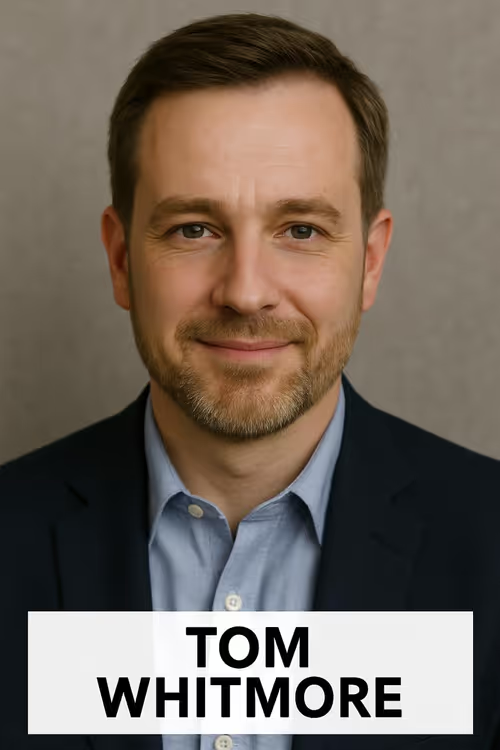
Written by
Tom Whitmore
Senior correspondent · Real Estate & Private Companies
Tom has interviewed most of the operators reshaping the Gulf skyline — and a few of the ones who tried and didn't. His beat is real estate, commodities, manufacturing, and the founder-led private companies that never bother to list. He knows which buildings and balance sheets survive a downturn before the spreadsheet does. Based in Dubai. Reach out at tom.whitmore@theplatinumcapital.com.