

Ray Dalio's All-Weather Philosophy and What Emerging Markets Can Learn From It
Ray Dalio's All-Weather portfolio strategy, built on the principle that risk can be balanced across economic regimes rather than predicted, has delivered remarkable resilience through decades of market turbulence and remains one of the most intellectually rigorous frameworks in modern asset allocation. For emerging market policymakers and institutional investors grappling with volatile capital flows, currency fragility and commodity dependence, the core lesson is not to replicate the portfolio itself but to internalise its foundational insight — that durable prosperity demands structural preparedness for every season, not leveraged bets on the one you expect.…
The Architect of Resilience
Ray Dalio did not set out to build one of the world's largest hedge funds. He set out to understand how economic machines work — and then to build portfolios that could survive anything those machines might produce. From a two-bedroom apartment in New York City in 1975, Dalio founded Bridgewater Associates, which grew into a firm managing well over $100 billion in assets at its peak, serving sovereign wealth funds, central banks, pension funds, and institutional investors across the globe. His intellectual contribution to finance, though, may ultimately prove more durable than even Bridgewater's extraordinary track record. The All-Weather portfolio strategy — a framework designed to perform reasonably well across every macroeconomic environment — has become one of the most discussed and replicated ideas in modern asset management. And for emerging market economies and their institutional investors, it offers lessons that extend far beyond portfolio construction.
The Logic Behind All-Weather
The All-Weather strategy emerged from a deceptively simple question Dalio asked himself in the mid-1990s: what kind of portfolio could he leave to his family that would hold up regardless of whether the world experienced inflation, deflation, rising growth, or falling growth? Rather than trying to predict which environment would materialise — a task at which even the most sophisticated forecasters regularly fail — Dalio proposed structuring a portfolio to perform adequately in all four quadrants of the economic cycle.
The framework rests on a core insight from risk parity theory. Traditional portfolios that appear diversified by asset class are often heavily concentrated in a single risk factor, typically equity risk. A conventional 60/40 stock-bond portfolio, for instance, derives the overwhelming majority of its volatility from the equity allocation. All-Weather seeks to balance risk contributions across asset classes — equities, long-term bonds, inflation-linked bonds, and commodities — so that no single economic outcome can devastate the portfolio. The result won't outperform in any one regime. But it avoids catastrophic underperformance in all of them. That is a significant trade-off, and a deliberate one.
This philosophy proved its worth during periods of severe market stress. During the 2008 global financial crisis, when many diversified portfolios suffered dramatic drawdowns, the All-Weather approach demonstrated its defensive characteristics. Bridgewater's Pure Alpha fund, which applies active management on top of similar macroeconomic thinking, has been widely cited as one of the most successful hedge fund strategies over multiple decades.
A Philosophy Rooted in Radical Honesty
You can't fully grasp All-Weather without understanding the intellectual culture from which it emerged. Dalio has become almost as well known for his management philosophy as for his investment strategy. His book Principles: Life and Work, published in 2017, became a global bestseller and laid out his commitment to what he calls "radical transparency" — a system in which ideas are stress-tested through open disagreement and decisions are made on the basis of meritocratic debate rather than hierarchy.
This culture of rigorous self-examination directly informs Dalio's investment worldview. The All-Weather portfolio is, at its heart, an act of intellectual humility. It acknowledges the limits of forecasting. It accepts that uncertainty is irreducible. And it responds not by seeking more information, but by building structures robust enough to withstand what cannot be known. In a financial industry often seduced by the confidence of prediction, that represents a genuinely distinctive stance.
What Emerging Markets Stand to Gain
The relevance of Dalio's framework to emerging market economies is both practical and philosophical. Many developing nations have lived through the brutal consequences of concentrated economic exposure — commodity-dependent economies devastated by price collapses, nations with dollar-denominated debt crushed by currency crises, pension systems overexposed to domestic equity markets that can lose half their value in months. The history of emerging market finance reads, in many respects, like a catalogue of the very risks All-Weather thinking is designed to mitigate.
At the sovereign level, the principle of environmental balance offers a powerful template. Several emerging market sovereign wealth funds and public pension systems remain heavily tilted toward domestic assets or single commodities. Few outside the region have noticed. The discipline of asking "what happens to this portfolio if growth slows and inflation rises simultaneously?" — a scenario painfully familiar to many developing economies — can reveal dangerous concentrations that conventional diversification metrics might miss entirely.
The risk parity concept also pushes emerging market institutional investors to think beyond nominal allocation. Holding twenty different assets means little if eighteen of them respond to the same macroeconomic driver. True diversification, as Dalio has repeatedly argued, requires diversification of risk sources, not merely asset labels. For economies where inflation volatility, currency instability, and political uncertainty amplify traditional market risks, this distinction is not academic. It is existential.
The Limits and the Invitation
No framework is without its constraints, and All-Weather is no exception. Critics have observed that the strategy's reliance on bonds benefited enormously from a multi-decade decline in global interest rates — a tailwind that may not persist. That is a significant challenge to the model's future performance. In emerging markets, where fixed income markets can be shallow, illiquid, or subject to sudden capital flight, implementing a pure risk parity approach presents practical problems that simply do not exist in developed economies. Access to inflation-linked instruments, commodity futures, and long-duration government bonds varies dramatically across developing nations.
Yet the deeper invitation of Dalio's work is not to replicate a specific allocation but to adopt a specific mode of thinking. The All-Weather philosophy asks investors and policymakers to confront their assumptions about the future, to build for scenarios they consider unlikely, and to measure success not by maximum returns in good times but by survivability across all times. For emerging economies — where the cost of being wrong is often borne by the most vulnerable citizens — this discipline carries a moral weight as well as a financial one.
Dalio has spent five decades refining a worldview that treats uncertainty not as an obstacle to be overcome but as a permanent condition to be respected. As emerging markets continue to build institutional capacity, deepen capital markets, and seek resilience against shocks both familiar and unprecedented, the intellectual legacy of All-Weather thinking offers something genuinely valuable: not a formula, but a framework for surviving what cannot be foreseen.
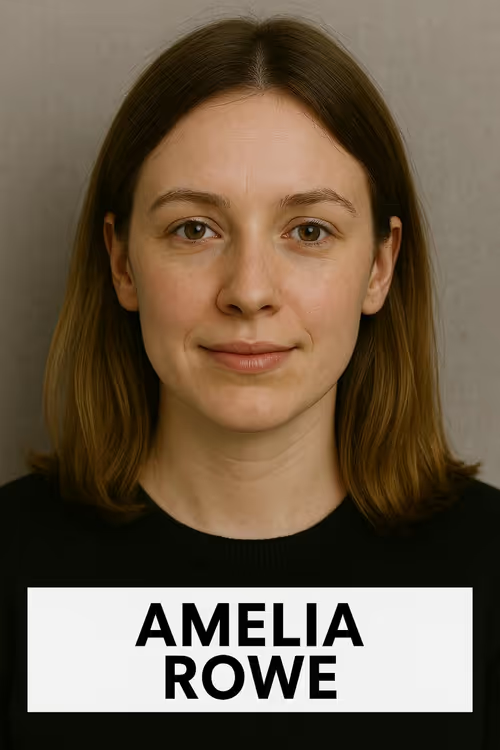
Amelia Rowe is a senior journalist at The Platinum Capital, covering global finance and institutional investment strategy.
Written by
Amelia Rowe
Senior correspondent · Banking & Economy
Amelia spent eight years inside a sovereign wealth fund before deciding she'd rather write about institutional money than allocate it. She covers central banking, insurance, and the macro decisions that quietly choose which markets get the next decade. Sharp on monetary policy; impatient with anyone who confuses noise with signal. Based in London. Reach out at amelia.rowe@theplatinumcapital.com.