

Sultan Al Jaber's Dual Role: ADNOC Chief and the Energy Transition Architect
Sultan Al Jaber's simultaneous stewardship of one of the world's largest hydrocarbon producers and his presidency of COP28 encapsulates the central paradox of the global energy transition — that the very actors most entrenched in fossil fuel economies may wield the capital, technical infrastructure and political leverage necessary to accelerate decarbonisation at scale. Whether this duality represents an irreconcilable conflict of interest or a pragmatic blueprint for managed transition will likely define the credibility of multilateral climate diplomacy for years to come.…
The Man at the Intersection of Oil and Ambition
Few figures in global energy command as much scrutiny — or as much influence — as Sultan Ahmed Al Jaber. He runs the Abu Dhabi National Oil Company (ADNOC), one of the world's largest hydrocarbon producers. He also chairs Masdar, the UAE's flagship renewable energy company. That dual role alone would make him a lightning rod. But his appointment as President of COP28, the United Nations climate summit held in Dubai in late 2023, dropped him squarely into the most contentious debate on the planet: how to reconcile fossil fuel production with the urgent demands of decarbonisation. His supporters call him a pragmatist uniquely positioned to bridge two worlds. His critics say the contradiction is the point. What nobody disputes is that Al Jaber has become one of the most consequential energy figures of his generation.
An Engineer Turned Energy Strategist
Born in 1973, Al Jaber holds a PhD in business and economics from Coventry University in the United Kingdom and an engineering degree from the University of Colorado Boulder. His career arc mirrors the UAE's own evolution from a hydrocarbon-dependent economy toward something more diversified. He joined ADNOC in the 1990s and climbed through the ranks, eventually landing the group CEO role in 2016 — appointed by President Sheikh Mohamed bin Zayed Al Nahyan, then the Crown Prince of Abu Dhabi. Under his watch, ADNOC has undergone a sweeping modernisation programme, shedding its reputation as a relatively conservative state oil company and reinventing itself as an internationally ambitious energy conglomerate with downstream expansion, strategic partnerships across Asia and Europe, and a growing presence in petrochemicals and natural gas.
Al Jaber also played a founding role in Masdar in 2006, serving as its chief executive before becoming chairman. Masdar City, the clean-energy district in Abu Dhabi that served as the company's centrepiece, was among the earliest large-scale attempts by a Gulf state to put real money behind renewable energy. Few outside the region paid much attention at the time. Under Al Jaber's stewardship, Masdar has grown into one of the world's largest renewable energy companies by capacity, with wind and solar projects spanning dozens of countries.
Reshaping ADNOC for a New Era
Al Jaber's tenure at ADNOC has been defined by an aggressive drive to expand capacity while simultaneously cutting the carbon intensity of the company's operations. He has overseen plans to increase ADNOC's oil production capacity substantially — a strategy rooted in the UAE's view that it should be among the last producers standing as global oil demand eventually declines. At the same time, he has pushed the company to invest in carbon capture, utilisation, and storage technologies, hydrogen production, and electrification of its operations. ADNOC has also listed several subsidiaries on the Abu Dhabi Securities Exchange, including ADNOC Distribution and ADNOC Drilling, moves that brought greater transparency and attracted international capital.
The company's expansion into petrochemicals — notably through its acquisition of a majority stake in Borealis's operations and the creation of integrated refining and chemicals complexes — reflects Al Jaber's conviction that value addition, not simply raw crude exports, is where Gulf energy is headed. ADNOC under his leadership has sought partnerships with major international firms, including stakes in global trading operations. That is a significant shift. It signals an ambition to compete not merely as a national oil company but as an integrated global energy player.
COP28 and the Crucible of Climate Diplomacy
No chapter of Al Jaber's career has drawn more global attention than his presidency of COP28. When the appointment was announced, environmental groups and some Western politicians objected loudly, arguing that having an oil company CEO lead climate negotiations represented a fundamental conflict of interest. Al Jaber and the UAE pushed back. The energy transition required the hydrocarbon industry's involvement, they argued, not its exclusion.
The summit, held in Dubai in November and December 2023, ultimately produced what many observers considered a historic outcome. For the first time in nearly three decades of UN climate negotiations, the final agreement explicitly referenced fossil fuels, calling on nations to contribute to "transitioning away from fossil fuels in energy systems" in a just and orderly manner. The language fell short of the outright "phase-out" demanded by climate-vulnerable nations and some European governments. But it still represented a significant diplomatic achievement, and observers widely credited Al Jaber's personal engagement in brokering compromises among nearly 200 countries. The summit also saw the launch of new pledges on renewable energy capacity, energy efficiency, and climate finance, including early operationalisation of the Loss and Damage Fund.
Al Jaber's performance at COP28 earned qualified praise from figures across the political spectrum, including UN Secretary-General António Guterres and former US climate envoy John Kerry, who acknowledged the sheer difficulty of securing consensus language on fossil fuels.
The Tension That Defines a Career
The central tension of Al Jaber's career — leading both a major oil producer and a major renewable energy company — is not one he runs from. He has repeatedly argued that the world needs a realistic approach to the energy transition, one that acknowledges continued demand for hydrocarbons while accelerating investment in alternatives. This position aligns with the broader stance of the UAE and several other Gulf states, which have invested heavily in solar, wind, hydrogen, and nuclear energy while maintaining that their low-cost, relatively lower-carbon oil and gas reserves should remain competitive in global markets for decades to come.
Critics argue that this framing gives fossil fuel producers cover to delay meaningful action, using renewable energy investments as a form of reputational insurance while continuing to expand hydrocarbon production. Supporters fire back that Al Jaber's track record — building Masdar into a global renewable energy force, driving ADNOC toward lower-emission operations, and securing the first fossil fuel reference in a COP agreement — represents more concrete progress than many of his detractors have achieved. Both sides have a point. Neither has a monopoly on it.
A Legacy Still Being Written
At fifty-one, Al Jaber remains at the helm of both ADNOC and Masdar, and his influence on UAE economic strategy extends well beyond energy. He holds a ministerial portfolio as the UAE's Special Envoy for Climate Change and serves on several of the country's highest-level economic councils. His decisions carry weight in boardrooms, capitals, and multilateral forums alike.
Whether history judges Sultan Al Jaber as the architect of a genuine energy transition or as a figure who enabled the fossil fuel industry's survival depends, in large part, on what happens next — not only within ADNOC and Masdar, but across the global energy system he has worked so visibly to shape. Few individuals have been asked to hold such contradictory forces in balance. Fewer still have managed to do so while commanding respect from both sides of the argument.
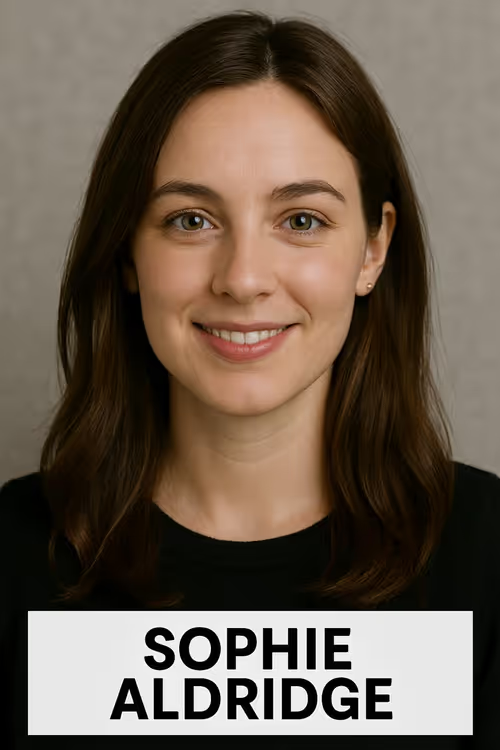
Written by
Sophie Aldridge
Global Economics Editor · Geopolitics
Sophie spent a decade advising governments on trade policy before deciding the story was more interesting than the memo. She covers global economics, geopolitics, and the power transitions reshaping emerging markets. Sharpest on sanctions, supply chains, and the politics behind the price of everything. Based in Washington, D.C. Reach out at sophie.aldridge@theplatinumcapital.com.