

Mohamed Al Jadaan: Saudi Arabia's Finance Minister and the Post-Oil Blueprint
Mohamed Al Jadaan has emerged as the principal architect of Saudi Arabia's most ambitious fiscal transformation, steering the kingdom's public finances away from crude dependency through sweeping tax reforms, sovereign debt strategies, and disciplined spending frameworks that have earned cautious credibility in global capital markets. His stewardship of the national budget — balancing the imperatives of Vision 2030's vast social spending with hard-nosed fiscal consolidation — represents the most consequential test of whether a petrostate can genuinely reinvent its economic foundations before the market forces the question.…
The Architect of Fiscal Discipline
When Mohamed Al Jadaan took the podium at the World Economic Forum in Davos in January 2023, he delivered a message that would have been unthinkable from a Saudi finance minister a decade earlier. Saudi Arabia, he declared, would no longer offer unconditional aid and concessional loans to developing nations. Instead, Riyadh expected reforms. The statement reverberated through the halls of global finance — not because it was controversial, but because it signaled how profoundly the Kingdom's fiscal philosophy had shifted. That is a significant shift. At the center of that transformation stands Al Jadaan himself, a former corporate lawyer turned fiscal steward whose quiet authority has helped reshape the economic foundations of the world's largest oil exporter.
From Legal Chambers to the Treasury
Mohamed Al Jadaan's path to the Ministry of Finance was unconventional by the standards of Gulf governance. He wasn't a career bureaucrat or a royal insider groomed for the role. Before entering public service, he built a distinguished career in corporate and capital markets law, eventually serving as chairman of the Capital Market Authority (CMA), Saudi Arabia's securities regulator. His tenure at the CMA, which began in 2015, focused on modernizing market infrastructure and strengthening investor protections — foundational work that would later prove essential as the Kingdom pursued the landmark initial public offering of Saudi Aramco.
His appointment as Minister of Finance in 2017 came at a moment of urgency. Oil prices had collapsed from their 2014 highs. The Kingdom was running substantial budget deficits. And Crown Prince Mohammed bin Salman had recently unveiled Vision 2030 — an ambitious national strategy to diversify the Saudi economy away from hydrocarbon dependence. Al Jadaan inherited one of the most demanding briefs in global public finance: impose fiscal discipline on a petrostate while simultaneously funding one of the most expensive economic transformation programs in modern history.
Balancing Austerity and Ambition
Al Jadaan's approach to this challenge has been defined by a pragmatism that sets him apart from many of his regional counterparts. Under his stewardship, Saudi Arabia introduced value-added tax for the first time, initially at five percent in 2018, then tripling it to 15 percent in 2020 as the pandemic cratered oil revenues. The move was politically sensitive in a country where citizens had long enjoyed a tax-free social contract. Al Jadaan defended it as a necessary step toward fiscal sustainability. He was right to.
He also oversaw cost-of-living allowance adjustments and subsidy reforms, measures designed to bring government expenditure closer to alignment with non-oil revenue growth. The results have been tangible. Saudi Arabia posted budget surpluses in 2022 for the first time in nearly a decade, aided by elevated oil prices but also by the structural revenue diversification Al Jadaan had championed. Non-oil revenues have grown substantially since he assumed office, driven by new taxation frameworks, fees, and the expansion of the private sector.
Yet Al Jadaan has consistently resisted the temptation to spend windfalls recklessly. His public statements have hammered the same themes: build fiscal buffers, manage public debt prudently, ensure the Kingdom's balance sheet stays resilient against oil price swings. This conservative instinct has earned him credibility with international credit rating agencies and institutional investors alike.
The Debt Market and Global Capital
One of Al Jadaan's most consequential contributions has been the development of Saudi Arabia's sovereign debt market. Under his leadership, the Kingdom has become one of the most active sovereign issuers in emerging markets, tapping international bond markets with regularity and sophistication. Saudi Arabia's debut international sukuk and conventional bond issuances attracted robust demand from global investors, reflecting growing confidence in the Kingdom's creditworthiness and institutional governance.
Al Jadaan has also played a central role in building the frameworks that allow mega-projects — NEOM, The Red Sea Development, Qiddiya, and others — to attract both public and private capital. He has been blunt about the need for private sector participation, acknowledging that the state alone cannot bankroll the entirety of Vision 2030's ambitions. His ministry has worked to create fiscal incentives and regulatory environments designed to draw foreign direct investment, a metric Saudi Arabia has sought to increase dramatically under the national transformation plan.
His engagement with multilateral institutions — the International Monetary Fund, the World Bank, and the G20, where Saudi Arabia held the presidency in 2020 — has elevated Al Jadaan's profile as a credible voice in global financial governance. During the Kingdom's G20 presidency, which collided with the onset of the COVID-19 pandemic, Al Jadaan helped coordinate the Debt Service Suspension Initiative for the world's poorest countries. It showed a willingness to exercise leadership on issues beyond Saudi national interest. Few outside the region have noticed.
Fiscal Realism in an Era of Grand Projects
Perhaps Al Jadaan's most important quality is his willingness to speak with candor about trade-offs. In a political environment where optimism about Vision 2030 is expected — and where dissent carries risk — he has publicly acknowledged the possibility of delaying or scaling back certain projects if fiscal conditions demand it. That kind of measured transparency is rare among finance ministers anywhere. In the Gulf, it is virtually unheard of. It has reinforced his reputation as a technocrat who prioritizes long-term stability over short-term spectacle.
His ministry has also driven efforts to improve fiscal transparency in Saudi Arabia, publishing more detailed budget documents and pre-budget statements than at any point in the Kingdom's history. These reforms lack the glamour of giga-projects. But they are the institutional foundations on which sustainable economic diversification actually depends.
A Steady Hand in a Volatile Region
Mohamed Al Jadaan operates in a region defined by geopolitical complexity and commodity price uncertainty. That he has managed to maintain fiscal credibility while funding an unprecedented national transformation speaks to both his technical competence and his political instincts. He is not a figure who courts headlines or cultivates a public persona beyond what his role requires. His influence runs through budgets, bond issuances, and policy frameworks — the unglamorous machinery of state finance that determines whether grand visions survive contact with economic reality.
As Saudi Arabia moves deeper into the 2030 timeline, the demands on Al Jadaan will only intensify. The Kingdom must continue growing non-oil revenues, manage the fiscal weight of an enormous project pipeline, and hold the confidence of international capital markets — all while contending with a global energy transition that threatens the long-term value of its primary asset. Few finance ministers anywhere face a brief of comparable scale. Al Jadaan's record suggests he is among the most capable hands to hold it.
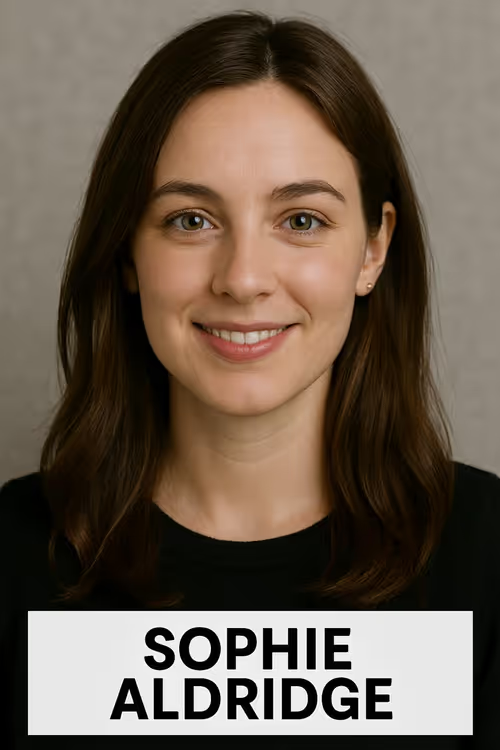
Written by
Sophie Aldridge
Global Economics Editor · Geopolitics
Sophie spent a decade advising governments on trade policy before deciding the story was more interesting than the memo. She covers global economics, geopolitics, and the power transitions reshaping emerging markets. Sharpest on sanctions, supply chains, and the politics behind the price of everything. Based in Washington, D.C. Reach out at sophie.aldridge@theplatinumcapital.com.