

African Urban Development: The Private Capital Building Cities
Africa's rapidly urbanizing cities are emerging as one of the most consequential investment frontiers of the coming decade, where demographic momentum and infrastructure deficits are converging to create generational opportunities for private capital to shape the built environment at scale. From mixed-use developments anchoring new central business districts in Nairobi and Lagos to logistics corridors unlocking value across secondary cities, sophisticated investors who move decisively now stand to define the commercial architecture of a continent adding the equivalent of a new Cairo to its urban population every eighteen months.…

While the Gulf's luxury real estate machine continues to set records — a Dh400 million Jumeirah beachfront acquisition here, a $10 billion Trump-branded residential portfolio in Saudi Arabia there — a quieter but equally consequential capital story is unfolding across sub-Saharan Africa. Private investors, family offices, and sovereign-adjacent developers are pouring funds into African urban infrastructure at a scale that would have seemed implausible a decade ago. The continent's cities are growing faster than any urban centres on earth. And a sophisticated tier of private capital has decided that building them — rather than waiting for governments to do so — is among the most compelling long-duration yield opportunities on the table right now.
The Scale of the Opportunity No One Is Talking About
Africa will add an estimated 950 million urban residents by 2050, according to UN-Habitat projections. Read that again. That is not a rounding error — it is the largest wave of urbanisation in human history, concentrated in markets where formal housing supply is structurally insufficient, commercial infrastructure is chronically underdeveloped, and logistics networks remain badly fragmented. Lagos, Nairobi, Cairo, Casablanca, and Abidjan already function as regional economic capitals. Dar es Salaam, Accra, Kigali, and Luanda are following, building momentum that most global investors have yet to price in. Few outside the region have noticed. They should.
The opportunity is not theoretical. Private capital is already moving, and the early participants are structuring positions that will define the urban shape of this continent for generations. Egypt's new administrative capital — a $58 billion development project east of Cairo — has drawn investment from Chinese state developers, Gulf sovereign funds, and a growing cohort of private regional investors. In Morocco, the Casablanca Finance City continues to attract institutional capital seeking a compliant, French-law jurisdiction through which to access West African markets. In Kenya, mixed-use developments along Nairobi's Westlands and Upper Hill corridors are now commanding per-square-metre pricing that would genuinely surprise anyone who has not visited the market in the past three years.
Gulf Capital Finds Its African Footing
The same investor class driving Dubai's off-plan absorption and structuring branded residential deals in Diriyah is turning attention southward. Gulf family offices — particularly those based in the UAE and Saudi Arabia — have begun allocating meaningfully to African real estate, pulled by yield differentials, demographic fundamentals, and cultural proximity to East African and North African markets where Gulf commercial relationships run deep.
Abu Dhabi's sovereign investment vehicles have been active in Egyptian infrastructure for years. But the shift visible in 2025 and 2026 is different — private, family-led capital making direct plays in residential and mixed-use development. One senior Emirati family office principal, speaking privately at a regional investment forum in Dubai earlier this year, described African urban real estate as "the position we wish we had taken in Dubai in 2004." That framing — Africa as early-cycle Gulf — is gaining traction among a specific tier of Gulf UHNW investors who understand long-duration capital deployment and are not running against quarterly liquidity constraints.
Nigerian developers with Gulf financing relationships are among the most active deal structurers in West Africa. In Lagos, large-scale mixed-use projects on Victoria Island and in Eko Atlantic — the $6 billion private city development reclaimed from the Atlantic Ocean — are absorbing capital from Nigerian diaspora investors, British-Nigerian family offices, and, increasingly, Emirati co-investors seeking yield well above the compressed cap rates now available in prime Dubai or Riyadh assets. That is a significant shift from even three years ago.
The Private Developers Shaping the Continent
The firms building Africa's cities are rarely household names outside their home markets. Their scale and ambition, however, are considerable. Rendeavour, the Africa-focused urban land developer backed by billionaire Stephen Jennings, is developing new city projects across Kenya, Ghana, Nigeria, Tanzania, Zambia, and the Democratic Republic of Congo — collectively spanning more than 12,000 acres of master-planned urban land. In Rwanda, the Kigali Innovation City project, a 61-hectare technology and business campus developed with backing from the Rwandan government and private institutional investors, represents a distinct model: state-catalysed, privately executed, and designed to pull regional headquarters from multinational firms into a single campus environment.
South Africa's listed property sector, while absorbing domestic macroeconomic pressure, continues to produce developers with the operational depth to export their model northward. Growthpoint Properties and Attacq have both signalled interest in pan-African exposure. Privately held South African developers have been active in Mozambique, Zambia, and Zimbabwe. The financing structures being deployed — typically blending development finance institution debt from the IFC or African Development Bank with private equity from European or Gulf family offices — are becoming increasingly sophisticated, steadily closing the gap between African project risk profiles and international investor appetite.
Infrastructure as the Unlock
Historically, the single greatest drag on African urban real estate returns has been infrastructure deficit — unreliable power, inadequate water systems, poor road connectivity, underdeveloped logistics. The private capital response has been direct: internalise infrastructure cost within the development model itself, creating self-contained urban nodes that generate their own utilities and security. Capital-intensive, yes. But developments built this way command significant pricing premiums in markets where the alternative is erratic municipal provision.
Eko Atlantic in Lagos is the most visible proof of concept. A privately financed land reclamation and city-building project, it includes its own seawall, power grid, and road network. The development has attracted multinational corporate tenants, luxury residential buyers, and Nigerian high-net-worth families who want a reliably serviced urban environment and are willing to pay for it. Per-square-metre pricing in completed Eko Atlantic residential product now rivals premium districts in Nairobi or Accra — and far exceeds the broader Lagos market. The numbers validate what the thesis always promised: infrastructure certainty commands a premium, and buyers will pay it.
What Sophisticated Investors Are Watching
For family offices and private investors assessing African urban real estate as an asset class, the most important variable is not country risk in the conventional sense. It is developer quality and infrastructure integration. The returns available in African mixed-use and residential development are genuinely attractive: gross development yields of 15 to 25 percent are achievable in markets like Nairobi, Lagos, and Cairo for well-structured projects. Compare that to prime Dubai residential cap rates, now compressed to 5 to 6 percent, or Riyadh branded residential product — such as the 500 mansions planned for Diriyah, priced from $6.7 million to $24 million — which is priced for perfection and leaves little room for error.
The investors who capture the generational upside of African urbanisation will be the ones who move before the market becomes fully legible to global capital flows. Gulf family offices with existing African trade relationships, Nigerian and Kenyan diaspora capital with genuine local market intelligence, and South African developers with hard-won operational expertise are the natural first movers. The early-cycle window is open. But the pace of capital formation across the continent makes one thing clear — it will not stay open indefinitely.
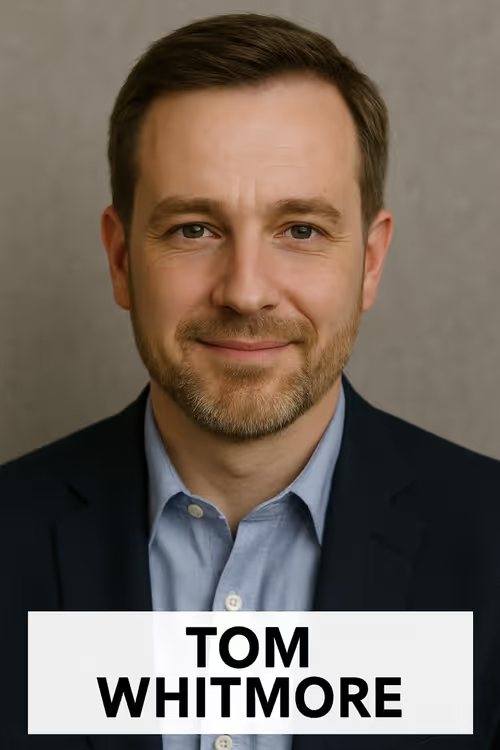
Written by
Tom Whitmore
Senior correspondent · Real Estate & Private Companies
Tom has interviewed most of the operators reshaping the Gulf skyline — and a few of the ones who tried and didn't. His beat is real estate, commodities, manufacturing, and the founder-led private companies that never bother to list. He knows which buildings and balance sheets survive a downturn before the spreadsheet does. Based in Dubai. Reach out at tom.whitmore@theplatinumcapital.com.