

Student Housing as an Asset Class in the Gulf and Beyond
As Gulf nations accelerate their ambitions to become global education hubs, purpose-built student housing has emerged as one of the most resilient and structurally underpinned asset classes available to sophisticated investors, offering stable, counter-cyclical income streams anchored by sovereign-backed university expansion. For family offices and institutional capital seeking inflation-resistant returns in markets where demographic momentum and government vision strategies converge, student housing across the Gulf and beyond represents not merely a tactical opportunity, but a generational repositioning of real estate capital.…

Dubai's luxury residential market rarely lacks for attention. Knight Frank recorded $5.1 billion in ultra-luxury home sales above $10 million in the first half of 2026 alone. But while that headline number circulates through the usual channels, a structurally different opportunity has been quietly accumulating institutional interest across the Gulf and beyond: purpose-built student accommodation. Less photogenic than a Jumeirah beachfront villa, certainly. What it offers instead is something the ultra-prime market cannot reliably guarantee — predictable, counter-cyclical yield backed by demographic mathematics that do not bend to sentiment cycles.
A Supply Gap That Numbers Make Undeniable
The GCC is home to some of the world's youngest and fastest-growing populations. Saudi Arabia alone carries over 1.9 million enrolled university students, with Vision 2030 aggressively expanding domestic institutions and international university partnerships simultaneously. The UAE hosts more than 60,000 international students across free zone campuses in Dubai, Abu Dhabi, and Sharjah — enrolment climbing at roughly 8% per year. Yet dedicated, purpose-built student housing remains critically undersupplied across both markets. Most students depend on private flat shares or overpriced short-term rentals. That arrangement inflates living costs, depresses academic retention rates, and leaves a gap in the market that private capital is well-positioned to fill.
The same story repeats across markets where Gulf capital is increasingly active. Indonesia: university enrolment exceeds 9 million students across state and private institutions, yet purpose-built student housing accounts for fewer than 5% of total accommodation units. Nigeria and Kenya face chronic residential shortfalls on campuses that have not materially expanded capacity in decades. Morocco, positioning itself as a regional education hub through investments in Rabat and Casablanca, confronts a structural deficit as it draws students from francophone West Africa. These are not isolated inefficiencies. They form a pattern.
What Institutional Capital Already Knows
The investment thesis for student housing was proven in Western markets years ago. In the United Kingdom, purpose-built student accommodation generates average net yields of 5% to 6.5% — outperforming most urban residential sectors — with occupancy consistently above 95% in prime university cities. In the United States, specialist REITs focused on student housing have delivered compound annual returns exceeding 9% over the past decade. The model is well understood: lease cycles anchored to academic calendars, tenant turnover lower than general residential, and parental guarantees that materially reduce credit risk. The numbers are not complicated. The returns are consistent.
What has shifted in 2026 is appetite. Gulf-based family offices and sovereign-adjacent private capital are moving to replicate this model in markets they know or are actively shaping. Consider the timing: the same month DIFC awarded its $817 million Heights Tower construction contract to Al Basti & Muktha — a signal of sustained confidence in long-cycle real estate infrastructure — family office advisors across the UAE began allocating dedicated capital to student housing as a distinct sub-sector. Not a footnote inside a broader residential portfolio. A standalone allocation. That is a meaningful shift in how the asset class is being categorized.
The Gulf as Developer and Destination
Saudi Arabia presents the most immediate domestic opportunity. The Kingdom has committed to doubling the number of Saudi students enrolled in higher education under Vision 2030, launching joint ventures with King Abdullah University of Science and Technology, NEOM's nascent academic partnerships, and a series of new technical and vocational colleges across Jeddah, Dammam, and Tabuk. Each campus requires a surrounding residential ecosystem. Government alone will not build it fast enough.
In the UAE, quiet experimentation is already underway. Several mid-scale developers in Sharjah — where the University City cluster hosts over 30,000 students — have redirected portions of their residential pipeline toward managed student accommodation: furnished studio and one-bedroom units on 11-month academic leases, bundled utilities, community amenities. Early occupancy data from these schemes points to stabilized yields of 6% to 7.5%. Comparable residential assets in the same sub-markets are not matching those numbers. Few outside the development community have noticed. They should.
For Gulf investors looking outward, Southeast Asia deserves serious attention. Vietnam's university enrolment has grown by over 20% since 2020, propelled by a young demographic and rising middle-class aspiration. Ho Chi Minh City and Hanoi both lack sufficient purpose-built accommodation near their major university clusters. Manageable land costs. Growing domestic demand. Limited institutional competition. For a conservative Gulf family office seeking a risk-return profile with genuine upside, that combination is difficult to dismiss.
Structuring the Investment: What Sophisticated Buyers Consider
Student housing rewards expertise. This is not a sector where passive ownership generates outperformance. Lease administration tied to academic calendars, student welfare obligations, brand reputation management, and the logistics of high-turnover furnished units all demand specialist operators. The UK's Unite Group and Singapore's Centurion Corporation built their edge not through property selection alone, but through operational platforms developed over years of iteration. That matters when you are evaluating a co-investment or a management agreement.
For Gulf family offices entering the sector, the preferred structure is co-investment alongside experienced operators — a preferred equity stake in a UK or Australian student housing platform, a joint venture with a Southeast Asian developer already active in the segment, or a direct development in Saudi Arabia executed under an international management agreement. Capital requirements per unit are relatively modest. Purpose-built student accommodation in emerging markets can be developed for $30,000 to $60,000 per bed. A $20 million commitment can anchor a meaningful portfolio with genuine geographic diversification. That accessibility, combined with the yield profile, is part of why the allocation conversation is accelerating.
Why the Timing Is Not Incidental
Dubai's $100 million single-home transaction and Arabian Acres' $109 million Jumeirah beachfront record in March 2026 confirm that demand for trophy assets among the world's wealthiest remains intense. But the same forces making Dubai magnetic — a growing educated population, expanding institutional infrastructure, rising international connectivity — are exactly what will drive university enrolment across the Gulf and its neighboring regions for the next twenty years. Student housing sits at the intersection of demographic certainty, policy-backed demand, and chronic undersupply. The institutions entered this trade early. Private capital across the Gulf is arriving at the same conclusion. The gap between those two groups is closing faster than most realize.
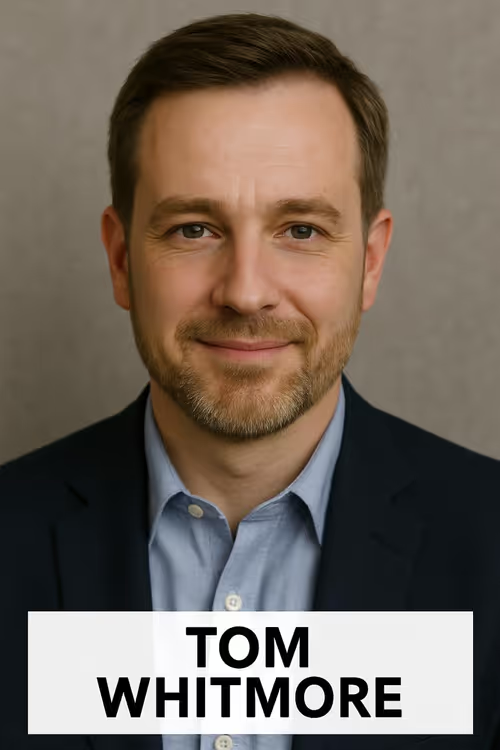
Written by
Tom Whitmore
Senior correspondent · Real Estate & Private Companies
Tom has interviewed most of the operators reshaping the Gulf skyline — and a few of the ones who tried and didn't. His beat is real estate, commodities, manufacturing, and the founder-led private companies that never bother to list. He knows which buildings and balance sheets survive a downturn before the spreadsheet does. Based in Dubai. Reach out at tom.whitmore@theplatinumcapital.com.