Sovereign Funds as Foreign Policy: The Strategic Investment Playbook
Sovereign wealth funds have evolved far beyond their original mandate as fiscal stabilizers, emerging as precision instruments of geopolitical influence through which nations quietly acquire strategic footholds in critical infrastructure, defense-adjacent technologies, and resource corridors that no diplomatic cable could secure. For the sophisticated investor or policy architect navigating this landscape, understanding the invisible architecture behind these capital deployments is no longer optional — it is the defining competency that separates those who anticipate the next realignment of global power from those who simply react to it.…

When the UAE formally exited OPEC on May 1, 2026 — ending a 59-year membership on the very day Saudi Crown Prince Mohammed bin Salman convened a GCC unity summit — the signal to global markets went far beyond oil quotas. It was a declaration that Abu Dhabi's sovereign capital would now operate on its own terms, answerable to no bloc's consensus. For seasoned observers of Gulf geopolitics, the move confirmed what many had suspected for years: sovereign wealth funds have become the primary instrument through which states exercise foreign policy, project influence, and secure strategic leverage — often more effectively than diplomatic cables or military alliances.
Capital as Statecraft
The transformation of sovereign wealth funds from passive reserve managers into active geopolitical tools has accelerated sharply over the past three years. The five largest Gulf SWFs — Saudi Arabia's Public Investment Fund, Mubadala, ADIA, L'imad, and the Qatar Investment Authority — collectively deployed nearly $26 billion between March and May 2026 alone, according to data compiled by Global SWF. That pace held steady even as the Saudi-Emirati rift deepened and conflict escalated in Yemen. The message was deliberate: political turbulence at home does not interrupt the outward march of sovereign capital.
What distinguishes 2026 from earlier cycles is the degree to which investment mandates now track diplomatic positioning with remarkable precision. Saudi Arabia's PIF, managing assets approaching $800 billion, has materially deepened its capital commitments to Pakistan and Turkey — both of whom appeared alongside Riyadh at the June 21 Cairo summit that formalised a new regional axis excluding the UAE. In sovereign fund strategy, correlation is rarely coincidence.
The UAE Plays a Different Game
Abu Dhabi's decision to leave OPEC was as much about strategic realignment as oil market arithmetic. With the dissolution of the Southern Transitional Council following Saudi pressure in early 2026, the UAE lost its principal proxy in Yemen. What it retains — and is actively expanding — is a dense web of investment relationships that no diplomatic rupture can easily unwind. Mubadala's portfolio now spans more than 50 countries, with significant exposure to Southeast Asian infrastructure, Central Asian energy transition assets, and African technology platforms.
ADIA, the more conservative of Abu Dhabi's flagship vehicles, has maintained its developed-market allocation — approximately 60 to 65 percent of its portfolio in North American and European equities and fixed income — but has quietly increased exposure to Indonesia and Vietnam, two jurisdictions where Emirati diplomatic engagement has intensified since 2024. That is a significant shift. For family offices and private investors tracking sovereign capital flows as a leading indicator of bilateral relationships, the ADIA reallocation warrants close attention. Where Abu Dhabi's patient capital goes, market access and regulatory goodwill tend to follow.
Qatar's Quiet Leverage
The Qatar Investment Authority operates with a degree of discretion unusual even by sovereign fund standards. Its geopolitical function, though, is no less deliberate than its Gulf counterparts. With an estimated $475 billion under management, QIA has used its position as a major institutional shareholder in European financial and luxury assets — Barclays, Volkswagen, LVMH — to maintain lines of access to Western governments that smaller Gulf neighbours simply cannot replicate. That access proved invaluable when Doha's mediation networks became the primary channel for Gaza ceasefire negotiations in 2024 and 2025. Few outside the region fully appreciated the connection. They should.
What the QIA model demonstrates is that sovereign fund diversification into prestige Western assets is not purely about returns. Holding material stakes in systemically important European institutions creates structural leverage — a seat at tables that no bilateral trade agreement can guarantee. For private investors and family offices in emerging markets, this is the underlying logic worth internalising: capital placed strategically in jurisdictions where you wish to maintain influence is an insurance policy, not merely a yield play.
The New Axis and Its Investment Implications
The June 2026 Cairo alignment between Saudi Arabia, Qatar, Egypt, Pakistan, and Turkey amounts to something more than a diplomatic communiqué. It is a blueprint for co-investment corridors. Saudi Vision 2030's foreign investment commitments to Egypt have already exceeded $15 billion across sectors ranging from real estate to renewable energy. Turkish construction and infrastructure firms, long active across Africa and Central Asia, are now finding PIF-adjacent capital available in markets — Nigeria, Kazakhstan, Uzbekistan — where Riyadh is actively building influence through development finance.
For investors based in these regions, the emergence of this axis creates both opportunity and strategic complexity. Capital arriving simultaneously from Riyadh, Doha, and Ankara in markets like Cairo or Karachi is not coincidental competition — it is coordinated positioning. The numbers tell a complicated story. Private investors and family offices who understand the architecture behind these flows can position ahead of the capital, in sectors and assets that sovereign mandates will inevitably target: logistics infrastructure, food security supply chains, digital payments, and green energy transition assets.
What Sophisticated Investors Should Do Now
The fracturing of GCC cohesion — most visibly in the Saudi-Emirati split — paradoxically creates a richer set of investment signals for those who read sovereign capital flows professionally. When two of the world's largest SWFs diverge strategically, they generate competing pools of patient capital pursuing similar macroeconomic themes through different geographic filters. Mubadala's deepening presence in Southeast Asia and Africa runs alongside PIF's consolidation in South Asia and the Levant. Both are deploying into technology, infrastructure, and healthcare — but the bilateral relationships they are cementing differ materially.
Family offices and private investors with meaningful exposure to emerging markets should track SWF activity not simply as validation of an asset class, but as a directional signal about which governments are likely to liberalise regulatory access, extend preferential licensing, or accelerate bilateral trade frameworks over the next 24 to 36 months. Sovereign funds do not invest in political vacuums. Their presence signals that a government-to-government relationship has been operationalised — and that commercial infrastructure will follow.
The deeper lesson of 2026 is this: at the level of sovereign capital, foreign policy and investment strategy are no longer parallel disciplines. They are the same discipline. For the investors, family principals, and wealth advisers who understand that, the current realignment of Gulf sovereign power is not a source of uncertainty — it is the most consequential set of investment signals in a generation.
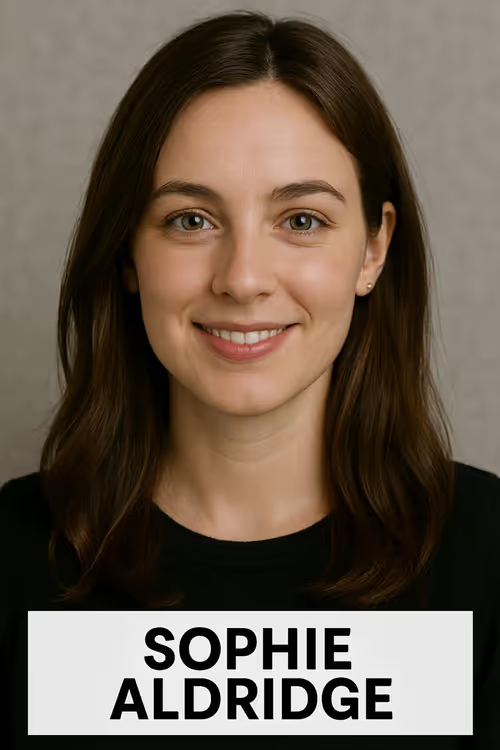
Written by
Sophie Aldridge
Global Economics Editor · Geopolitics
Sophie spent a decade advising governments on trade policy before deciding the story was more interesting than the memo. She covers global economics, geopolitics, and the power transitions reshaping emerging markets. Sharpest on sanctions, supply chains, and the politics behind the price of everything. Based in Washington, D.C. Reach out at sophie.aldridge@theplatinumcapital.com.