Tadawul Listings Pipeline: The Saudi IPOs to Watch
Saudi Arabia's capital markets are entering a defining chapter, with a new wave of high-caliber listings set to reshape the Tadawul's sectoral landscape and deepen the Kingdom's appeal as a destination for sophisticated institutional capital. From energy infrastructure spinoffs to consumer conglomerates riding the Vision 2030 demand surge, the IPOs advancing through the pipeline represent not merely investment opportunities, but strategic positioning in one of the world's most consequential economic transformations.…

Saudi Arabia's Tadawul exchange entered 2026 as one of the most closely watched equity markets in the world — a platform where Vision 2030 ambitions, family conglomerate unlockings, and sovereign-linked privatisations were expected to converge in a year of landmark listings. That script has been torn up. A combination of regional geopolitical pressure, investor caution triggered by the Iran war, and several high-profile listing withdrawals have compressed the Gulf's IPO calendar in ways few anticipated. For sophisticated investors tracking where patient capital meets structural reform, though, the Tadawul pipeline remains among the most consequential stories in emerging-market equity today.
A Market Under Pressure — But Not in Retreat
The numbers tell a complicated story. Gulf first-time share sales have raised just over $1 billion in 2026 — the lowest aggregate since 2021 and a stark reversal from the post-pandemic boom that had positioned the GCC as one of the world's most active IPO corridors. The Iran conflict has been the principal disruptor. It dampened institutional appetite and pushed several issuers to defer rather than withdraw permanently. Saudi Arabia's Arabian Dyar and Mutlaq Al Ghowairi Contracting Company were both expected to list on Tadawul in the first half of the year. Arabian Dyar got pushed to the post-summer window. MGC moved more abruptly: in a June 9 statement, the company announced it had withdrawn its IPO plans entirely following consultations with its financial advisers. That decision signalled just how acutely sentiment had deteriorated among mid-market Saudi issuers.
HSBC's regional chief Selim Kervanci, whose bank currently holds 45 merger, acquisition, and IPO mandates across the Gulf, has been measured but direct. Restoring deal flow, he has said, will require at least one full quarter of calm following the US-Iran peace agreement before issuers and their advisers feel sufficiently confident to return to market. That positions Q4 2026 as the credible activation window. For investors preparing now, that window is approaching faster than the headlines suggest.
What the Pipeline Actually Looks Like
Despite the slowdown, Tadawul's underlying listing queue has not evaporated. The Capital Market Authority continues to process applications, and several issuers across real estate, logistics, healthcare, and consumer finance remain in advanced preparation. The Saudi exchange has structurally matured. Index inclusion by MSCI and FTSE Russell broadened the institutional investor base, and the parallel Nomu market continues to provide an entry ramp for smaller-capitalisation companies targeting family office and regional private investor participation.
Real estate sits among the most active sectors in the deferred pipeline. Arabian Dyar — a residential and mixed-use developer with exposure to some of the Kingdom's most ambitious urban projects — represents exactly the kind of Vision 2030-linked asset that institutional allocators from London to Riyadh have been tracking. Its post-summer listing, when it materialises, will test whether the retail-driven demand that characterised Saudi IPOs in 2022 and 2023 can be replicated in a more cautious environment. The answer will set the tone for everything that follows before year-end.
Sovereign Capital as the Stabilising Force
One defining feature of Saudi capital markets in this cycle is the role sovereign and quasi-sovereign anchors play in providing pricing confidence. Gulf sovereign wealth funds committed a record $53.9 billion across 108 deals in the first half of 2026, with Mubadala alone deploying $15.2 billion at the group level. Most of that capital flowed outward — nearly half into the United States, with China and the United Kingdom as the next preferred destinations. The underlying signal, though, is one of institutional sophistication and appetite for large-format transactions. Gulf funds participated in 21 of 42 global mega-deals exceeding $1 billion in H1 2026. Few outside the region have fully registered what that number represents. They should.
For Tadawul-listed companies and those in the pipeline, sovereign presence functions as both a floor and a signal. When PIF-affiliated entities or Saudi Aramco's investment arm take anchor positions in domestic listings, they compress the risk premium that international investors would otherwise demand. Family offices with exposure to the Saudi market — particularly those managing second- and third-generation wealth from the Kingdom's established trading and contracting dynasties — are watching how sovereign anchoring gets deployed in upcoming listings as a leading indicator of which transactions will price successfully.
The Bond Market as Context for Equity Valuations
Any serious analysis of Tadawul equity listings has to account for what is happening in Gulf fixed income. Saudi Arabia's bond market dominance in Q1 2026 was pronounced: the Kingdom led GCC issuances that totalled $55.7 billion in the quarter, with conventional bond formats accounting for 65.2% of total activity, according to Kuwait-based research house Markaz. The UAE ranked second with $13.57 billion across 36 offerings.
This matters to IPO investors for a straightforward reason. When sovereign and quasi-sovereign issuers can access deep, liquid debt markets at competitive rates, the pressure to pursue equity listings for balance-sheet purposes diminishes. Many of the Saudi companies currently in the Tadawul pipeline are listing for structural reasons — regulatory compliance, liquidity for founding families, or strategic visibility — not urgent capital need. That shifts the negotiating dynamic between issuers and investors. Expect pricing discipline to be a consistent theme across the second-half listing calendar.
What Sophisticated Investors Should Be Positioning For
For family offices, private investors, and institutional allocators with existing or prospective Gulf exposure, the deferred listings of 2026 create a specific kind of opportunity. Companies that completed regulatory preparation, engaged bookrunners, and built investor relations infrastructure — then delayed purely for market timing reasons — frequently make for stronger listings than those rushed to market in peak conditions. The filtering effect of a difficult year is, paradoxically, a quality signal.
The Q4 2026 window, if geopolitical conditions stabilise as expected following the US-Iran peace framework, could concentrate a significant volume of transactions into a compressed timeframe. That is a significant shift from how this year was supposed to unfold. Investors with the analytical capacity to separate genuinely deferred quality assets from structurally challenged businesses that used market conditions as cover will be the ones extracting value from the Tadawul pipeline. Families and private offices with local networks, early-stage access to prospectus materials, and relationships with the Saudi exchange's adviser community are already doing precisely that groundwork. The IPO market is quiet. The preparation for its return is anything but.
Written by
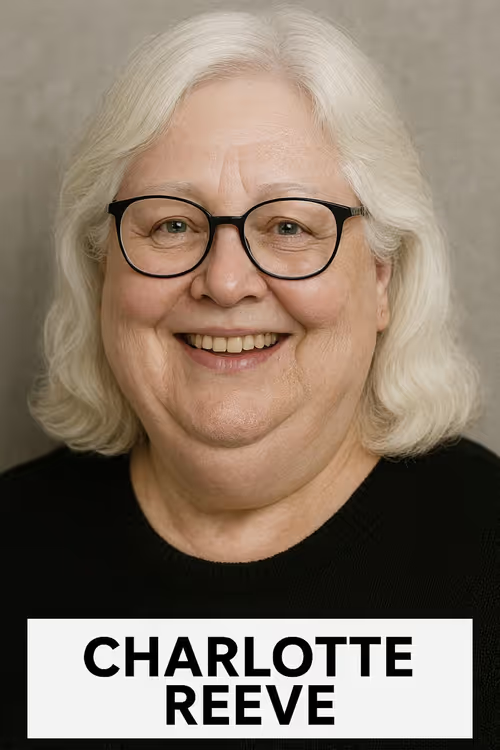
Charlotte Reeve
Senior correspondent · Capital Markets & Fintech
Charlotte cut her teeth on an equities desk before moving to the other side of the notebook. She covers capital markets, stock exchanges, and the fintech operators trying to disintermediate the banks that trained her. Sharpest on market microstructure and payments infrastructure; still reads a prospectus for fun. Based in Singapore. Reach out at charlotte.reeve@theplatinumcapital.com.