Vision 2030 at the Two-Thirds Mark: Delivery Versus Promise
As Saudi Arabia's landmark transformation agenda crosses its two-thirds threshold, the divergence between headline ambition and measurable economic reality demands the unflinching scrutiny that institutional capital and sovereign decision-makers can no longer afford to defer. From the uneven pace of non-oil revenue diversification to the recalibrated timelines surrounding giga-projects, the structural fault lines emerging beneath Vision 2030's polished narrative carry consequences that will define the kingdom's investment grade trajectory for decades to come.…

Twelve years ago, Saudi Arabia's planners set a deadline that most of the world dismissed as fantasy: break the Kingdom's addiction to oil revenues and build a globally competitive, diversified economy by 2030. Two-thirds of that timeline has now run. What remains is not a clean success story, nor a cautionary tale of overreach. It is something messier and more interesting — a transformation of genuine scale, moving at uneven speed, with real money now betting on the outcome.
PIF Rewrites the Playbook
No institution captures the mood shift inside Vision 2030 more sharply than the Public Investment Fund. At the Future Investment Initiative Priority Europe summit in Rome this past June, PIF Governor Yasir Al-Rumayyan announced a strategic turn that anyone allocating capital in this region should register. "Now our new strategy is to bring the world back to Saudi," he told the assembled investors. Short sentence. Large implications.
The earlier version of PIF was essentially an outbound vehicle — capital flowing from Riyadh into SoftBank's Vision Fund, Newcastle United, and a wide spread of international stakes. The newly approved 2026–2030 strategy reverses the logic. Saudi Arabia itself becomes the destination. That is a significant shift, and the numbers behind it give Al-Rumayyan's confidence a hard commercial foundation rather than just a political one.
PIF recorded annual profit after tax climbing from SAR 26 billion to SAR 65 billion in 2025. On July 13, 2026, the fund formalised an MoU with I Squared Capital for up to $2 billion in co-investment. Separately, Brookfield Middle East Partners launched a private equity fund with PIF as anchor investor — Brookfield itself committed $500 million of its own capital — which has already raised nearly $2 billion, with half directed toward in-Kingdom investments. Yazeed Al-Humied, PIF's Deputy Governor and Head of MENA Investments, made the strategic intent explicit: the Brookfield structure exists to pull international private equity into Saudi Arabia and the wider GCC. These deals are not passive portfolio positions. They are structural bets on Saudi Arabia as an investable geography in its own right.
The Diversification Scorecard
Vision 2030's central promise was always about revenues — specifically, breaking the government's fiscal dependence on hydrocarbons. The progress here is real. It is also uneven, and anyone presenting it as otherwise is selling something.
Non-oil GDP growth has outpaced headline projections across several quarters. Tourism, entertainment, and logistics have posted genuine structural gains rather than cyclical bumps. Riyadh's emergence as a regional hub for multinational headquarters — pushed along by the 2024 deadline that tied Saudi government contracts to regional HQ presence — has added meaningful density to the private sector. The Saudi Tourism Authority reported more than 100 million visitors in 2024, running ahead of schedule on its 2030 target. Those are real numbers.
But oil revenues still dominate the fiscal picture. At current production levels and price environments, the budget remains sensitive to Brent movements in precisely the ways Vision 2030 was designed to prevent. The IMF has estimated the Kingdom's fiscal breakeven oil price at above $90 per barrel in recent years. VAT, introduced at 5% in 2018 and tripled to 15% in 2020, has expanded the non-oil tax base — but building a diversified fiscal model from the bones of a hydrocarbon-funded state is a generational project. No ten-year plan was ever going to complete it. The honest question is whether the trajectory is right. In several areas, it is.
Technology as a Strategic Lever
The area where Vision 2030 is moving fastest — and where outside observers have been slowest to pay attention — is technology. Saudi institutions are not simply buying access to foreign innovation. They are acquiring stakes in its development and shaping how it gets deployed in the region. That distinction matters.
Saudi Aramco's venture capital arm, Wa'ed Ventures, offers the clearest window into this strategy. In March 2026, its $500 million fund took a strategic position in Resemble AI, a US-based company working in AI voice generation and real-time deepfake detection. The applications — financial services verification, media authentication, government communications — align directly with where Gulf governments and institutions are spending. The investment is structured to support Resemble AI's expansion into Saudi Arabia and the broader Middle East, with explicit alignment to regional data sovereignty requirements. That last point resonates far beyond Riyadh, across the Gulf and into Central Asia.
In June 2026, Wa'ed moved further up the stack with an investment in Ori, a UK-based AI cloud provider. The pattern holds. For family offices and private investors tracking sector allocation across the Gulf, the consistency of this technology investment thesis — running from PIF's global venture exposure down through Aramco's corporate VC — signals a coordinated, state-backed effort to build technological depth that outlasts any oil price cycle. Few outside the region have fully clocked this. They should.
Giga-Projects: Ambition Under Pressure
NEOM is the number that everyone quotes and nobody quite knows how to value. The $500 billion futuristic city project has taken real hits since its initial announcement — The Line's projected population was revised sharply downward, and timelines across several components have stretched. Saudi officials have characterised these as signs of disciplined project management rather than retreat. There is a credible version of that argument: delivering any meaningful portion of NEOM's original vision would represent an infrastructure achievement with almost no modern precedent.
The rest of the giga-project portfolio tells a more varied story. Diriyah Gate, the cultural and heritage district on Riyadh's outskirts, is tracking reasonably close to its original phasing. Qiddiya, the entertainment city south of the capital, has broken ground across multiple components. The Red Sea Project has welcomed its first international guests, with resort capacity expanding incrementally. Taken together, these projects represent an experiment in state-directed placemaking at a scale the world has not seen in decades. Their full economic returns will be measured well beyond 2030 — which makes them natural territory for sovereign funds and family offices running patient capital on long duration.
What This Means for Investors with Long Horizons
At the two-thirds mark, the signal for serious investors is increasingly constructive. But it rewards granular judgment, not broad-brush enthusiasm.
The sectors showing genuine structural momentum are clear enough: financial services and capital markets, tourism and hospitality infrastructure, technology and AI deployment, and logistics anchored to the Kingdom's geography between Asia, Africa, and Europe. PIF's co-investment structures — the Brookfield and I Squared deals being the most visible examples — give institutional partners a credible entry mechanism with sovereign backing. That combination is not easy to replicate.
The risks are not hidden, and any honest assessment names them. Execution complexity on the giga-projects remains live. Fiscal reliance on oil pricing has not disappeared. Private sector job creation has not yet kept pace with Saudi workforce growth in the way the plan requires. These are real variables, not footnotes.
But Al-Rumayyan's framing — bring the world to Saudi — is being tested now in capital markets, not just in government communiqués. Global institutional money is responding. For investors across the Gulf, Central Asia, and Africa who understand that national-scale transformation is measured in decades rather than quarters, the Saudi story at its two-thirds mark is a bet still very much in motion. And increasingly, it is a bet that sophisticated capital is choosing to make.
Written by
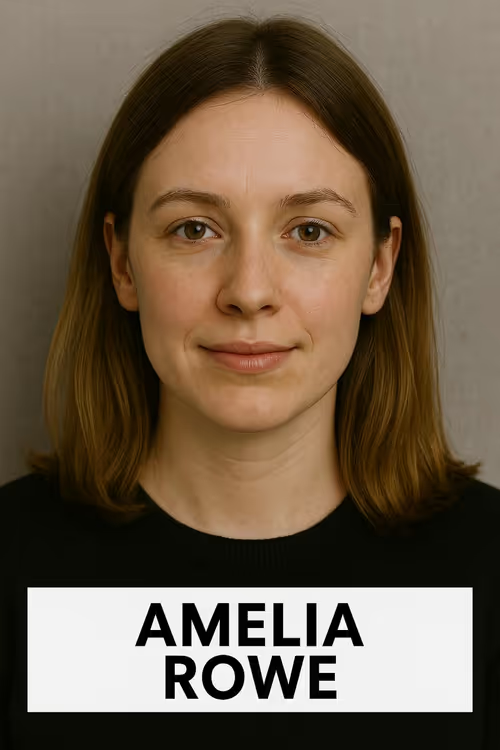
Amelia Rowe
Senior correspondent · Banking & Economy
Amelia spent eight years inside a sovereign wealth fund before deciding she'd rather write about institutional money than allocate it. She covers central banking, insurance, and the macro decisions that quietly choose which markets get the next decade. Sharp on monetary policy; impatient with anyone who confuses noise with signal. Based in London. Reach out at amelia.rowe@theplatinumcapital.com.