

Blockchain Beyond Crypto: Real-World Financial Applications
Blockchain technology has quietly evolved far beyond its cryptocurrency origins, embedding itself into the infrastructure of trade finance, cross-border settlements, and institutional asset management in ways that are fundamentally reshaping how capital moves across borders. For family offices, sovereign wealth funds, and high-net-worth investors navigating an increasingly complex global financial landscape, understanding the strategic implications of distributed ledger adoption is no longer optional — it is a prerequisite for protecting and growing generational wealth.…

For years, blockchain's reputation was inseparable from cryptocurrency volatility — a technology perpetually promising transformation while delivering speculation. That story is being quietly but decisively rewritten. Across the Gulf, Southeast Asia, and emerging markets, regulators, sovereign institutions, and well-capitalised private players are deploying blockchain not as a speculative instrument but as financial infrastructure. The shift is structural. For family offices, private investors, and institutional capital allocators, it demands attention.
From Proof of Concept to Live Infrastructure
The clearest signal of blockchain's maturation came in August 2025, when Saudi Awwal Bank executed the first blockchain-based Islamic repurchase agreement in the Kingdom's history. This was not a sandbox experiment. It was a live transaction within a regulated framework, running on distributed ledger infrastructure — and it demonstrated that Islamic finance's strict requirements around asset ownership, transparency, and Shariah compliance can be served, arguably better served, by programmable contracts than by legacy documentation processes. The GCC has recognised the SAB transaction as a milestone, not merely for Islamic finance, but for wholesale banking technology broadly.
Then there is Riyad Bank's digital arm, Jeel, which partnered with Ripple in early 2026 to pilot blockchain-based cross-border transfers and tokenisation inside a live regulatory environment. The distinction matters. Ripple's technology has long served correspondent banking improvements, but the Jeel partnership is one of the most advanced deployments in the Arab world — operating under SAMA's oversight, not alongside it. Cross-border payments across the GCC currently cost an average of 5.4% per transaction, per World Bank estimates. Blockchain-native rails can bring that below 1%, with settlement times collapsing from days to seconds. That is a significant shift.
Open Banking Meets Distributed Ledger
In March 2026, SAMA granted its first live open banking licences, moving Saudi Arabia decisively from pilot phase to commercial operation. APIs now enable real-time data flows between licensed banks and fintech providers. Combine that with distributed ledger infrastructure, and entirely new possibilities open up — for credit assessment, onboarding, and cross-institutional settlement. The convergence is not accidental. Open banking creates the data layer; blockchain creates the trust and settlement layer. Together, they form the architecture for a financial system that is faster, cheaper, and — critically for Gulf markets — more auditable.
For private investors and family offices operating across multiple jurisdictions, this is not abstract. Multi-currency treasury management, intra-family transfers across borders, investment structures spanning the UAE, Saudi Arabia, and Southeast Asia — all carry friction costs that blockchain-enabled rails are beginning to eliminate. The question is no longer whether the technology works. The question is which institutions are building on it earliest and most credibly.
Islamic Finance as a Blockchain Use Case
The $230 million seed round raised by Abu Dhabi-based Mal in January 2026 — one of the largest fintech seed rounds globally in Q1 — tells you where patient, sophisticated capital is moving. Mal's founder Abdallah Abu-Sheikh previously built Botim into one of the region's most widely used communication apps. He is now building an AI-native Islamic digital banking platform with leadership drawn from Revolut and Nubank. The BlueFive Capital-led round is not a bet on crypto. It is a bet on the infrastructure of compliant, mobile-first Islamic finance — a market serving over 1.9 billion Muslims globally, the majority of whom remain underserved by formal banking.
Blockchain's alignment with Islamic finance principles receives far less analytical attention than it deserves. Shariah-compliant transactions require asset-backing, transparency of ownership, and clear documentation of transfers. Programmable smart contracts fulfil those requirements by design. As Mal and its peers build product on regulated rails, blockchain stops looking like a disruption to Islamic finance and starts looking like the natural technical expression of what Islamic finance has always required. For family offices with capital in the Gulf or Southeast Asia, platforms built at this intersection represent a category that is both commercially significant and strategically aligned with where regional regulators are heading.
Tokenisation and the Quiet Transformation of Private Assets
Beyond payments and banking rails, tokenisation of real-world assets is accelerating in ways that directly affect private wealth holders. Real estate, private credit, infrastructure, commodities — asset classes once restricted to institutional players or requiring minimum commitments beyond all but the largest family offices — are being fractionalised and placed on-chain, enabling secondary liquidity, programmable distributions, and genuinely global access. Few outside the region have tracked how quickly this is moving. They should.
In the UAE, both the Dubai Financial Services Authority and Abu Dhabi Global Market have issued frameworks for security token offerings, and licensed platforms are now transacting. In Southeast Asia, the Monetary Authority of Singapore's Project Guardian has brought together DBS, JPMorgan, and Apollo to test tokenised fund structures. Kazakhstan and Uzbekistan, each developing their own digital asset regulatory frameworks, are studying these deployments closely as templates for capital market modernisation. For a private investor holding illiquid assets — a hospitality portfolio in Morocco, an infrastructure stake in Nigeria, a real estate position in Vietnam — tokenisation offers a genuine path to partial liquidity without a full exit.
What Sophisticated Capital Should Watch in the Next 18 Months
Tabby's evolution from buy-now-pay-later provider to full neobank — accelerated by the UAE Central Bank issuing its Stored Value Facilities licence — shows how rapidly regulatory recognition transforms a fintech's strategic reach. CEO Hosam Arab has been explicit that Tabby's ambitions extend well beyond consumer credit. With $604 million raised and a $4.5 billion valuation, Tabby now holds customer funds, can issue cards, and is building money management infrastructure. Blockchain-native settlement is a logical next layer as the company scales across markets running on different banking rails.
The numbers tell a complicated story, but the direction does not. Blockchain is becoming the connective tissue of the next generation of financial infrastructure across the Gulf, Central Asia, and Southeast Asia — not through speculative token launches, but through sovereign partnerships, licensed deployments, and institutional adoption at the wholesale banking level. The most consequential blockchain decisions right now are not being made on trading platforms. They are being made in central bank offices in Riyadh, Abu Dhabi, and Singapore. For governments managing sovereign wealth, for families with cross-border asset structures, and for private investors seeking the next credible infrastructure play, the window to position ahead of broad adoption is measurably narrower than it was twelve months ago.
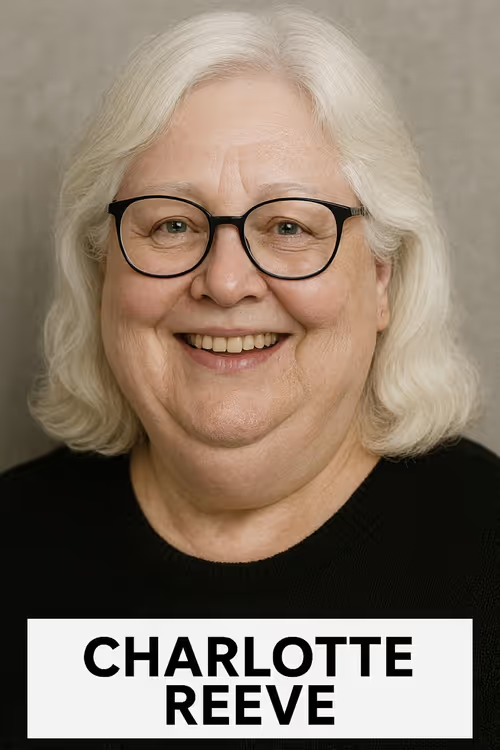
Written by
Charlotte Reeve
Senior correspondent · Capital Markets & Fintech
Charlotte cut her teeth on an equities desk before moving to the other side of the notebook. She covers capital markets, stock exchanges, and the fintech operators trying to disintermediate the banks that trained her. Sharpest on market microstructure and payments infrastructure; still reads a prospectus for fun. Based in Singapore. Reach out at charlotte.reeve@theplatinumcapital.com.