

Demographics and the Long-Term Growth Outlook
As global birth rates continue their structural decline and aging populations reshape consumption patterns across developed and emerging markets alike, investors who fail to account for demographic headwinds risk misallocating capital on a generational scale. Understanding the compounding interplay between workforce contraction, pension system strain, and shifting demand cycles is no longer an academic exercise — it is the defining lens through which long-term portfolio construction must now be viewed.…

For the world's most consequential investors, demographic data has always occupied an awkward middle ground — too slow-moving to generate quarterly alpha, yet too powerful to ignore when allocating across decades. That calculus is shifting. The World Bank projects GCC GDP growth accelerating to 4.5% in 2026, led by Saudi Arabia and the UAE, and the structural demographic forces underpinning that expansion demand serious attention from every family office, sovereign-aligned fund, and private capital allocator with emerging market exposure. Population dynamics are not merely a backdrop to growth — in the Gulf, Central Asia, and across Sub-Saharan Africa, they are increasingly its engine.
The Gulf's Demographic Dividend — and Its Deliberate Engineering
The GCC presents one of the most unusual demographic configurations in the world. In the UAE and Qatar, expatriates account for more than 85% of the total population, creating labour markets that are functionally imported and, by design, highly responsive to policy. Saudi Arabia is the outlier. With a citizen population of roughly 32 million and a median age under 30, it is a nation where a genuine youth bulge is being channelled — with considerable political intention — into economic participation. Vision 2030's female labour force participation targets have already moved from 17% in 2017 to above 33% in 2024. That is one of the most rapid demographic shifts recorded in any major economy in recent memory.
When the World Bank forecasts Saudi non-oil GDP rising at 3.6% annually through 2026–2027, it is pricing in precisely this kind of structural mobilisation. Not just investment flows. The productive activation of a population that was, until very recently, substantially sidelined.
The UAE is engineering its demographic advantage differently. Rather than relying on citizen population growth, Abu Dhabi and Dubai have introduced golden visas, freelance permits, and long-term residency pathways to attract and retain high-income human capital from across South Asia, the Arab world, and increasingly from Europe and North America. Dubai's economy grew 4.4% in H1 2025 alone, with non-oil sectors driving nearly all of that momentum. ICAEW and Oxford Economics now project UAE GDP reaching 5.6% in 2026 — a figure that would place it among the fastest-growing developed-infrastructure economies on the planet. That growth is demographically dependent. It requires continued net inward migration of skilled workers, entrepreneurs, and the kind of wealthy families who are increasingly choosing Dubai as a principal residence rather than a tax address.
Saudi Arabia's Real Estate Opening — A Demographic Signal to Capital
In January 2026, Saudi Arabia enacted legislation permitting non-Saudi nationals to own freehold real estate in designated zones across the Kingdom. A decade ago, that reform would have been unthinkable. The move functions simultaneously as a Vision 2030 diversification instrument and a demographic statement: Riyadh is signalling its intent to compete with Dubai not just on infrastructure, but on population attractiveness.
For private investors and family offices that have watched UAE residential values appreciate sharply since 2020, the Saudi opening represents a structurally earlier-stage opportunity — with all the risk and return asymmetry that implies. Projections from Century Financial and regional advisors suggest that Riyadh's Grade A residential market could absorb significant institutional and private capital from GCC nationals, diaspora investors, and international buyers over the next three to five years. That absorption accelerates as giga-projects — NEOM, Diriyah, the Red Sea Project — begin delivering leasable and saleable inventory at scale. The window before pricing discovers itself is narrower than most offshore allocators appreciate.
Central Asia and Africa — Where the Demographic Curve Is Steepest
Gulf-anchored investors frequently underestimate how closely their own region's growth story is mirrored — and in raw demographic terms, sometimes exceeded — by markets to the east and south. Few outside the region have noticed. They should.
Kazakhstan's population now exceeds 20 million, with a median age of just 31. Since 2022, the country has absorbed a significant wave of Russian and Ukrainian high-skilled migrants, while the government has made deliberate investments in financial infrastructure. The Astana International Financial Centre now hosts over 1,800 registered entities. Uzbekistan, with a population of 37 million growing at above 1.5% annually, is the most populous country in Central Asia and one of the most compelling long-duration consumer market stories in the entire region. The numbers tell a complicated story — one that most institutional capital has yet to fully read.
In Sub-Saharan Africa, the arithmetic is starker still. Nigeria alone will add more people to its workforce over the next twenty years than the entire current population of Germany. Kenya's fintech sector — anchored by M-Pesa's infrastructure and increasingly sophisticated capital markets — is drawing venture capital and private equity at scale, with Nairobi positioning itself as the continent's financial hub for East and Southern Africa. Egypt, with a population approaching 106 million and a government actively courting Gulf sovereign wealth investment into industrial zones and logistics corridors along the Suez, presents perhaps the most complex demographic-investment calculus in the region: extraordinary human capital potential, offset by fiscal pressures and currency management challenges that demand sophisticated structuring from institutional allocators. The upside is real. So is the complexity.
What Demography Means for Family Offices in 2026 and Beyond
For family offices managing between USD 50 million and USD 500 million in assets, the demographic argument translates into a specific set of allocation considerations. Consumer-facing businesses in high-growth population markets — retail banking, healthcare, education, and food processing across Southeast Asia, the Gulf, and Africa — offer revenue visibility that aging, slow-growth OECD economies structurally cannot match. Vietnam and Indonesia, both with favourable age structures and expanding middle classes, continue attracting manufacturing investment as supply chains diversify away from China. Family offices with patient capital horizons are finding compelling entry points in logistics, light industrial real estate, and digital financial services across both markets.
The Gulf's own demographic engineering — managed importation of human capital combined with citizen workforce activation — creates durable demand for residential real estate, healthcare infrastructure, and private education at a quality tier the public sector cannot fully satisfy. Saudi Arabia's non-oil private sector, projected to grow 4.1% across GCC non-energy sectors in 2026 according to ICAEW and Oxford Economics, is an increasingly credible destination for private capital that would previously have defaulted, almost reflexively, to London or New York. That default is being reconsidered in boardrooms and family councils across three continents.
The long-term growth outlook, read correctly, is not a macroeconomic abstraction. It is a map of where people are young, where they are being educated, and where policy is deliberately expanding their economic participation. For investors with the horizon and the regional relationships to act on that map, the demographic dividend across the Gulf, Central Asia, and Africa is not arriving. It is already compounding.
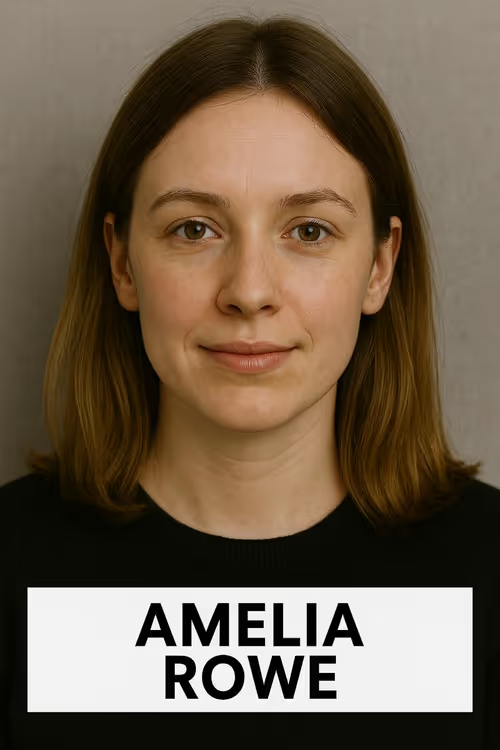
Written by
Amelia Rowe
Senior correspondent · Banking & Economy
Amelia spent eight years inside a sovereign wealth fund before deciding she'd rather write about institutional money than allocate it. She covers central banking, insurance, and the macro decisions that quietly choose which markets get the next decade. Sharp on monetary policy; impatient with anyone who confuses noise with signal. Based in London. Reach out at amelia.rowe@theplatinumcapital.com.