Gulf Capital in Africa: The New Investment Corridor
As sovereign wealth funds and ultra-high-net-worth dynasties from the Arabian Peninsula accelerate their reallocation of capital toward sub-Saharan and North African markets, a structural shift is quietly redrawing the architecture of global investment flows. The convergence of Gulf liquidity, Africa's demographic dividend, and a new generation of bilateral trade frameworks is creating one of the most consequential — and underreported — wealth corridors of the twenty-first century.…

Something significant is happening between the Gulf and Africa — and it is moving faster than most Western financial institutions have noticed. Sovereign wealth funds, private family offices, and state-backed conglomerates from the UAE, Saudi Arabia, and Qatar are deploying capital across the continent with a strategic coherence that goes well beyond opportunistic deal-making. This is not a new story. But it has entered a decisive new phase — one defined by infrastructure ownership, food security architecture, and financial market integration that is reshaping who controls the arteries of African commerce.
The Strategic Logic Behind the Surge
Gulf capital has always followed a dual mandate: yield and geopolitical positioning. Africa, with its 1.4 billion-person consumer base, accelerating urbanisation, and chronic infrastructure deficit, offers both. What has changed in 2025 and into 2026 is the velocity and sophistication of deployment. The UAE alone has signed bilateral investment framework agreements with more than a dozen African nations in the past eighteen months. Abu Dhabi's ADQ sovereign fund is anchoring deals in food logistics, port infrastructure, and clean energy across Egypt, Kenya, and Ethiopia. Saudi Arabia's Public Investment Fund has moved similarly — its agricultural supply chain investments reflect Riyadh's acute awareness that food import dependency is a strategic vulnerability, and that African farmland and logistics networks can partially address it.
The broader Gulf diversification agenda is pulling capital in the same direction. As Hamza Dweik, head of trading for MENA at Saxo Bank, observed in the context of the landmark GCC–UK Free Trade Agreement finalised in May 2026 — the first such deal between the Gulf bloc and a G7 partner — the agreement "supports the broader diversification agenda" of Gulf economies. That logic applies with equal force to Gulf capital flows into Africa. Dependence on a single commodity cycle is existential risk. Africa is a multi-decade hedge against exactly that.
Ports, Logistics, and the Infrastructure Play
The most consequential Gulf investments in Africa are not in mining or real estate. They are in logistics and port infrastructure — the chokepoints through which trade volume converts into economic power. DP World, the Dubai-based ports operator, now manages or holds concessions across terminals in Berbera, Dakar, Luanda, Lagos, and Maputo, among others. Each position is not merely commercial. It is a node in an emerging Gulf-anchored trade corridor connecting East Africa to the Arabian Peninsula and, increasingly, to South and Southeast Asia.
Abu Dhabi Ports Group has been equally aggressive. Its Khalifa Port expansion is designed in part to serve as a transshipment hub for African cargo moving toward Asian markets. These are thirty-year asset plays — not quarterly return calculations. They reflect the patient capital mentality of sovereign and family-office wealth at its most sophisticated.
For private investors and family offices watching these moves, the implication is direct: logistics and cold-chain infrastructure gaps across sub-Saharan Africa represent a generational opportunity that state actors are currently pricing but not monopolising. Nigeria's port inefficiencies alone cost the economy an estimated $2 billion annually in dwell time and cargo losses. That is both a structural problem and an investable thesis for private capital with longer time horizons.
Financial Market Integration and the Currency Question
Perhaps the least-discussed but most structurally important development in the Gulf–Africa corridor is the quiet work being done on financial market connectivity. The UAE dirham's de facto role as a settlement currency for informal trade across East and West Africa has been documented for years. What is new is the formalisation of that role — through bilateral currency frameworks, digital payment rails, and UAE-based family offices establishing African subsidiaries that run local-currency treasury operations.
Dubai's position as the financial hub of choice for African high-net-worth individuals and family offices has solidified further. DIFC-registered entities are increasingly used as holding structures for pan-African assets. Mauritius remains relevant for certain tax treaty structures, but Dubai offers something Mauritius cannot: proximity to Gulf LP capital, access to Islamic finance instruments, and a regulatory environment that understands the discretion requirements of African family wealth. That combination is difficult to replicate.
Egypt sits at the intersection of these dynamics in a particularly telling way. Cairo's relationship with Gulf capital — most visibly through the $35 billion Ras El-Hekma development deal anchored by ADQ — has demonstrated that the Gulf will commit transformational sums to African markets when the sovereign risk framework is acceptable and the strategic logic holds. That deal, announced in early 2024 and now in active development phases through 2026, has recalibrated how other African governments think about what Gulf capital can actually deliver. The numbers tell a complicated story, but the signal is unmistakable.
Agriculture, Food Security, and the Quiet Land Equation
Food security is the thread connecting Gulf sovereign strategy to African agricultural investment more explicitly than any other sector. Saudi Arabia's SALIC — the Saudi Agricultural and Livestock Investment Company — has expanded its African portfolio significantly, with operations and offtake agreements spanning Sudan, Uganda, and South Africa. The UAE's Al Dahra Agriculture has similarly deepened its African footprint, with Egyptian and Moroccan operations forming the backbone of a supply chain feeding Gulf markets with grain, vegetables, and animal feed.
Morocco deserves particular attention. Its phosphate reserves, controlled through OCP Group, make it the single most important player in global fertiliser supply outside of Russia. Gulf sovereign funds have been careful to build relationships with Rabat accordingly. OCP's ongoing expansion of fertiliser blending operations across sub-Saharan Africa — from Nigeria to Ethiopia — is partly financed through Gulf-linked capital structures. That cements Morocco's role as the agricultural gateway between Gulf capital and African farmland economics. Few outside the region have registered the full significance of that positioning. They should.
What This Means for Private Capital and Family Offices
For family offices and private investors with meaningful capital — particularly those based in the Gulf, Central Asia, or Southeast Asia — the Gulf–Africa corridor presents a specific set of opportunities that are not yet efficiently priced. Agricultural logistics, cold-chain infrastructure, trade finance for intra-African commerce, and financial services platforms targeting Africa's emerging middle class are all sectors where Gulf-anchored private capital can move alongside sovereign actors without competing directly against them. That window does not stay open indefinitely.
The families and offices best positioned here are those already operating in multi-jurisdictional structures, comfortable with fifteen-year return profiles, and able to leverage relationships across both Gulf regulatory environments and African government networks simultaneously. The sovereign funds have already moved with conviction. The question now is which private actors will follow — before differentiated access starts to price itself out of reach.
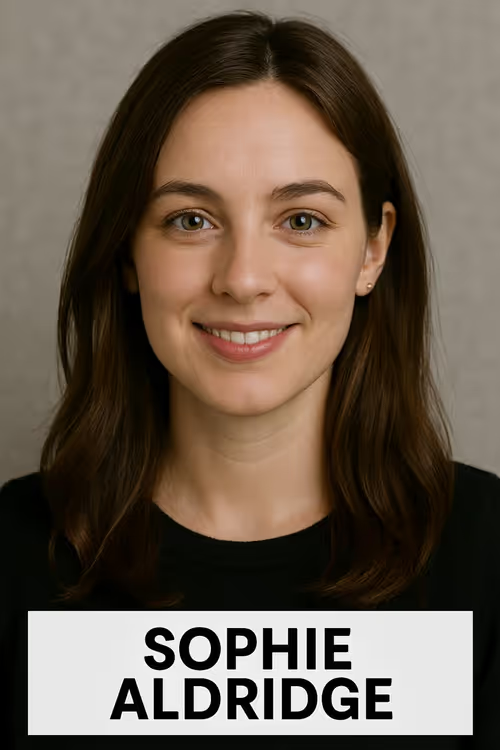
Written by
Sophie Aldridge
Global Economics Editor · Geopolitics
Sophie spent a decade advising governments on trade policy before deciding the story was more interesting than the memo. She covers global economics, geopolitics, and the power transitions reshaping emerging markets. Sharpest on sanctions, supply chains, and the politics behind the price of everything. Based in Washington, D.C. Reach out at sophie.aldridge@theplatinumcapital.com.


