

Open Finance vs Open Banking: What Comes Next
As open banking matures from a regulatory mandate into a competitive battleground, the far more consequential shift toward open finance threatens to redraw the boundaries of wealth management, insurance, and capital markets in ways that most institutional players are only beginning to comprehend. For family offices, sovereign wealth funds, and policymakers navigating this transition, understanding the structural distinction between the two frameworks is no longer optional — it is the difference between capturing generational opportunity and being rendered obsolete by those who did.…

For years, open banking was described as the future of finance. In 2026, that future has arrived — and it has already been overtaken by something larger. Open finance, the broader and more ambitious successor, threatens to reshape not just how consumers access bank accounts but how wealth itself is structured, moved, and understood. The Gulf is not a bystander in this shift. It is the region where the most consequential experiments are taking place — and where the stakes, for families, institutions, and sovereign investors alike, are highest.
The Distinction That Actually Matters
Open banking was narrow by design. It enabled licensed third parties to access a customer's bank account data — with consent — to deliver better lending decisions, faster payments, or smarter budgeting tools. Regulators in the UK and EU pioneered the framework. The Gulf followed, cautiously at first, then with notable acceleration.
Open finance extends that logic across the entire financial life of an individual or institution. Investment portfolios. Insurance policies. Pension accounts. Trade finance instruments. Real estate holdings. Tokenised assets. Where open banking offered a window into a current account, open finance offers a view of the whole balance sheet. For a family office principal managing assets across three jurisdictions, or a private investor holding positions in both listed equities and illiquid alternatives, that distinction is not semantic — it is structural.
The critical enabler is the API: the technical bridge that allows systems to share data securely and in real time. What has changed in 2026 is that regulators across the Gulf are no longer treating APIs as an experiment. They are treating them as infrastructure. That is a significant shift.
Saudi Arabia Moves From Sandbox to System
The most significant regulatory milestone of the quarter arrived in March 2026, when SAMA — Saudi Arabia's central bank — granted its first live open banking licences. The sandbox-only era is over. For the first time, APIs are enabling real data-sharing between established Saudi banks and licensed fintech providers at scale, unlocking faster credit decisions, more granular customer profiling, and the kind of personalised financial services previously available only to clients of global private banks.
The implications for wealth management in the Kingdom are considerable. Saudi family offices, many of which have historically relied on relationship-driven, opaque processes to consolidate financial information, now face a moment of genuine disruption — and genuine opportunity. Aggregating data across multiple Saudi banks through a single compliant interface changes how advisers build portfolios, how credit is extended against illiquid assets, and how next-generation family members engage with inherited wealth structures. Processes that once took weeks now take hours. That compression matters.
Simultaneously, Riyad Bank's digital arm Jeel has partnered with Ripple to pilot blockchain-based cross-border transfers and tokenisation within the regulatory framework — a move that signals the Kingdom's intention to integrate open finance rails with programmable money. This is not a proof of concept. It is a live test with real capital behind it.
The New Entrants Rewriting the Rules
The licensing environment is attracting a calibre of capital and talent that would have been unimaginable in Gulf fintech five years ago. Few outside the region have noticed. They should.
In Q1 2026, Mal — an AI-native Islamic digital financial platform — raised $230 million in seed funding, one of the largest fintech seed rounds globally by any measure. The round was led by Abu Dhabi-based BlueFive Capital, and the leadership team includes senior executives drawn from Revolut and Nubank, two of the institutions that defined the first wave of digital banking in Europe and Latin America.
Mal's CEO Abdallah Abu-Sheikh has been explicit about the company's ambitions: AI-driven, mobile-first financial products designed for Muslim-majority markets, with active regulatory conversations already underway in the UAE, Bangladesh, Indonesia, and Pakistan. That geographic spread is telling. It maps almost precisely onto the corridors where open finance infrastructure is being built from the ground up — unencumbered by the legacy core banking systems that continue to slow adoption in Western markets. The West spent decades building infrastructure it must now dismantle. These markets are building clean.
Tabby's trajectory tells a parallel story. Having reached a $4.5 billion valuation following a secondary share sale in October 2025, the MENA region's most valuable fintech startup subsequently secured a Stored Value Facilities licence from the UAE Central Bank — granting it the right to hold customer funds, issue payment cards, and build money management tools. CEO Hosam Arab has been consistent in his message: Tabby is not building a BNPL app. It is building a financial platform. The distinction matters because it signals the direction of travel across the entire sector — from single-product fintechs to full financial aggregators, the model that open finance is specifically designed to enable.
Beyond Payments: The Tokenisation Layer
Open finance becomes genuinely transformative when it connects to asset tokenisation. The numbers tell a complicated story, and the Gulf Energy Exchange's announcement of OIL1 — the world's first oil-backed stablecoin, developed by a Bahrain and UAE-based consortium — is a useful place to read it. OIL1 points toward a future where real-world assets are not just referenced digitally but made liquid, transferable, and programmable. When open finance APIs can read and interact with tokenised asset positions alongside conventional bank balances, the concept of a consolidated financial view acquires real meaning for investors holding physical commodities, real estate, or private equity alongside traditional accounts.
For family offices in Kazakhstan, Nigeria, or Indonesia — markets where wealth is frequently concentrated in hard assets rather than financial instruments — this convergence represents a genuine re-architecting of how portfolios are managed, reported, and eventually transferred across generations. The technical foundation is being laid now. The institutions that grasp this early will define the advisory relationships of the next decade. Those that wait will inherit someone else's terms.
What Sophisticated Investors Should Be Watching
The transition from open banking to open finance is not primarily a technology story. It is a governance story. The families, institutions, and investors who will benefit most are those who engage early with the consent frameworks, data standards, and liability structures that regulators are currently designing — because those frameworks will determine what can be shared, with whom, and on what terms. Get that wrong and the efficiencies of open finance become someone else's leverage over your data.
In practical terms, family offices operating across the Gulf, Central Asia, and Southeast Asia should be reviewing their data architectures with the same rigour they apply to investment selection. Which fintech relationships create genuine data portability? Which ones quietly create new forms of dependency? These are not abstract questions. They have direct consequences for how consolidated reporting works, how credit is structured, and how asset transfer functions at the point of succession.
The platforms being built today — by Mal, by Tabby, by Jeel in partnership with Ripple — are not targeting the mass market alone. They are building infrastructure that will eventually serve the full spectrum of wealth, from the emerging affluent to the ultra-high-net-worth. The window for early influence over how that infrastructure is shaped is narrowing. It belongs, right now, to those paying close attention.
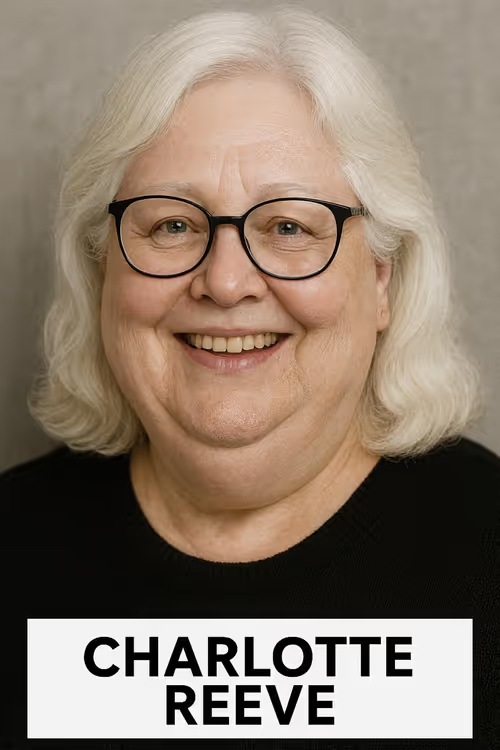
Written by
Charlotte Reeve
Senior correspondent · Capital Markets & Fintech
Charlotte cut her teeth on an equities desk before moving to the other side of the notebook. She covers capital markets, stock exchanges, and the fintech operators trying to disintermediate the banks that trained her. Sharpest on market microstructure and payments infrastructure; still reads a prospectus for fun. Based in Singapore. Reach out at charlotte.reeve@theplatinumcapital.com.