

Saudi Fintech Licences: The Startups Winning Central Bank Approval
Saudi Arabia's fintech sector is entering a decisive phase of maturation, as the Saudi Central Bank accelerates its licensing pipeline to position the Kingdom as the region's dominant hub for financial innovation ahead of Vision 2030 milestones. A select cohort of startups has successfully navigated SAMA's rigorous regulatory framework, securing approvals that signal not only institutional credibility but compelling opportunities for sophisticated capital seeking exposure to one of the world's most rapidly digitising consumer financial markets.…

Saudi Arabia's fintech sector has grown up. The kingdom is no longer simply encouraging innovation — it is licensing it, regulating it, and weaving it into the architecture of the national economy. With SAMA's issuance of its first live open banking licences in March 2026, the Saudi Central Bank sent an unambiguous message to founders, investors, and family offices across the region: the pilot programme era is finished. The era of commercial fintech infrastructure has begun.
SAMA's Open Banking Milestone Changes the Rules of Engagement
The March 2026 open banking licences represent arguably the most significant structural shift in Saudi financial services since the launch of mada, the kingdom's domestic payments network. For the first time, licensed fintechs can access real-time customer banking data — with consent — through standardised APIs, enabling a generation of credit, wealth, and payment products that were previously impossible to build at scale. The implications stretch well beyond consumer convenience. For high-net-worth families managing liquidity across multiple Saudi banks, open banking creates the technical foundation for consolidated treasury views, automated cash sweeping, and credit products calibrated to actual transaction behaviour rather than paperwork.
The timing is deliberate. SAMA's own data shows that electronic payments accounted for 85% of total retail payments in Saudi Arabia in 2025, up from 79% the year before. Six percentage points of modal shift in a single year. That is a significant move — and it tells you the kingdom's payment infrastructure has reached a tipping point where regulatory architecture must chase consumer behaviour rather than lead it. The live open banking licences are SAMA's mechanism for ensuring the fintechs riding this wave are operating inside a supervised, accountable framework. Not just benefiting from it.
The Startups Earning Central Bank Trust
Receiving a SAMA licence is not a formality. The central bank's fintech regulatory sandbox — launched in 2018 — has tested dozens of companies. Only a select cohort has progressed from experimental approval to live commercial licensing. The companies earning that distinction share a common profile: strong governance structures, demonstrable compliance capacity, and business models that complement rather than threaten established banking relationships. That last point matters particularly in Saudi Arabia, where the major retail banks retain significant political and commercial weight.
Among the most closely watched in the current cohort are embedded lending platforms, payroll-linked financial services providers targeting the kingdom's substantial migrant workforce, and B2B payment infrastructure companies serving the SME sector — a segment that Vision 2030 has explicitly identified as a growth engine. SAMA has also shown consistent appetite for Shariah-compliant fintech models, reflecting both domestic demand realities and Riyadh's ambitions as a global Islamic finance hub. Founders who built a clear Shariah compliance framework from day one have consistently fared better in the approval process than those who treated it as an afterthought. The central bank noticed. It always does.
The Regional Capital Flowing Into Saudi Fintech
The investment context surrounding Saudi fintech licences cannot be separated from the broader regional funding environment of 2025 and 2026. The $230 million seed round raised by Mal — an AI-native Islamic digital financial platform backed by Abu Dhabi's BlueFive Capital — has recalibrated what Gulf fintech investors consider a credible early-stage commitment. That number would have seemed implausible for a seed round three years ago. It no longer does. Mal's leadership team draws senior executives from Revolut and Nubank and is currently in active regulatory discussions across the UAE, Bangladesh, Indonesia, and Pakistan. Saudi Arabia has not been publicly confirmed as a priority market. It is the obvious next one.
Tabby's trajectory offers a parallel lesson in what structured regulatory engagement can produce. The company reached a $4.5 billion valuation through a secondary share sale in October 2025 — making it the most valuable fintech startup in the region — then secured a Stored Value Facilities licence from the Central Bank of the UAE in 2026. CEO Hosam Arab has been unambiguous that Tabby's ambitions extend well beyond buy-now-pay-later. Stored value licensing lets Tabby hold customer funds, issue payment cards, and build money management infrastructure from the ground up. The Saudi market, where Tabby already has substantial user penetration, is the natural theatre for the next chapter. A SAMA licence would transform Tabby from a Saudi-market operator into a Saudi-market institution. There is a meaningful difference between those two things.
Blockchain Infrastructure Enters the Mainstream
Running parallel to the open banking rollout is a development that deserves more attention than it has received. Riyad Bank's digital arm, Jeel, is piloting blockchain-enabled cross-border transfers and tokenisation in partnership with Ripple — described explicitly not as a proof of concept, but as a live test within a regulatory framework. Few outside the Gulf banking community have paid close attention. They should. For family offices and private investors with treasury operations spanning the GCC, South Asia, or East Africa, this matters directly. Cross-border remittance costs within Gulf corridors have long been a structural inefficiency. Blockchain settlement infrastructure operating inside a regulated Saudi banking entity changes that calculus.
The Ripple partnership also signals that SAMA is prepared to accommodate distributed ledger technology within its supervised framework — provided the institutional counterparty meets its governance standards. That distinction between licensed blockchain infrastructure and unregulated crypto activity is one that sophisticated investors in the kingdom have been waiting for. Jeel's live pilot suggests the clarity they were looking for is arriving through practice rather than policy announcement. That is, frankly, a more durable kind of clarity.
What This Means for Investors and Family Offices
For family offices and private capital allocators watching Saudi Arabia, the licence cohort emerging in 2026 represents a pre-institutional investment window that will not stay open long. The companies receiving SAMA approval now are, by definition, the most regulation-ready fintechs in the market. In the Gulf context, that translates directly into reduced execution risk and faster paths to institutional partnerships, government procurement, and acquisition interest from the major banks. The window between regulatory approval and institutional absorption has historically been short. It will be here too.
The broader signal from Riyadh is one of deliberate, sequenced opening. SAMA is not deregulating fintech. It is licensing it selectively and building a supervised ecosystem capable of absorbing private capital at scale. For investors accustomed to the opacity of early-stage emerging market fintech, Saudi Arabia's framework-first approach offers something genuinely rare: downside protection built into the regulatory architecture itself. The startups winning central bank approval today are not simply building products. They are building durable positions inside one of the most consequential financial systems in the developing world — and doing it with the regulator's explicit blessing.
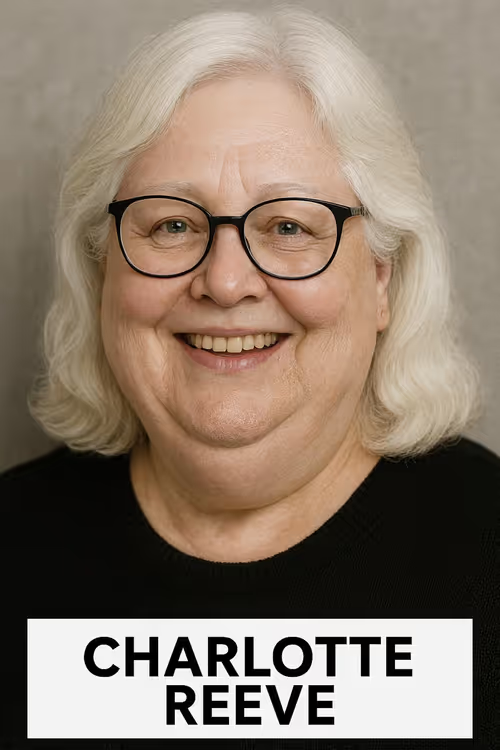
Written by
Charlotte Reeve
Senior correspondent · Capital Markets & Fintech
Charlotte cut her teeth on an equities desk before moving to the other side of the notebook. She covers capital markets, stock exchanges, and the fintech operators trying to disintermediate the banks that trained her. Sharpest on market microstructure and payments infrastructure; still reads a prospectus for fun. Based in Singapore. Reach out at charlotte.reeve@theplatinumcapital.com.